 Skip to content
Key Takeaways
- Telemedicine app development is helping healthcare providers deliver secure, convenient, and accessible care beyond traditional clinic visits.
- Modern telemedicine platforms improve patient engagement, reduce operational costs, and create new revenue opportunities for healthcare businesses.
- AI-powered features such as smart appointment scheduling, virtual assistants, and clinical documentation are transforming digital healthcare.
- Building a successful telemedicine app requires the right features, a secure technology stack, and a healthcare-focused development partner.
- Businesses investing in telemedicine today are positioning themselves for long-term growth in an increasingly digital healthcare industry.
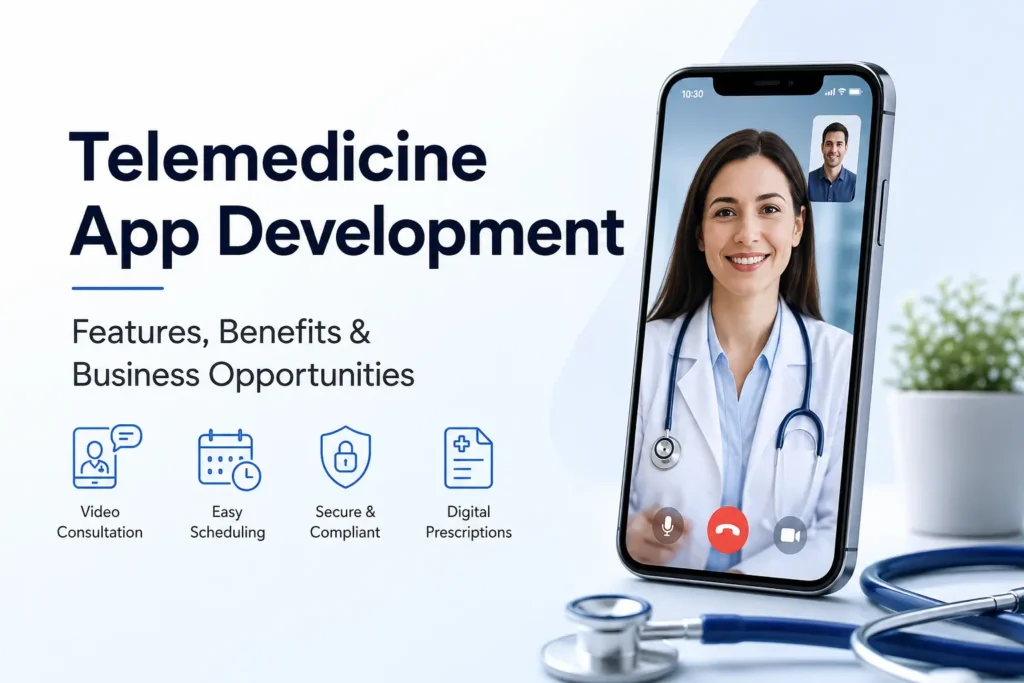
Telemedicine App Development: Features, Benefits & Business Opportunities
Healthcare has evolved significantly over the last decade, and one of the biggest drivers of that transformation is telemedicine app development.
Patients no longer expect healthcare to be limited to physical clinic visits. Today, they want the flexibility to consult doctors from home, schedule appointments online, access prescriptions digitally, and communicate securely through mobile devices.
For healthcare providers, this shift is creating new opportunities to improve patient care while operating more efficiently.
From private clinics and hospitals to mental health professionals, physiotherapy centers, and healthcare startups, organizations are investing in telemedicine applications to deliver faster, smarter, and more accessible healthcare services.
This isn’t just a temporary trend.
Telemedicine has become a long-term business strategy that allows healthcare organizations to expand their reach, improve patient satisfaction, and remain competitive in a rapidly changing healthcare landscape.
Whether you’re planning your first healthcare application or expanding an existing digital platform, understanding the telemedicine app development process is the first step toward building a solution that delivers real business value.
In this guide, you’ll learn:
- What telemedicine app development is
- Why telemedicine continues to grow in 2026
- The different types of telemedicine applications
- Essential features every successful telemedicine app should include
- Business benefits for healthcare providers
- How AI is transforming virtual healthcare
- What to consider before starting your project
If your healthcare business is exploring digital transformation, this guide will help you understand why telemedicine is becoming one of the most valuable investments in modern healthcare.
What Is Telemedicine App Development?
Telemedicine app development is the process of designing and building digital applications that allow healthcare providers and patients to communicate remotely using smartphones, tablets, or web platforms.
Instead of requiring every consultation to happen inside a clinic or hospital, telemedicine applications enable patients to receive medical advice, follow-up care, and healthcare services from virtually anywhere.
Depending on the business model, a telemedicine platform may include:
- Video consultations
- Voice consultations
- Secure messaging
- Online appointment booking
- Digital prescriptions
- Electronic medical records
- Patient portals
- Payment processing
- Health monitoring
- AI-powered healthcare assistance
These applications create a seamless experience for both patients and healthcare professionals while reducing unnecessary travel, administrative work, and waiting times.
For healthcare businesses, telemedicine isn’t replacing traditional healthcare, it extends healthcare services beyond physical locations and improves accessibility for patients.
Why Telemedicine Is Growing Faster Than Ever
Healthcare organizations are investing heavily in digital solutions because patient expectations have changed.
Today’s patients value convenience just as much as quality healthcare.
They expect to:
- Book appointments online
- Consult doctors remotely
- Receive digital prescriptions
- Access medical records securely
- Communicate without repeated phone calls
- Receive follow-up care from home
Healthcare providers that fail to offer these conveniences risk losing patients to competitors with better digital experiences.
At the same time, telemedicine helps healthcare businesses solve many operational challenges.
Instead of overcrowded waiting rooms and limited appointment availability, providers can offer flexible consultation options while improving overall efficiency.
Several factors are driving telemedicine growth in 2026:
Increasing Demand for Remote Healthcare
Many patients now prefer virtual consultations for routine healthcare needs.
Follow-up visits, prescription renewals, mental health consultations, nutrition counseling, and chronic disease management can often be handled effectively through telemedicine.
This improves convenience while saving time for both patients and healthcare professionals.
Better Internet and Mobile Technology
High-speed internet and widespread smartphone adoption have made virtual healthcare more accessible than ever before.
Patients no longer need specialized equipment.
Most telemedicine consultations can be completed using devices they already own.
Growing Healthcare Costs
Healthcare providers are continuously looking for ways to improve operational efficiency.
Telemedicine helps reduce administrative overhead while allowing providers to serve more patients without significantly increasing physical infrastructure.
AI Is Accelerating Digital Healthcare
Artificial Intelligence is making telemedicine applications smarter.
Modern platforms now include features such as:
- Intelligent appointment scheduling
- AI chat assistants
- Automated patient triage
- Voice-to-text clinical documentation
- Predictive analytics
- Personalized healthcare recommendations
These technologies improve both patient experiences and staff productivity.
As AI continues to evolve, telemedicine applications are becoming more intelligent, efficient, and valuable for healthcare organizations.
Types of Telemedicine Applications
Not every telemedicine platform serves the same purpose.
The right solution depends on the healthcare business, its patients, and the services it provides.
Some of the most common types include:
Video Consultation Apps
These applications allow doctors and patients to communicate through secure video calls.
They’re commonly used by:
- General practitioners
- Specialists
- Mental health professionals
- Nutritionists
- Physiotherapists
Video consultations help reduce travel while providing a more personal experience than phone calls alone.
Remote Patient Monitoring Apps
These platforms allow healthcare providers to monitor patients remotely using connected medical devices.
Examples include tracking:
- Blood pressure
- Blood glucose
- Heart rate
- Oxygen levels
- Weight
- Chronic disease indicators
This type of telemedicine is especially valuable for long-term patient care.
Mental Health Telemedicine Apps
Mental healthcare has experienced significant growth in digital services.
Secure telemedicine platforms allow therapists, psychologists, and counselors to conduct confidential virtual sessions while improving accessibility for patients who may not be able to visit a clinic.
Specialist Consultation Platforms
Hospitals and healthcare networks often use telemedicine to connect patients with specialists located in different cities—or even different countries.
This expands access to expert medical advice without requiring extensive travel.
Integrated Healthcare Platforms
Many healthcare organizations now combine telemedicine with:
- Patient management
- Appointment scheduling
- Billing
- Electronic health records
- Mobile applications
- AI-powered automation
These all-in-one healthcare platforms provide a seamless experience while simplifying business operations.
Why Healthcare Businesses Are Investing Now
Telemedicine is no longer viewed as an optional digital feature.
It has become a competitive advantage.
Organizations investing in telemedicine app development today are improving patient experiences, increasing operational efficiency, and creating new opportunities for business growth.
However, building a successful telemedicine application requires much more than adding video calls.
The most successful platforms focus on user experience, security, scalability, and features that solve real healthcare challenges.
Essential Features Every Successful Telemedicine App Should Have
The success of a telemedicine platform depends on more than attractive design.
Healthcare providers need software that is secure, reliable, and simple to use for both patients and medical professionals.
When planning telemedicine app development, focus on features that improve patient care while simplifying day-to-day operations.
Here are the most important features every modern telemedicine application should include.
1. Secure User Registration and Login
Every healthcare platform should begin with a secure authentication system.
Different users require different access levels, including:
- Patients
- Doctors
- Receptionists
- Administrators
- Healthcare managers
Role-based access ensures users only see the information relevant to their responsibilities while protecting sensitive patient data.
2. Online Appointment Scheduling
Appointment booking is one of the most valuable features of any telemedicine platform.
Patients should be able to:
- View available time slots
- Choose their preferred doctor
- Schedule appointments online
- Receive confirmation instantly
- Reschedule or cancel appointments easily
For healthcare providers, automated scheduling reduces manual work while minimizing booking errors.
3. HD Video and Voice Consultations
Video consultation is the core feature of most telemedicine applications.
The platform should support:
- High-quality video
- Stable audio
- Screen sharing when needed
- Secure communication
- Low-latency connections
Reliable virtual consultations improve patient confidence while creating a better healthcare experience.
4. Secure Messaging
Not every healthcare interaction requires a video appointment.
Secure messaging allows doctors and patients to communicate through encrypted conversations for:
- Follow-up questions
- Medication guidance
- Prescription updates
- Treatment instructions
- Appointment reminders
This improves communication while reducing unnecessary clinic visits.
5. Electronic Health Records (EHR)
Doctors should have quick access to patient information during consultations.
An integrated Electronic Health Record system helps manage:
- Medical history
- Previous consultations
- Prescriptions
- Laboratory reports
- Allergies
- Treatment plans
Having all patient information in one place improves clinical decision-making and saves valuable time.
6. Digital Prescriptions
After virtual consultations, doctors should be able to generate prescriptions digitally.
Patients can receive prescriptions instantly without returning to the clinic.
Digital prescriptions improve convenience while reducing paperwork.
7. Secure Payment Integration
Modern telemedicine applications often include built-in payment processing.
Patients should be able to:
- Pay consultation fees online
- Receive invoices
- View payment history
- Use secure payment gateways
Integrated payments simplify financial management for healthcare businesses.
8. Notifications and Appointment Reminders
Missed appointments cost healthcare providers both time and revenue.
Automated reminders sent through:
- SMS
- Push notifications
help reduce no-shows while keeping patients informed.
9. Doctor Dashboard
Healthcare professionals need a centralized dashboard to manage daily activities.
A typical dashboard includes:
- Appointment calendar
- Patient records
- Consultation history
- Prescriptions
- Earnings overview
- Notifications
An organized dashboard improves productivity and simplifies daily workflows.
10. Patient Dashboard
Patients should also have access to their own personalized portal.
This allows them to:
- Book appointments
- Join video consultations
- Access prescriptions
- Review medical history
- Download reports
- Update personal information
Giving patients more control improves engagement and satisfaction.
Business Benefits of Telemedicine App Development
Telemedicine is not just beneficial for patients—it also creates measurable business value for healthcare organizations.
Here are the biggest advantages.
Increased Patient Reach
Traditional healthcare is limited by geography.
Telemedicine allows healthcare providers to consult patients located in different cities or even different countries.
This creates new opportunities for business growth without opening additional physical locations.
Improved Patient Satisfaction
Convenience plays a major role in patient experience.
Virtual healthcare allows patients to:
- Save travel time
- Reduce waiting periods
- Access care faster
- Receive follow-up support easily
Happy patients are more likely to return and recommend your services.
Higher Operational Efficiency
Automating scheduling, communication, documentation, and reminders allows healthcare staff to spend more time delivering care instead of handling administrative work.
This improves productivity across the organization.
Better Resource Management
Telemedicine helps healthcare providers optimize:
- Doctor availability
- Consultation schedules
- Administrative workload
- Patient flow
As a result, businesses can serve more patients without significantly increasing operational costs.
New Revenue Opportunities
Telemedicine creates additional income streams through:
- Virtual consultations
- Subscription-based healthcare services
- Remote follow-up care
- Digital wellness programs
- Specialist consultations
Healthcare providers can expand their services without being limited by physical infrastructure.
Stronger Competitive Advantage
Patients increasingly choose providers offering digital convenience.
Healthcare businesses investing in telemedicine demonstrate innovation while building stronger relationships with modern patients.
How AI Is Transforming Telemedicine
Artificial Intelligence is making telemedicine platforms significantly more intelligent.
Instead of replacing healthcare professionals, AI supports them by automating repetitive tasks and improving decision-making.
Some of the most valuable AI-powered features include:
AI Appointment Scheduling
AI automatically recommends available appointment times based on doctor availability and patient preferences.
Virtual Health Assistants
AI chatbots answer common patient questions, collect basic information, and guide users before consultations.
This reduces administrative workload while improving response times.
Automated Clinical Documentation
Speech-to-text technology converts doctor conversations into structured clinical notes, saving valuable documentation time.
Smart Patient Triage
AI helps prioritize patients based on symptoms and urgency, allowing healthcare teams to manage resources more effectively.
Predictive Analytics
Healthcare organizations use AI to analyze patient data and identify trends that support preventive care and better business decisions.
Telemedicine Is Becoming Smarter Every Year
Modern telemedicine applications are no longer limited to video calls.
Today’s platforms combine:
- Cloud technology
- Artificial Intelligence
- Mobile applications
- Secure healthcare infrastructure
- Business intelligence
to create connected healthcare ecosystems that improve experiences for both patients and providers.
Organizations investing in telemedicine app development today are building solutions that will remain valuable for years to come.
Telemedicine App Development Process
Building a successful telemedicine platform requires much more than writing code.
Every stage of development should focus on delivering a secure, user-friendly, and scalable healthcare solution that supports both patients and healthcare professionals.
Below is the typical telemedicine app development process followed by successful healthcare software projects.
Step 1: Discovery and Business Analysis
Every successful project starts with understanding the business.
During this phase, your development team identifies:
- Business goals
- Target audience
- User roles
- Core features
- Compliance requirements
- Project roadmap
Clear planning helps reduce development risks while keeping the project aligned with business objectives.
Step 2: UI/UX Design
Healthcare applications should be simple enough for everyone to use.
A well-designed interface helps patients:
- Book appointments quickly
- Join consultations easily
- Find medical information faster
Doctors and administrators also benefit from dashboards that simplify their daily workflows.
A clean user experience increases adoption while reducing training time.
Step 3: Application Development
Once the design is approved, developers begin building the platform.
Typical modules include:
- Patient Portal
- Doctor Dashboard
- Appointment Management
- Video Consultation System
- Secure Messaging
- Electronic Health Records
- Payment Integration
- Notification System
- Admin Panel
Each module is developed and tested throughout the project.
Step 4: Testing and Quality Assurance
Healthcare software must perform reliably.
Testing includes:
- Functional testing
- Performance testing
- Security testing
- Cross-device compatibility
- User acceptance testing
The goal is to ensure patients and healthcare professionals enjoy a seamless experience.
Step 5: Deployment
After successful testing, the application is deployed.
This may include:
- Web application launch
- Android application release
- iOS application release
- Cloud infrastructure setup
- Database configuration
- Security monitoring
A structured deployment process minimizes downtime and ensures a smooth launch.
Step 6: Continuous Improvement
Launching your application is only the beginning.
Successful healthcare platforms continue evolving through:
- Feature updates
- Performance improvements
- AI enhancements
- Security updates
- User feedback
Continuous improvement helps healthcare businesses remain competitive while meeting changing patient expectations.
Common Mistakes to Avoid
Many healthcare organizations rush into software development without proper planning.
Avoid these common mistakes:
Trying to Build Everything at Once
Start with an MVP (Minimum Viable Product).
Launch essential features first, gather user feedback, then expand over time.
Ignoring User Experience
Even the most powerful application will fail if users struggle to navigate it.
Patients and healthcare professionals should find the platform intuitive from day one.
Choosing Price Over Quality
Selecting the cheapest development option often leads to poor performance, security issues, and expensive redevelopment later.
Instead, choose a partner with healthcare software experience.
Forgetting About Scalability
Your software should support future growth.
As your organization expands, the platform should easily accommodate:
- More users
- Additional locations
- New healthcare services
- AI-powered capabilities
- Third-party integrations
Why Choose PWH Services for Telemedicine App Development?
At PWH Services, we help healthcare businesses transform ideas into secure, scalable digital healthcare solutions.
Our team specializes in building healthcare platforms that improve patient experiences while supporting long-term business growth.
Our expertise includes:
- Telemedicine Applications
- Healthcare Mobile Apps
- Clinic Management Systems
- Hospital Management Platforms
- Patient Portals
- AI Integration & Automation
- Healthcare Web Applications
- Custom Healthcare Software Solutions
Every project is designed around your unique business requirements—not a one-size-fits-all template.
Whether you’re building a new telemedicine platform or modernizing an existing healthcare system, we work closely with your team to deliver technology that creates real business value.
You can explore our Portfolio to see recent projects, learn more about our healthcare and software development services on the PWH Services website, or connect with us through our Contact Us page.
If you’re ready to discuss your project, you can also Book a Free 30-Minute Consultation with our experts. We’ll help you define the right strategy, identify the essential features, and recommend the most effective development approach for your healthcare business.
Looking to Build a Telemedicine App?

The future of healthcare is digital—and businesses investing today are creating better experiences for patients while preparing for long-term growth.
Whether you’re planning:
- A telemedicine platform
- A healthcare mobile app
- A patient portal
- A clinic management system
- An AI-powered healthcare solution
having the right technology partner makes all the difference.
PWH Services develops secure, scalable, and user-focused healthcare software tailored to your business goals.
Frequently Asked Questions
What is telemedicine app development?
Telemedicine app development is the process of creating secure web and mobile applications that enable remote healthcare services such as video consultations, appointment scheduling, patient communication, and digital prescriptions.
What features should a telemedicine app include?
A modern telemedicine application should include secure login, appointment scheduling, video consultations, patient records, secure messaging, digital prescriptions, payment integration, notifications, and an admin dashboard.
How long does it take to develop a telemedicine app?
Development timelines vary based on project scope. A basic MVP typically takes 3–4 months, while a feature-rich telemedicine platform may require 5–8 months or more.
Can AI improve telemedicine applications?
Yes. AI can automate appointment scheduling, support virtual assistants, generate clinical documentation, improve patient triage, and provide predictive healthcare insights, making telemedicine platforms more efficient and user-friendly.
Why should healthcare businesses invest in telemedicine?
Telemedicine helps healthcare organizations expand their reach, improve patient satisfaction, reduce operational costs, streamline workflows, and create new revenue opportunities while delivering more accessible healthcare services.
