Skip to content
Every Day Businesses Miss AI Opportunities. Many businesses fail to unlock the true potential of artificial intelligence (AI) simply because they don’t fully understand how AI software works or how to implement it effectively. Even if your AI app idea is promising, without the right strategy, tools, and expertise, it risks becoming another costly and ineffective project.
Studies show that 70–85% of AI initiatives don’t meet expectations, leading to wasted resources and business frustration. But with the right approach, AI can boost productivity by up to 40%, enabling smarter, faster decision-making.
In this guide, we’ll explore:
-
What AI is and how it works
-
Different types of AI (from basics to advanced)
-
Key AI techniques and tools for 2025
-
The top programming languages used in AI development
-
How to build an AI app step by step
-
The industries benefiting most from AI
-
Real-world AI apps making an impact
What is AI & How Does AI Software Work?
Artificial Intelligence (AI) allows machines to mimic human-like learning, reasoning, and decision-making—only much faster and more accurate.
At its core, AI uses data + algorithms to find patterns, make predictions, and improve itself over time. Here’s the step-by-step workflow:
-
Data Collection – The foundation of any AI system. Data can be text, images, audio, or sensor input. Proper labeling and structuring help AI “understand” its purpose.
-
Data Processing & Learning – Algorithms process the input, detect patterns, and refine predictions. Machine learning and deep learning enable models to improve with experience.
-
Producing Results & Improvement – AI outputs predictions or actions and continues to evolve through ongoing feedback and new data.
Types of AI: From Basics to Advanced
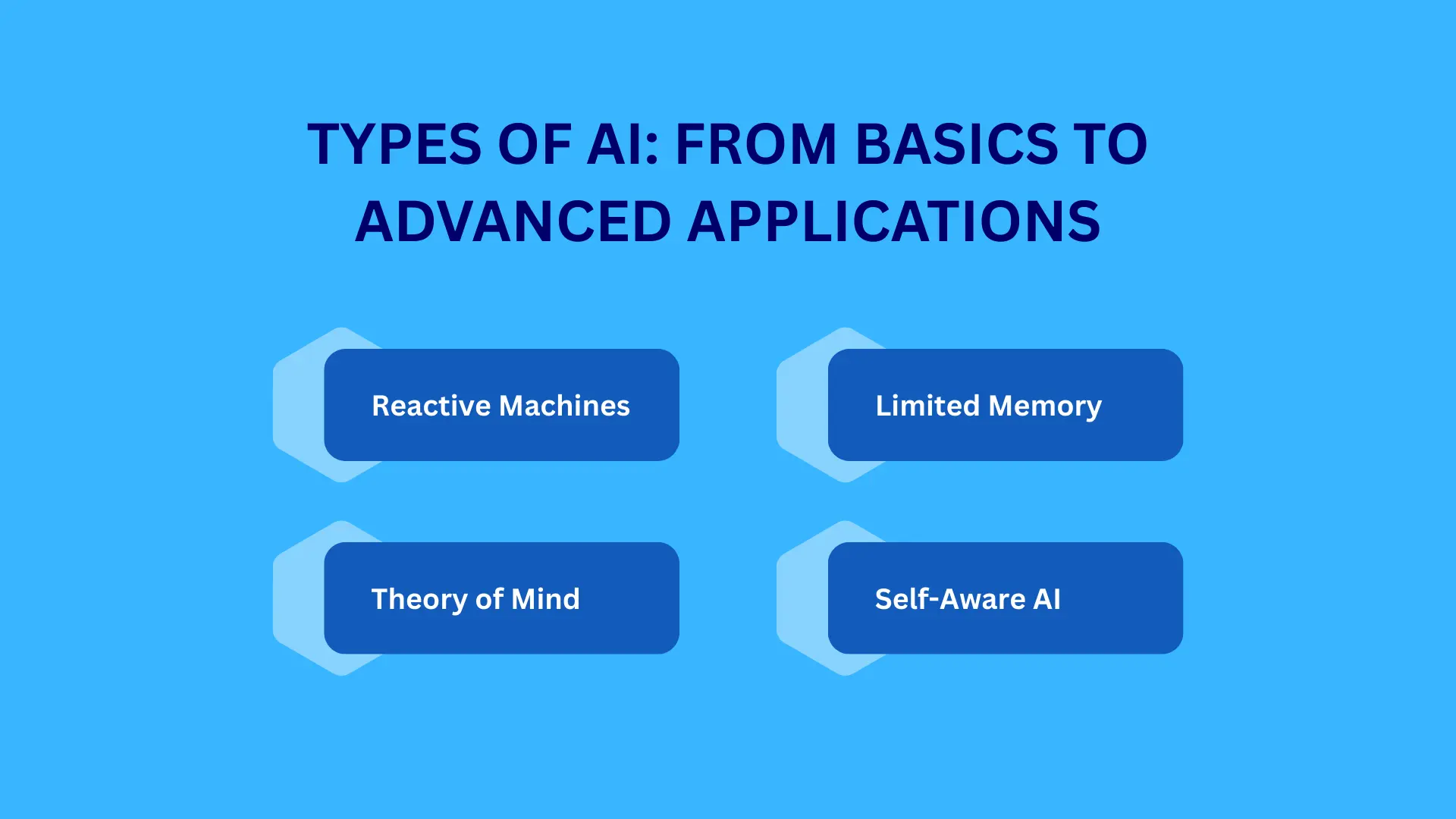
According to AI researchers, there are four main types of AI:
-
Reactive Machines – Basic AI that reacts only to present inputs.
-
Example: IBM’s Deep Blue chess computer.
-
-
Limited Memory AI – Learns from past data to improve future decisions.
-
Example: Autonomous vehicles analyzing traffic and behavior patterns.
-
-
Theory of Mind AI – Future-focused AI capable of understanding human emotions and intentions.
-
Example: Conversational models like ChatGPT beginning to move in this direction.
-
-
Self-Aware AI – A still-theoretical stage where machines achieve consciousness and independent reasoning.
Not sure which AI type fits your business needs? Talk to our AI experts today and get tailored guidance.
AI Techniques That Are Changing the Game in 2025
Here are the top AI methods businesses are using in 2025:
| AI Technique | How It Works | Applications |
|---|---|---|
| Supervised Learning | Learns from labeled data | Spam filtering, product recommendations |
| Unsupervised Learning | Finds hidden patterns in unlabeled data | Market segmentation, fraud detection |
| Reinforcement Learning | Learns via trial and error with feedback | Robotics, gaming AI, predictive text |
| Deep Learning | Uses multi-layer neural networks | Image recognition, autonomous driving |
| Machine Learning | Improves automatically through data | Fraud detection, predictive analytics |
| NLP (Natural Language Processing) | Understands and generates language | Chatbots, translation, sentiment analysis |
| Computer Vision | Interprets visual data | Medical imaging, AR, facial recognition |
Top Programming Languages Behind Modern AI
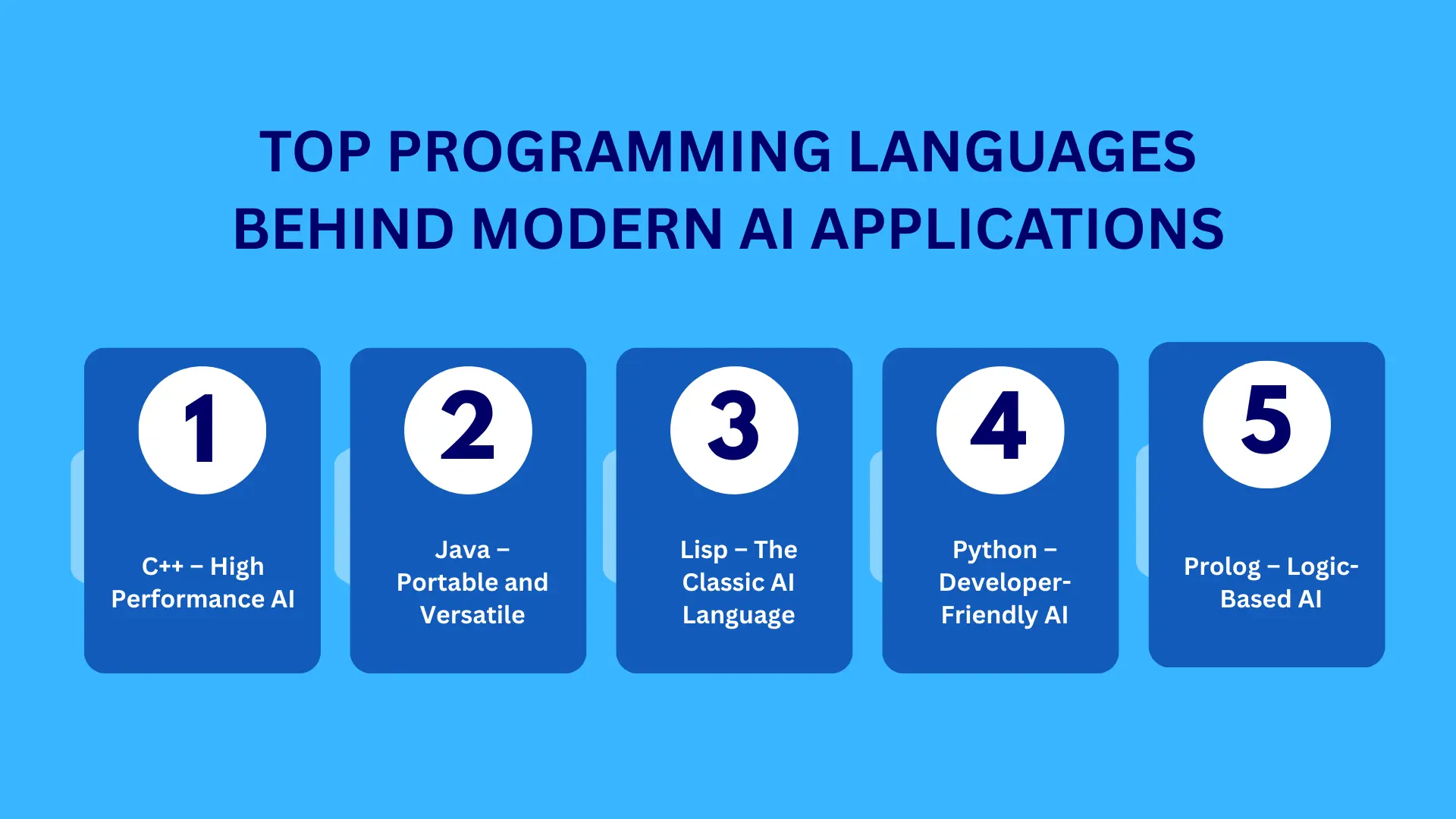
The programming language you choose directly affects AI performance, scalability, and development speed.
-
C++ – High-performance tasks, robotics, and game AI.
-
Java – Cross-platform enterprise AI and recommendation engines.
-
Lisp – Classic AI language for symbolic reasoning.
-
Python – Most popular, with rich AI libraries like TensorFlow & PyTorch.
-
Prolog – Specialized in logical reasoning and expert systems.
12 Must-Know AI Tools & Frameworks for 2025
AI’s rapid evolution is driven by powerful tools and frameworks. Here are the most impactful ones for businesses in 2025:
| Tool / Framework | Best For | Highlights |
|---|---|---|
| TensorFlow | Deep Learning, NLP | Backed by Google, production-ready |
| PyTorch | Research, NLP | Flexible, great for prototyping |
| Keras | Beginners | Easy API, built on TensorFlow |
| Scikit-learn | Classical ML | Lightweight, integrates with Pandas |
| CNTK | Speech Recognition | Enterprise-ready, scalable |
| Caffe | Computer Vision | Speed-focused, used in academia |
| Neuroph | Java Neural Networks | Lightweight, beginner-friendly |
| Apache SystemML | Big Data + ML | Scales on Hadoop/Spark |
| Torch | Deep Learning | Lua-based, GPU-efficient |
| H2O.ai | AutoML | Accessible predictive analytics |
| IBM Watson | Enterprise AI | Pre-trained, business-specific models |
| OpenAI GPT Models | NLP | Leading generative AI models |
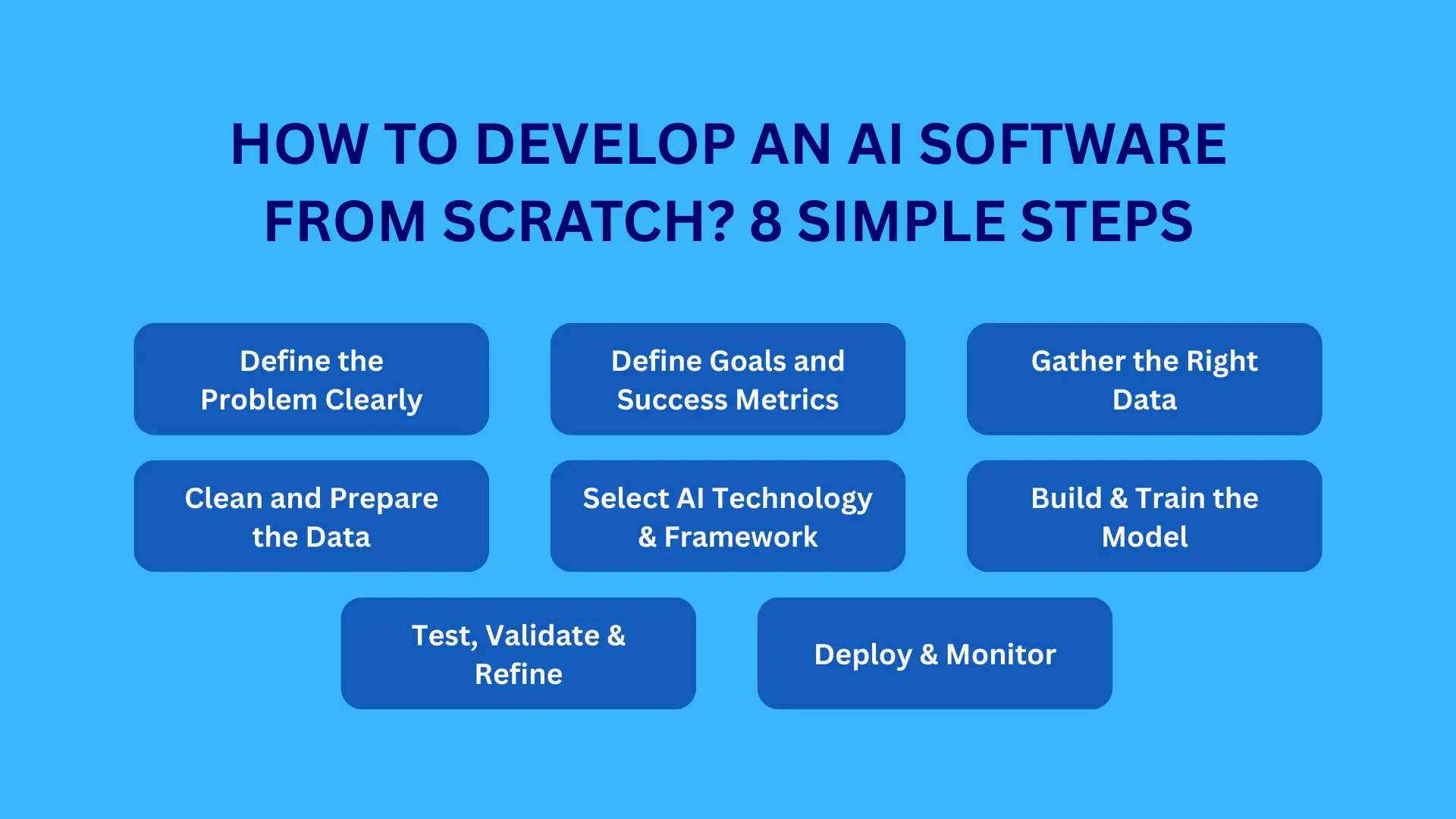
How to Develop AI Software from Scratch (8 Steps)
-
Define the problem clearly
-
Set goals and success metrics
-
Gather relevant data
-
Clean and prepare the dataset
-
Choose the right AI technology & framework
-
Build and train the model
-
Test, validate, and refine
-
Deploy, monitor, and improve
For end-to-end AI development tailored to your business, explore our AI app development services
Challenges in AI App Development
-
Technical – Reliability, scalability, and debugging limitations.
-
Data – Quality, compliance, and governance concerns.
-
Ethical & Legal – Bias, transparency, privacy issues.
-
Organizational – Talent shortage, infrastructure costs.
Industries Benefiting from AI App Development
AI adoption is accelerating across multiple industries:
-
Healthcare – Diagnosis, personalized treatment, predictive analytics.
-
Finance – Fraud detection, robo-advisors, AI chatbots.
-
Retail & eCommerce – Personalized recommendations, inventory optimization.
-
Education – AI tutors, automated grading, predictive learning analytics.
-
Logistics & Transport – Route optimization, predictive maintenance.
-
Real Estate – Price prediction, AI-driven customer support, virtual tours.
Popular AI Apps Making Waves
-
Ask AI – Instant knowledge-based responses.
-
ChatGPT – Conversational AI for business and personal use.
-
Otter.ai – Meeting transcription and productivity.
-
Google Maps – Predictive navigation.
-
Ally Financial AI – Smart banking and personalized finance insights.
PWH Services: Your Trusted AI Partner
AI is no longer a “future concept”—it’s a business necessity. But creating AI apps isn’t just about writing code; it’s about working with large datasets, training models, and aligning outcomes with real business goals.
At PWH Services, we specialize in building custom AI-powered applications, from chatbots and predictive analytics to multimodal AI solutions. Whether you’re a startup or an enterprise, our AI app solutions are designed to give you a competitive edge.