 Skip to content
Key Takeaways
- Choosing the right healthcare software development company is one of the most important decisions for the success of your healthcare project.
- Industry expertise, security, compliance, scalability, and post-launch support matter far more than choosing the lowest price.
- A reliable development partner should understand healthcare workflows, patient privacy, modern technologies, and long-term product growth.
- Whether you’re building a clinic management system, telemedicine platform, wellness app, or AI-powered healthcare solution, selecting the right team can save both time and money.
- This guide explains exactly what to look for before hiring a healthcare software development company in 2026.
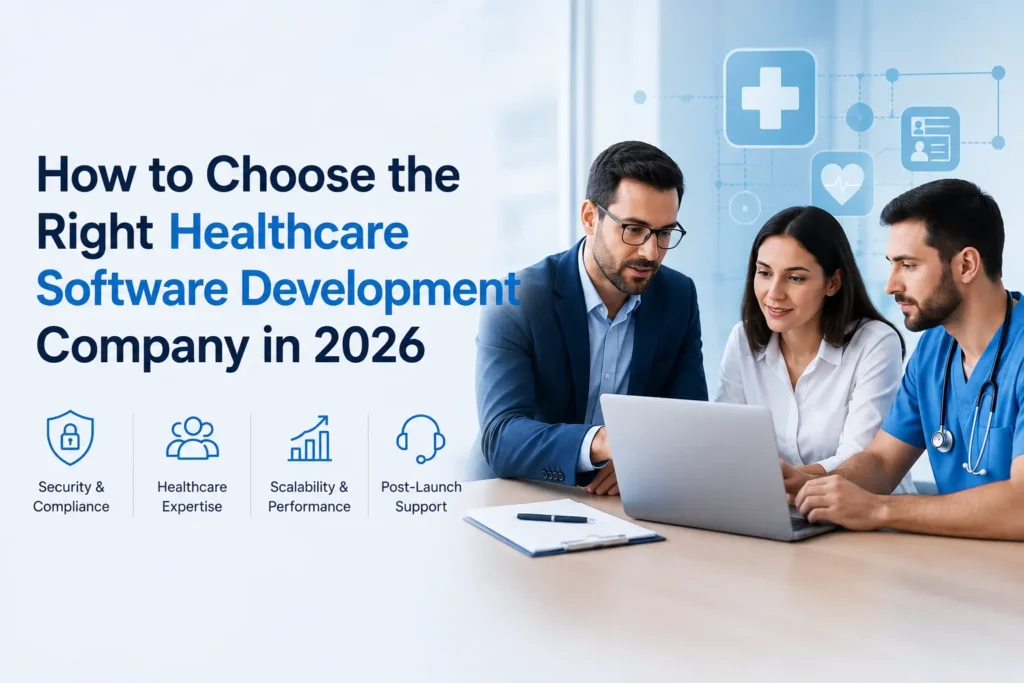
How to Choose the Right Healthcare Software Development Company in 2026
Healthcare is becoming increasingly digital. From online appointment booking and electronic medical records to AI-powered diagnostics and telemedicine platforms, technology is transforming how healthcare providers deliver services and how patients experience care.
As a result, more hospitals, clinics, wellness businesses, healthcare startups, and medical organizations are investing in custom software to improve efficiency, reduce administrative workloads, and provide better patient experiences.
But building healthcare software isn’t just about writing code.
Healthcare applications handle sensitive patient information, complex workflows, regulatory requirements, and mission-critical operations. Choosing the wrong development partner can lead to security vulnerabilities, delayed launches, unexpected costs, and software that fails to meet your business objectives.
That’s why selecting the right healthcare software development company is one of the most important decisions you’ll make during your digital transformation journey.
This guide will help you understand what separates an average software company from a true healthcare technology partner, the questions you should ask before signing a contract, and how to confidently choose a development team that can turn your vision into a secure, scalable, and future-ready healthcare solution.
Why Choosing the Right Healthcare Software Development Company Matters
Many organizations compare software development companies based only on price.
While budget is certainly important, it should never be the only deciding factor.
Healthcare software is fundamentally different from building a standard business website or eCommerce application. It must be designed to handle sensitive medical information, support complex user roles, integrate with healthcare systems, and remain reliable as your organization grows.
The right development company helps you:
- Build software that aligns with your clinical and operational workflows.
- Create intuitive experiences for both healthcare professionals and patients.
- Reduce costly development mistakes and future rework.
- Develop software that can scale as your business expands.
- Deliver secure and reliable digital healthcare experiences.
- Receive ongoing support after launch.
Choosing the wrong partner often results in missed deadlines, budget overruns, poor user adoption, and expensive redevelopment later.
Simply put, the company you choose will have a direct impact on your project’s success.
What Is a Healthcare Software Development Company?
A healthcare software development company specializes in designing, developing, and maintaining digital solutions specifically for the healthcare industry.
Unlike general software agencies, healthcare-focused development teams understand the unique challenges of medical organizations, including patient privacy, compliance requirements, appointment workflows, healthcare terminology, and interoperability with third-party systems.
Common healthcare solutions include:
Clinic Management Systems
Helping clinics manage appointments, patient records, staff scheduling, billing, reporting, and day-to-day operations.
Telemedicine Platforms
Enabling secure virtual consultations between healthcare providers and patients through video conferencing, messaging, and digital prescriptions.
Patient Portals
Allowing patients to book appointments, access medical records, receive reminders, and communicate with healthcare providers.
Healthcare Mobile Applications
Mobile apps that help patients manage appointments, medications, wellness goals, fitness tracking, remote monitoring, and healthcare communication.
Hospital Management Systems
Comprehensive platforms that streamline administrative operations, inventory management, staff coordination, reporting, and patient care.
AI-Powered Healthcare Solutions
Modern healthcare software increasingly integrates Artificial Intelligence to support automation, predictive analytics, patient engagement, workflow optimization, and smarter decision-making.
A specialized healthcare software development company understands how to combine these technologies into solutions that improve both operational efficiency and patient outcomes.
When Should You Hire a Healthcare Software Development Company?
Not every healthcare business needs custom software immediately.
However, there are clear signs that indicate it’s time to invest in a tailored digital solution.
You should consider hiring a healthcare software development company if:
- Your staff spends too much time on manual administrative tasks.
- You’re relying on spreadsheets, paper records, or disconnected systems.
- Existing software doesn’t match your workflow.
- You need a branded patient experience.
- You’re planning to launch a healthcare startup or digital health platform.
- You want to automate repetitive processes.
- You’re expanding to multiple clinic locations.
- You require custom integrations with third-party systems.
- You want to introduce AI-powered capabilities into your healthcare services.
Custom healthcare software becomes especially valuable when your organization has unique operational requirements that off-the-shelf solutions cannot fully support.
Before You Compare Prices, Understand Your Business Goals
One of the biggest mistakes businesses make is requesting quotes before defining what they actually need.
A development company can only provide accurate recommendations when your project goals are clear.
Before contacting software vendors, ask yourself:
- What business problem are we trying to solve?
- Who will use this software?
- Which manual processes should be automated?
- Do we need a web application, a mobile app, or both?
- What integrations are essential?
- Which features are required for launch, and which can wait for future updates?
Having clear answers to these questions not only speeds up development but also helps you choose a company that genuinely understands your vision rather than simply offering the lowest estimate.
The Best Healthcare Software Companies Focus on Business Outcomes
Successful software projects aren’t measured by lines of code.
They’re measured by business results.
The right development partner should understand your objectives, whether that’s:
- Reducing patient no-shows.
- Improving appointment scheduling.
- Increasing operational efficiency.
- Enhancing patient engagement.
- Supporting business growth.
- Improving staff productivity.
- Creating a competitive advantage.
Technology should solve real business challenges—not create new ones.
That’s why the best healthcare software development companies begin every project by understanding your business before recommending technical solutions.
12 Things to Look for Before Hiring a Healthcare Software Development Company
Not all software development companies are created equal.
Some agencies can build visually appealing applications but lack experience with healthcare workflows. Others may offer low prices but struggle with security, scalability, or long-term support.
If you’re investing thousands of dollars into a healthcare software project, choosing the right development partner should be based on expertise—not marketing promises.
Here are the most important factors to evaluate before making your decision.
1. Healthcare Industry Experience
The first question you should ask is simple:
Have they built healthcare software before?
Healthcare is one of the most complex industries for software development. A company with proven healthcare experience already understands many of the challenges involved, including patient journeys, appointment workflows, role-based access, and secure handling of sensitive information.
Ask to see examples of projects such as:
- Clinic Management Systems
- Hospital Management Platforms
- Telemedicine Applications
- Wellness Mobile Apps
- Electronic Medical Record (EMR) Systems
- Patient Portals
- Healthcare Dashboards
A company with relevant experience can often identify potential issues before development even begins, helping you avoid costly mistakes later.
2. Strong Technical Expertise
Technology changes rapidly, and your software should be built using modern, scalable technologies that support future growth.
An experienced healthcare software development company should be comfortable working with technologies such as:
- React or Next.js for responsive web applications
- Flutter or React Native for cross-platform mobile apps
- Node.js, .NET, Python, or Laravel for secure backend development
- Cloud platforms like AWS or Google Cloud
- PostgreSQL or MySQL databases
- REST APIs and third-party integrations
The goal isn’t simply to use the latest technology—it’s to choose the right technology for your business needs.
A reliable development partner should explain why a particular technology stack is the best fit for your project, rather than overwhelming you with technical jargon.
3. Security Should Never Be an Afterthought
Healthcare software stores some of the most sensitive information a business can handle.
Patient records, appointment histories, personal information, prescriptions, and clinical notes all require strong protection.
When evaluating a development company, ask how they approach security.
Look for practices such as:
- Data encryption
- Secure authentication
- Role-based access control
- Regular security testing
- Secure cloud infrastructure
- Backup and disaster recovery planning
- Activity logging and monitoring
A trustworthy software partner treats security as a core part of development—not as an optional feature added at the end.
4. Understanding Healthcare Compliance
Depending on your target market, your software may need to comply with specific healthcare regulations.
For example:
- HIPAA (United States)
- GDPR (Europe and UK)
- Local healthcare privacy regulations in other regions
Even if your application doesn’t require formal certification, your development partner should understand how secure healthcare systems are designed and how patient data should be protected.
Instead of asking:
“Are you HIPAA certified?”
Ask:
“How do you design software that supports HIPAA-aware security practices?”
Their answer will tell you far more about their real expertise.
5. UI/UX Design That Works for Healthcare Professionals
Healthcare software is used by busy people.
Doctors.
Receptionists.
Nurses.
Administrators.
Patients.
Every extra click, confusing screen, or complicated workflow wastes valuable time.
A great healthcare software development company invests heavily in User Experience (UX) before writing code.
Good healthcare interfaces should be:
- Clean
- Easy to navigate
- Fast to use
- Mobile-friendly
- Accessible
- Designed around real healthcare workflows
Beautiful design alone isn’t enough.
The software should help users complete tasks quickly and confidently.
6. AI Capabilities Are Becoming a Competitive Advantage
Artificial Intelligence is no longer reserved for large healthcare organizations.
Modern healthcare businesses increasingly use AI to improve efficiency and patient experiences.
Examples include:
- AI appointment assistants
- Intelligent chatbots
- Automated appointment reminders
- Predictive analytics
- Smart reporting dashboards
- Document summarization
- Workflow automation
- Patient engagement tools
If your long-term roadmap includes AI, choose a development company that already understands how AI can integrate into healthcare solutions.
Even if you don’t need AI today, selecting a partner with this capability ensures your software can evolve as your business grows.
7. Ask to See Their Portfolio—Not Just Testimonials
Every software company claims to build “high-quality solutions.”
The portfolio tells the real story.
When reviewing previous work, pay attention to:
- Overall design quality
- Ease of navigation
- Mobile responsiveness
- Similar healthcare projects
- Scalability
- Technical complexity
- Business problems solved
A strong portfolio demonstrates not only technical skills but also the company’s ability to understand different industries and deliver meaningful business outcomes.
If a company has experience building healthcare software, that’s a significant advantage.
8. Communication Can Make or Break Your Project
Even the most technically skilled developers can’t deliver a successful project without clear communication.
During the discovery phase, observe how the company interacts with you.
Do they:
- Listen carefully to your requirements?
- Ask thoughtful business questions?
- Explain technical concepts in simple language?
- Respond promptly?
- Set realistic expectations?
The best development partners don’t simply take orders—they collaborate with you to build the best possible solution.
Strong communication leads to fewer misunderstandings, faster development, and better project outcomes.
9. Their Development Process Should Be Transparent
Reliable software companies follow a structured development process rather than jumping straight into coding.
A typical workflow should include:
- Discovery and requirements gathering
- Research and planning
- Wireframing
- UI/UX design
- Development
- Quality assurance and testing
- User acceptance testing
- Deployment
- Post-launch support
A transparent process keeps everyone aligned and reduces surprises throughout the project.
10. Scalability Matters More Than You Think
Many businesses initially build software for one clinic or one location.
A few years later, they’re expanding to multiple branches, adding more staff, introducing new services, and integrating additional systems.
If scalability wasn’t considered from the beginning, upgrading the software later can become expensive and time-consuming.
Ask your development partner:
- Can this platform support multiple locations?
- Can new features be added without rebuilding everything?
- Can the infrastructure handle future growth?
The right architecture today can save thousands of dollars in redevelopment costs tomorrow.
11. Post-Launch Support Is Just as Important as Development
Launching your healthcare software is not the finish line—it’s the beginning.
After your application goes live, you’ll likely need:
- Bug fixes
- Security updates
- Performance improvements
- Feature enhancements
- Third-party integration updates
- Cloud infrastructure monitoring
- User feedback implementation
Unfortunately, some development companies disappear once the project is delivered.
That’s why you should always ask:
- What happens after launch?
- Do you provide ongoing maintenance?
- Is technical support included?
- How are future feature requests handled?
- What are your response times for critical issues?
A long-term technology partner should continue helping your business grow instead of simply delivering a finished product and moving on.
12. Choose a Partner—Not Just a Vendor
Many companies can build software.
Far fewer genuinely care about helping your business succeed.
A true technology partner doesn’t simply ask:
“What features do you need?”
Instead, they ask:
- What problem are you trying to solve?
- What are your business goals?
- How do your current workflows operate?
- What challenges does your staff face every day?
- What will success look like six months after launch?
This business-first approach often leads to better software because every feature is designed around solving real problems—not adding unnecessary complexity.
Red Flags You Should Never Ignore
Choosing the wrong healthcare software development company can cost far more than choosing the right one.
Watch for these warning signs before signing any agreement.
🚩 They promise unrealistic delivery timelines.
🚩 They immediately discuss pricing without understanding your business.
🚩 They have little or no healthcare experience.
🚩 They cannot explain their development process.
🚩 They avoid discussing security and data protection.
🚩 Their portfolio lacks real-world projects.
🚩 Communication is slow or inconsistent.
🚩 They don’t provide post-launch support.
🚩 Everything is “yes” without asking thoughtful questions.
A trustworthy company is transparent about challenges, timelines, and limitations instead of making unrealistic promises.
Questions You Should Ask Before Hiring
Before choosing a healthcare software development company, schedule a discovery meeting and ask questions like these:
- Have you developed healthcare software before?
- Can you show similar projects you’ve completed?
- Which technologies do you recommend, and why?
- How do you approach software security?
- What does your development process look like?
- How will progress be communicated?
- Who owns the source code after launch?
- What happens if we need additional features later?
- What post-launch support do you provide?
- How do you estimate project costs and timelines?
Their answers will reveal whether they’re simply selling a service or genuinely interested in becoming your long-term technology partner.
Why Businesses Choose PWH Services
Building healthcare software requires more than technical expertise—it requires understanding the people who will use it every day.
At PWH Services, we help healthcare providers, startups, clinics, and wellness businesses transform ideas into secure, scalable, and user-friendly digital solutions.
Our team specializes in:
- Custom Healthcare Software Development
- Healthcare Mobile App Development
- Clinic Management Systems
- Wellness Applications
- AI Integration & Automation
- Custom Web Applications
- UI/UX Design
- Cloud-Based Solutions
- API Integrations
- Long-Term Product Support
We believe every healthcare business has unique workflows, which is why we build software tailored to your specific operational needs rather than forcing your business to adapt to generic solutions.
Whether you’re planning your first MVP or expanding an existing healthcare platform, our goal is to become a technology partner that supports your business well beyond launch.
You can explore PWH Services, view Our Portfolio to see recent projects, or learn about our Technology Partnership Program for long-term collaboration.
If you’d like to discuss your healthcare software idea, Contact Our Team or Book a Free 30-Minute Consultation with our experts to explore the best approach for your project.
Final Thoughts
Choosing the right healthcare software development company isn’t about finding the cheapest quote.
It’s about selecting a partner that understands your industry, prioritizes security, communicates clearly, and builds software that supports your long-term business goals.
Healthcare technology continues to evolve rapidly, and organizations that invest in the right digital solutions today will be better positioned to improve patient experiences, streamline operations, and stay competitive in the years ahead.
Take your time, evaluate potential partners carefully, ask the right questions, and choose a company that values your success as much as you do.
The right development partner won’t just build your software—they’ll help shape the future of your healthcare business.
Frequently Asked Questions
How do I choose the best healthcare software development company?
Look for a company with healthcare industry experience, a strong portfolio, modern technical expertise, security-focused development practices, transparent communication, and reliable post-launch support.
Why should I hire a healthcare-focused software development company instead of a general software agency?
Healthcare software involves unique workflows, patient data protection, compliance considerations, and industry-specific challenges. A specialized development company understands these requirements and can deliver solutions that better meet healthcare needs.
How much does it cost to hire a healthcare software development company?
Costs vary depending on project complexity, features, integrations, and platform requirements. For a detailed breakdown, you can also read our article on How Much Does Clinic Management Software Cost in 2026.
How long does healthcare software development usually take?
An MVP typically takes between 10–16 weeks, while larger healthcare platforms with mobile applications and advanced integrations can require 16–24 weeks or more.
Can AI be integrated into healthcare software?
Yes. Modern healthcare platforms increasingly include AI-powered appointment assistants, workflow automation, predictive analytics, intelligent reporting, chatbots, and patient engagement tools.
