The eCommerce industry is evolving at an unprecedented pace. In 2025, digital storefronts and mobile commerce are reshaping how consumers shop worldwide. For businesses, staying updated with 2025 ecommerce statistics is essential to plan growth, optimize operations, and enhance customer experiences.
At PWH Services, we help companies leverage these insights to create high-performing, future-ready eCommerce solutions.
What Do Current Global eCommerce Numbers Show for 2025?
The global eCommerce market continues to grow exponentially. Consumer adoption of online shopping is rising across all regions, powered by improved internet access, mobile devices, and seamless payment options.
In 2025, eCommerce is no longer just about convenience; it’s about delivering personalized, engaging experiences that drive loyalty and repeat purchases.
Unprecedented Market Growth
Global retail eCommerce sales are projected to exceed $4.3 trillion in 2025, accounting for nearly 24% of total retail sales worldwide.
Asia-Pacific leads the expansion, with countries like China, India, and Southeast Asia contributing over 50% of global growth. The U.S. and Europe follow closely, supported by mature logistics, high digital adoption, and robust consumer confidence.
Mobile Commerce Leadership
Mobile continues to dominate digital shopping. Around 73% of online transactions now occur via smartphones or tablets.
Brands with mobile-optimized stores, fast load times, and personalized recommendations see conversion rates increase by up to 45% compared to desktop-only platforms.
The Power of Personalization
Personalized experiences drive eCommerce success. In 2025:
80% of consumers prefer shopping with brands that offer tailored recommendations.
AI-powered product suggestions, personalized content, and dynamic pricing are now standard expectations.
Integrating personalization with analytics can turn casual buyers into loyal, repeat customers.

How Large Is the U.S. eCommerce Market?
The United States remains a global leader in online retail, shaping trends and innovations worldwide. The U.S. eCommerce market continues to grow in size and influence, driving business strategy across industries.
U.S. Market Size and Revenue
In 2024, U.S. retail eCommerce sales reached $1,192.6 billion. Q4 2024 alone accounted for $352.93 billion, marking a 24.6% year-over-year increase.
By 2029, annual U.S. eCommerce revenue is expected to reach $1.9 trillion, highlighting the market’s robust growth potential.
U.S. eCommerce Share of Total Retail
The U.S. Census Bureau reports that in Q2 2025, eCommerce sales totaled $304.2 billion, representing 16.3% of all retail sales. This reflects steady growth from 2024, with online shopping steadily capturing a larger share of total retail revenue.
Number of eCommerce Businesses in the U.S.
As of 2025, the U.S. hosts approximately 11.9 million eCommerce websites, slightly down from the pandemic peak but still significantly higher than pre-pandemic levels.
Active online stores range from 2.7 to 3.5 million, highlighting a competitive and thriving digital marketplace.
Where is the U.S. eCommerce Market Headed in 2025?
The U.S. eCommerce market is forecasted to reach $1.3 trillion in 2025, capturing nearly 22% of total U.S. retail sales. Online shopping is deeply embedded in American lifestyles, with consumers expecting convenience, speed, and secure transactions.
Steady Progress and Market Optimism
Over 270 million U.S. consumers shop online annually, spending an average of $5,500 per person. Same-day delivery, flexible payments, and reliable eCommerce platforms are driving this sustained growth.
Number of eCommerce Enterprises in the United States
Currently, there are approximately 2.8 million eCommerce businesses in the U.S., with a 12% compound annual growth rate over the past three years. Small businesses and entrepreneurs are leveraging AI, social media, and innovative apps to expand reach and increase revenue.
Consumer Behavior Insights
80% of U.S. adults shop online monthly.
Over 50% shop weekly, mainly for clothing, electronics, and groceries.
Sustainability, eco-friendly packaging, and reliable delivery are increasingly influencing purchasing decisions.
Who Dominates the U.S. eCommerce Market Share?
The U.S. eCommerce market is concentrated, with a few key players dominating sales and setting consumer expectations.
Amazon’s Dominant Position
Amazon remains the leader, accounting for 40.9% of U.S. retail eCommerce sales in 2025 (~$540 billion). Nearly 2 out of 5 online dollars spent in the U.S. go to Amazon, highlighting its continued dominance.
Other Major Players
Other key competitors include:
Walmart: $93.86 billion, 6.4% share
Apple: 3.6% market share
Target & Home Depot: 1.9% each
Costco: 1.5% share
eBay: 9.22% by website traffic
Top eCommerce Sites by Traffic
As of November 2023, the most visited U.S. eCommerce websites are:
Amazon
eBay
Walmart
Traffic patterns highlight the ongoing importance of large-scale online platforms.
What are the Key Determinants of eCommerce Market Share Growth?
Market growth is driven by technological innovation, social commerce, sustainability, and enhanced customer experiences.
Latest Technology
AI, AR, and machine learning are transforming shopping, enabling:
Personalized experiences
Predictive analytics
AI-driven customer service
68% of customers are more likely to buy from brands offering immersive digital experiences.
Rise of Social Commerce
Social media now accounts for 35% of global eCommerce sales, fueled by shoppable posts, influencer marketing, and live streaming. Platforms like Instagram, TikTok, and Facebook are key revenue drivers.
Sustainability and Moral Purchase
Modern consumers prioritize eco-friendly products.
60% of online shoppers prefer sustainable goods
45% are willing to pay extra for environmentally responsible products
Sustainability is a critical factor for long-term loyalty.
What are the 2025 Global Trends in Online Retail?

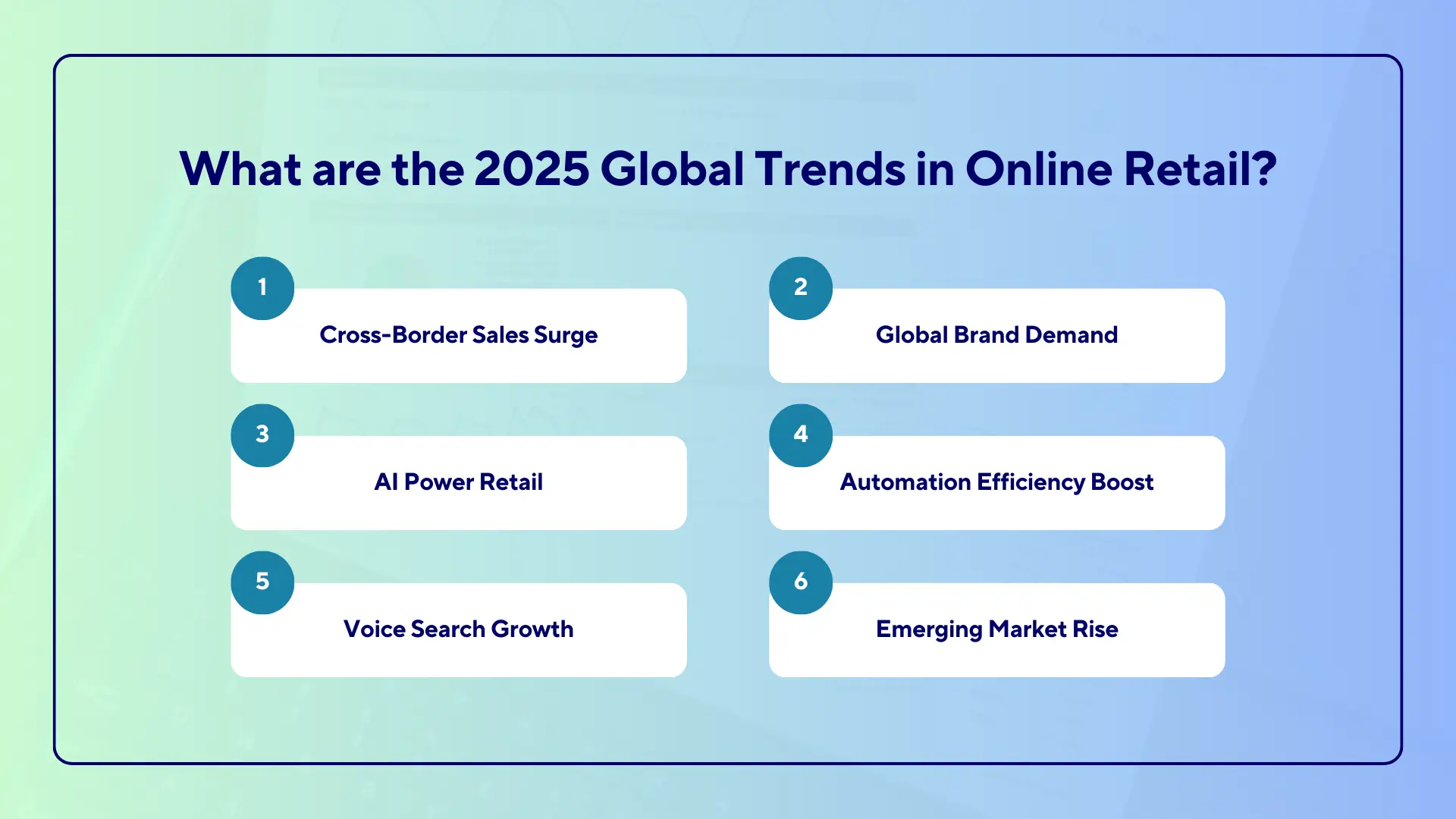
Global online retail is increasingly shaped by digital automation, AI, and advanced analytics, defining the next wave of eCommerce trends.
Cross-Border Commerce Boom
Cross-border eCommerce sales are projected at $2.4 trillion in 2025. Consumers seek competitive pricing, variety, and reliable international shipping.
AI and Automation are Transforming Retailing
By 2025, 70% of eCommerce companies will use AI to:
Personalize experiences
Predict demand
Reduce fraud
Optimize fulfillment
AI integration is now central to competitive advantage.
Voice and Visual Search on the Increase
40% of online buyers use voice assistants for product discovery
Visual search adoption grows 30% annually
These tools boost engagement, conversions, and overall shopping satisfaction.

How Many People Shop Online Worldwide?
Global online shopping is a mainstream activity. In 2025, billions of consumers actively engage with eCommerce platforms, spanning every continent.
Global Online Shopper Population
2025: 2.77 billion online shoppers
2024: 2.71 billion
2023: 2.64 billion
These numbers reflect a steady increase in digital purchasing worldwide, with the global eCommerce market expected to reach $8 trillion by 2027.
Online Purchase Behavior Reports
56% of internet users make at least one online purchase weekly
Average global online spend: $1,620/year
These figures highlight the deep integration of eCommerce into everyday life.
Mobile Commerce Users And Their App Usage
Mobile commerce is surging, with billions of transactions occurring weekly via smartphones. Mobile-first experiences, fast load times, and intuitive apps are now non-negotiable for conversion growth.
Online Shopping Statistics from the United States
Online shoppers in 2024: 279.9 million
2022–2023 growth: +6.5 million
Projected 2026: 288.2 million
Projected 2028: 316.6 million
The U.S. is a mature, highly active eCommerce market with consumers expecting speed, convenience, and secure digital shopping.
Which Regions Are Leading eCommerce Growth Globally?
China: >45% of global revenue
U.S.: ~20% global share
Europe: $1.2 trillion annual revenue
India & Southeast Asia: Rapid mobile-first adoption
Middle East & Africa: Fast-growing emerging markets
What Do Online Retailing Growth Rates Mean for Companies?
These trends guide businesses in strategy, personalization, and global expansion. Companies that adopt data-driven insights outperform competitors and enhance customer loyalty.
Data-Driven Decision Making
Optimize product placement
Forecast demand
Improve pricing strategies
Enhance customer experience
Brands leveraging analytics see up to 60% higher revenue.
Adoption of Omnichannel Experiences
Multichannel shoppers deliver 30% higher lifetime value. Integration of online and offline channels is critical for success in 2025.
What Future Trends Will Characterize eCommerce Post 2025?
The next era of eCommerce is defined by hyper-personalization, frictionless payments, and AI-driven logistics.
The Age of Hyper-Personalization
AI-driven platforms enable tailored product recommendations, increasing average order value by 20–25%.
Frictionless Payment Systems
Digital wallets, BNPL, and cryptocurrencies enhance checkout experiences. Over 60% of global buyers will adopt digital payment methods by 2025.
The Power of AI-Powered Logistics
AI and IoT enable:
Efficient fulfillment
Predictive delivery
Smart inventory management
These innovations reduce costs and improve customer satisfaction.
How PWH Services Transforms eCommerce Insights into Real Success
At PWH Services, we help businesses convert data insights into action:
Custom eCommerce website & app development
Conversion-driven UI/UX
AI-powered analytics
Mobile-first and SEO-optimized solutions
We ensure your eCommerce platform thrives in 2025 and beyond.