Skip to content
POC in software development is often the difference between a successful product and a costly failure. Have you ever invested heavily in a software idea that looked perfect on paper—but collapsed during execution? You’re not alone. Businesses lose millions every year building full-scale software solutions that fail due to untested assumptions.
This is exactly where a Proof of Concept (POC) in software development becomes your smartest financial safeguard. A POC is not a delay or an unnecessary phase—it’s a focused, low-cost experiment designed to validate your riskiest assumptions early.
By validating whether your core idea works technically and operationally, a POC in software development replaces guesswork with real data. It helps uncover technical challenges upfront, aligns stakeholders with tangible evidence, and ensures user needs are considered before committing to large budgets.
At PWH Services, we view a POC as the most strategic first investment—not an extra step. This disciplined approach protects your budget, accelerates smarter decisions, and ensures your software vision is built on confidence, not assumptions.
What is PoC in Software Development?
A Proof of Concept (POC) in software development is a small, focused initiative designed to determine whether your software idea is technically feasible before moving forward. It’s not a prototype or an MVP—it answers one critical question: Can this actually be built?
Think of a POC in software development as a reality check for your project. Instead of committing months of development and significant capital, a POC tests the core functionality, integrations, and technical constraints with minimal investment.
This approach makes POC in software development a powerful risk-mitigation strategy. It uncovers scalability issues, integration gaps, performance limitations, and technical blockers at the earliest stage—when fixes are fastest and cheapest.
Beyond feasibility, a POC in software development empowers stakeholders with real evidence. Decisions are no longer based on assumptions but on measurable outcomes, leading to substantial cost savings and higher project success rates.
A POC typically answers questions such as:
-
Can this technology meet our performance requirements?
-
Will third-party systems and APIs integrate smoothly?
-
Are there scalability or security concerns?
-
Do hidden technical blockers exist?
If the answer is yes, you move forward confidently. If not, you pivot early—before wasting time and money.
PoC vs Prototype vs MVP: What’s the Real Difference?
Before diving deeper into why we need a POC in software development, it’s important to understand how it differs from a Prototype, MVP, or Pilot Project.
These terms are often used interchangeably, which can push projects in the wrong direction from day one. Understanding the differences between POC vs MVP software development, prototypes, and pilot projects helps you choose the right approach at the right time.
Knowing when to validate a concept versus when to test it with real users can save months of rework and thousands in unnecessary costs.
| Aspect | Proof of Concept (POC) | Prototype | MVP (Minimum Viable Product) | Pilot Project |
|---|---|---|---|---|
| Primary Purpose | Validate technical feasibility | Demonstrate design & UX | Validate market demand | Test in real-world conditions |
| Target Audience | Internal teams & stakeholders | Investors & stakeholders | Early adopters | Limited user segment |
| Functionality | Single core concept | Interactive mockups | Basic but complete product | Near full functionality |
| Timeline | Days to weeks | Weeks to months | 2–4 months | 1–6 months |
| Investment Level | Low ($5K–$20K) | Medium ($10K–$50K) | High ($50K–$150K+) | Medium–High ($30K–$100K+) |
| Output Quality | Rough & experimental | Visual & clickable | Market-ready | Production-grade |
| User Testing | None | Limited | Extensive | Controlled |
When Should You Use Each?
-
Start with a POC in software development when technical feasibility is uncertain
-
Build a Prototype to visualize UX and design flows
-
Launch an MVP once feasibility is proven and market demand needs validation
-
Run a Pilot Project to test a solution with a controlled user group before scaling
Why Do We Need a POC in a Software Project?
The real question isn’t why we need a POC in software development—it’s whether you can afford not to have one.
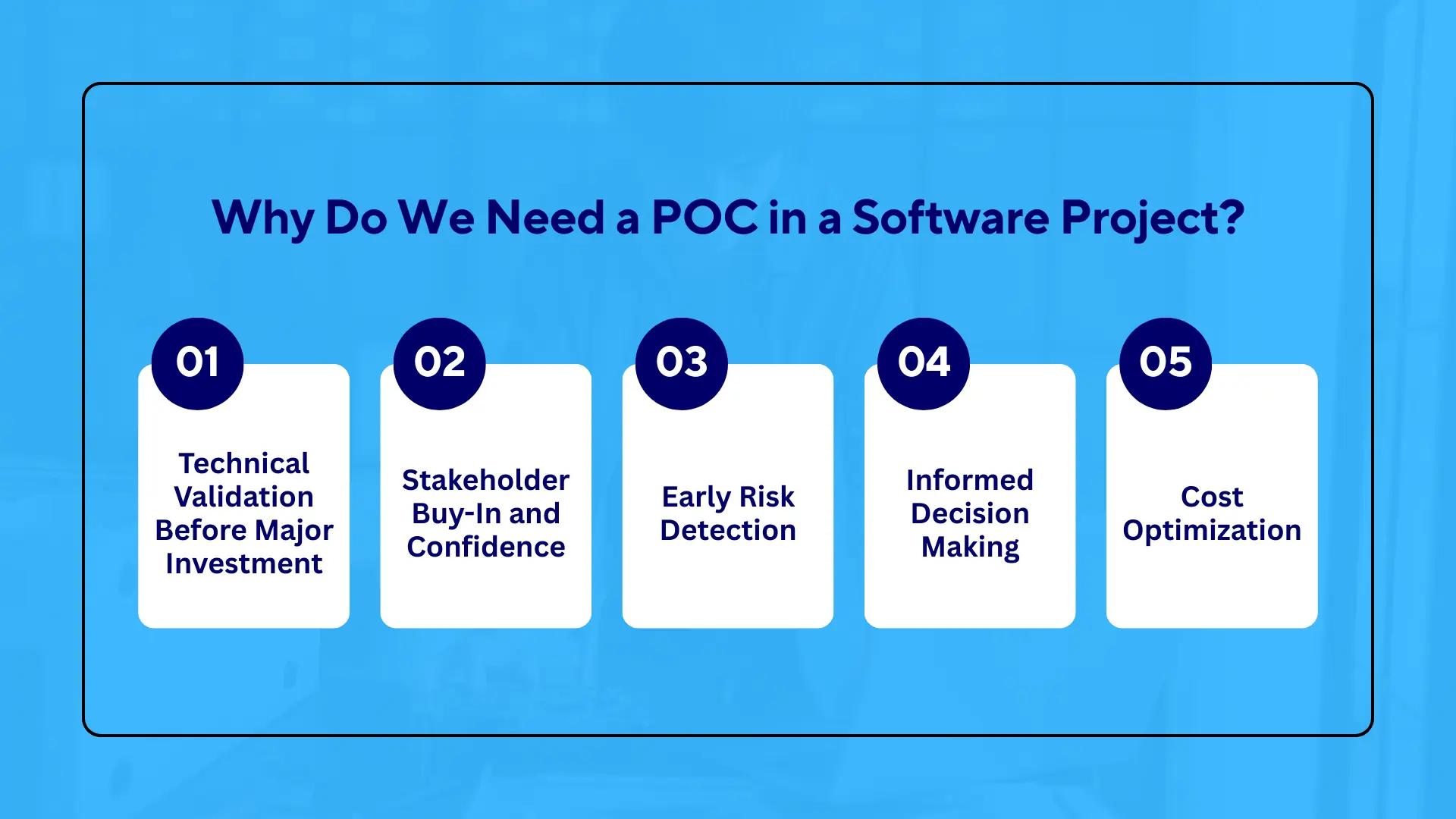
1. Technical Validation Before Major Investment
The importance of POC in software development begins with technical validation. A great idea means nothing if the technology can’t support it. A POC tests your architecture, integrations, APIs, and technology stack before large investments are made.
Real-world insight: A fintech firm discovered through a POC that their real-time fraud detection algorithm couldn’t process transactions fast enough.
-
Cost of POC: $8,000
-
Cost if discovered later: $300,000+
Projects that start with a POC in software development can reduce overall development costs by 25–30%.
2. Stakeholder Buy-In and Confidence
A POC in software development transforms skepticism into confidence. Instead of asking stakeholders to trust assumptions, you show them working proof.
Demonstrating feasibility can increase stakeholder investment readiness by up to 40%, significantly improving funding approval and internal alignment.
3. Early Risk Detection
Reducing risk is one of the biggest benefits of POC in software development. It helps uncover:
-
Legacy system integration issues
-
Performance and scalability bottlenecks
-
Security vulnerabilities
-
API limitations
-
Data migration challenges
-
Unrealistic timelines
Every risk identified early is exponentially cheaper to fix than after full development.
4. Informed Decision Making
A POC in software development replaces guesswork with clarity:
-
Should you proceed, pivot, or stop?
-
What’s the realistic budget and timeline?
-
Which technologies and vendors are best?
-
What skills does your team need?
Clear answers lead to smarter execution.
5. Cost Optimization
The average POC in software development costs between $5,000 and $25,000—a fraction of full development expenses.
Consider the reality of failed software projects:
-
Only 16.2% finish on time and on budget
-
19% fail completely
-
52.7% exceed budgets by 189%
-
Businesses waste $2 trillion annually on failed projects
Cost savings from a POC in software development include:
-
Avoiding unviable products
-
Choosing cost-effective tech stacks
-
Preventing scope creep
-
Reducing rework
-
Strengthening vendor negotiations
A single $15,000 POC has saved companies from $500,000+ failures.
Benefits of Proof of Concept in Software
The benefits of proof of concept in software development extend far beyond validation.
For Startups
-
Attract investors with demonstrable technology
-
Validate market assumptions before burning capital
-
Increase investor confidence by up to 40%
-
Align teams around feasibility
-
Accelerate time-to-market
-
Prove the founder’s vision is technically achievable
With 42% of startups failing due to lack of market need, a POC in software development is mission-critical.
For Enterprises
-
Justify budgets with concrete proof
-
Reduce innovation risk—66% of tech projects fail partially or fully
-
Test vendor claims before long-term contracts
-
Align cross-functional teams
-
Protect brand reputation from public failures
For startups, a POC in software development ensures survival.
For enterprises, it enables safe innovation.
How to Create a POC in Software Development: 5 Essential Steps
The success of a POC in software development lies in disciplined execution.
1. Define the Problem Clearly
Identify the real problem, success metrics, constraints, and goals. Market research and user insights ensure alignment between business and technology.
2. Explore Potential Solutions
Brainstorm feasible solutions within technical and budget constraints. Early involvement of engineers ensures realism and scalability.
3. Build a Prototype
Create wireframes, mockups, or minimal implementations to visualize and validate functionality.
4. Test and Gather Feedback
Validate assumptions through feedback from users, experts, and stakeholders. Iterate to improve product-market fit.
5. Develop a Roadmap for Execution
Document findings, risks, resources, timelines, and next steps to guide full-scale development.
How a POC Can Save Your Business Money
A POC in software development may seem like an upfront cost—but it prevents massive losses.
The Cost of Skipping a POC
Without a POC:
-
$200,000+ lost
-
8 months wasted
-
Project cancellation or pivot
With a POC:
-
$15,000 invested
-
Risks identified in weeks
-
Confident full-scale development
That’s not spending—it’s smart risk management.
Ready to Build Your POC with PWH Services?
Now that you understand why POC in software development is essential, the next step is execution.
At PWH Services, we help startups and enterprises transform ideas into validated, scalable solutions. From technical feasibility to roadmap creation, our experts guide you through the entire POC lifecycle.
Explore our solutions at https://pwhservices.tech/
Discover our application expertise at https://pwhservices.tech/app-solutions
Don’t leave your software investment to chance—build confidence before you scale.