Skip to content
Top 10 AI Study Apps for Students in 2026 are transforming the modern learning experience. In today’s fast-paced academic world, students are no longer relying only on textbooks or repetitive note-reading. With heavy course loads, tight deadlines, and constant digital distractions, learners are turning to smart AI-powered tools to study more efficiently and save valuable time.
AI study apps now act as intelligent learning assistants. From summarizing lectures and generating flashcards to solving complex math problems step by step, artificial intelligence is becoming an essential part of everyday education.
But the real question is: Which AI study app is right for you? The answer depends on your learning style, academic goals, and subject requirements.
Let’s explore why AI study tools are becoming essential in 2026—and which platforms stand out the most.
Why AI Study Apps Are Becoming Essential for Students in 2026
Artificial intelligence in education is no longer just a trend—it represents a major shift in how knowledge is delivered and absorbed. As digital classrooms expand and skill-based learning becomes more important, AI tools are helping students adapt quickly.
Here’s why AI study apps are now essential:
-
The global AI in education market is growing rapidly and is projected to reach billions in value by 2030.
-
A large percentage of students already use AI tools for writing, research, and revision.
-
Personalized AI learning can significantly improve knowledge retention compared to traditional methods.
Students are no longer experimenting with AI—they are relying on it to stay competitive in increasingly demanding academic environments.
Revolutionary Changes AI Brings to Learning
AI does more than digitize textbooks—it personalizes learning experiences.
Instead of forcing every student to follow the same pace, AI adapts to individual strengths and weaknesses.
Key improvements AI brings to education include:
-
Personalized explanations based on weak areas
-
Instant feedback instead of waiting for teacher evaluations
-
Interactive quizzes and recall testing
-
Step-by-step guided problem solving
-
Flexible learning formats (visual, auditory, text-based)
AI-powered learning shifts students from passive reading to active engagement. This interactive approach improves understanding and long-term retention.
Key Features That Define Leading AI Study Applications
Not all AI tools provide real academic value. The best AI study apps share certain powerful features designed to improve clarity and efficiency.
Top features include:
-
Converting lectures, PDFs, and videos into summaries and flashcards
-
AI tutors that explain concepts step by step
-
Adaptive quizzes targeting weak areas
-
Visual math and science problem breakdowns
-
Study planning and progress tracking dashboards
These features reduce mental overload and help students focus on understanding rather than organizing materials.
Top 10 AI Study Apps for Students in 2026
Choosing the right AI app can significantly impact academic performance. Below are the top platforms ranked based on usability, effectiveness, and student benefits.
1. StudyFetch
StudyFetch transforms study materials into structured notes, quizzes, and AI-guided tutoring. Students can upload PDFs, slides, or recorded lectures and receive organized study content instantly.
Pros:
-
Multi-format content conversion
-
Built-in AI tutor
-
Saves preparation time
Cons:
-
Advanced tools may require payment
-
Limited niche subject customization
Best For:
Students looking for an all-in-one study platform.
2. Mindgrasp
Mindgrasp simplifies complex material into clear summaries and structured study guides. It’s especially helpful for lecture-heavy subjects.
Pros:
-
Strong lecture summarization
-
Great for quick revisions
-
User-friendly interface
Cons:
-
Limited offline access
-
Not ideal for complex math
Best For:
Students preparing for exams with large reading loads.
3. Quizlet (AI-Powered)
Quizlet has evolved with AI-powered adaptive learning. It focuses on weak areas and enhances memorization using spaced repetition.
Pros:
-
Smart flashcards
-
Large shared library
-
Beginner-friendly
Cons:
-
Premium AI features are limited
-
Less effective for deep conceptual learning
Best For:
Memorization-heavy subjects.
4. NotebookLM
NotebookLM focuses on document-based research. It analyzes uploaded PDFs and articles to generate accurate explanations.
Pros:
-
Works only with your documents
-
Accurate research summaries
-
Reduces information overload
Cons:
-
Not ideal for quick exam prep
-
Limited multimedia support
Best For:
Essay writing and research projects.
5. Khanmigo by Khan Academy
Khanmigo emphasizes guided learning and critical thinking instead of just providing answers.
Pros:
-
Encourages concept-building
-
Student-safe environment
-
Curriculum-aligned
Cons:
-
Subject limitations
-
Requires internet access
Best For:
Students building strong fundamentals.
6. Gauth
Gauth allows students to take pictures of math or science problems and receive step-by-step solutions.
Pros:
-
Clear visual explanations
-
Strong STEM support
-
Easy to use
Cons:
-
Risk of over-dependence
-
Limited theoretical support
Best For:
Math and science learners.
7. Studyable
Studyable focuses on explaining reasoning behind answers, promoting deeper understanding.
Pros:
-
Logical breakdowns
-
Balanced guidance
-
Multi-subject support
Cons:
-
Smaller database
-
Basic interface
Best For:
Students who want to master problem-solving.
8. Knowt
Knowt specializes in flashcard-based recall learning with AI optimization.
Pros:
-
Memory-focused design
-
Simple interface
-
Great for exam prep
Cons:
-
Limited analytics
-
Not suited for long research tasks
Best For:
Quick revision and memorization.
9. Notion AI
Notion AI blends productivity and learning by organizing notes, summaries, and schedules.
Pros:
-
Excellent organization
-
Customizable workspace
-
Collaborative features
Cons:
-
Learning curve
-
Not a dedicated tutor
Best For:
Students who value structured planning.
10. Ekkotalk
Ekkotalk converts study material into podcast-style audio for on-the-go learning.
Pros:
-
Ideal for multitasking
-
Audio-based flexibility
-
Easy conversion
Cons:
-
Limited visuals
-
Minimal interactivity
Best For:
Auditory learners.
How to Choose the Right AI Study App Based on Your Learning Style
Every student learns differently. Choosing the right AI study tool ensures it supports—not distracts—your learning.
-
Visual learners prefer diagram-based apps
-
Auditory learners benefit from audio conversion tools
-
Exam-focused students need flashcards and adaptive quizzes
-
Research-focused students require document analysis tools
Selecting wisely ensures AI enhances productivity.
Benefits of Using AI Study Apps Beyond Better Grades
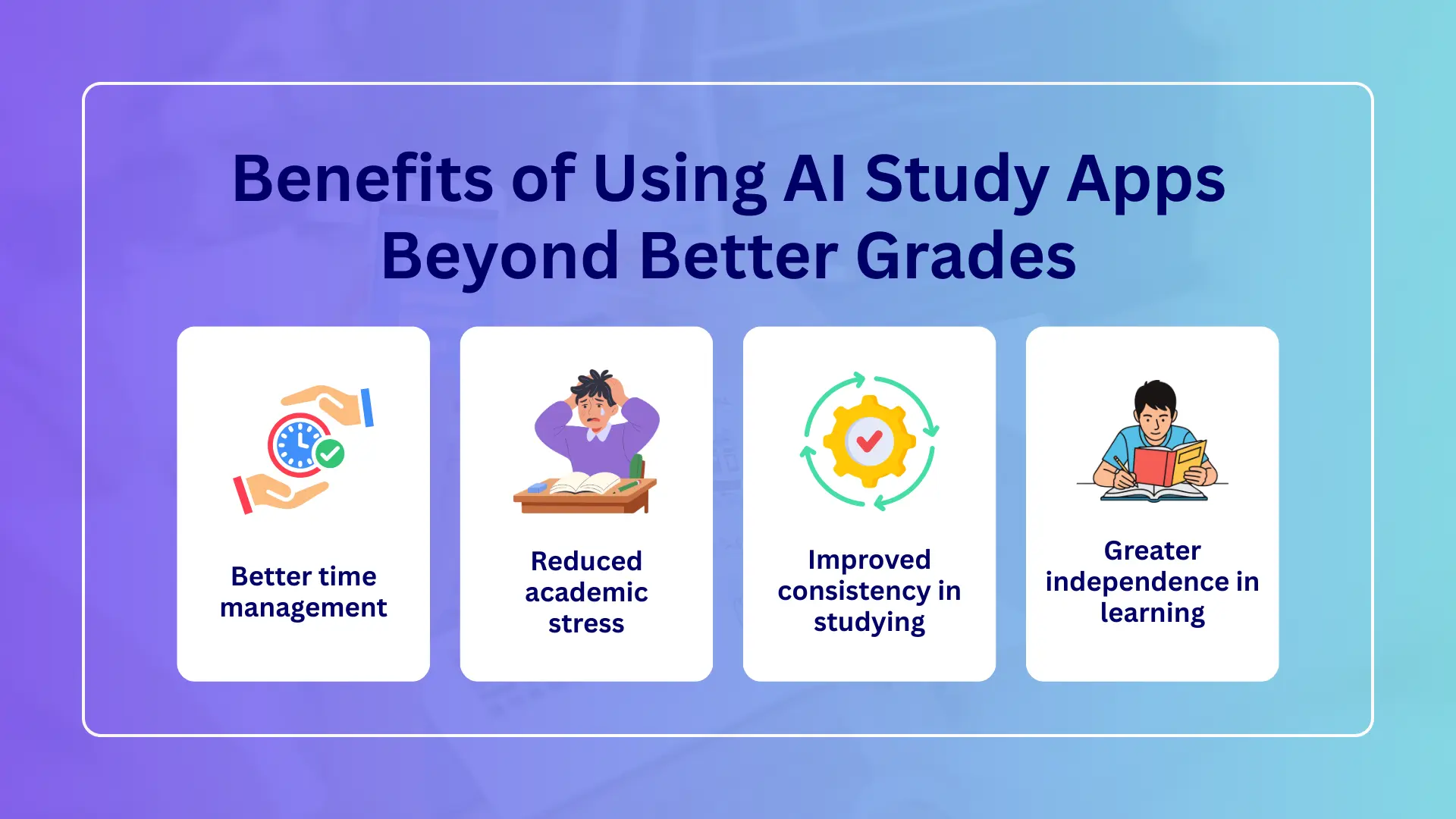
AI tools improve more than just academic scores.
Major benefits include:
-
Better time management
-
Reduced stress
-
Consistent study habits
-
Greater independence
These tools help students develop lifelong learning skills.
Potential Limitations and Ethical Considerations
AI must be used responsibly.
Students should:
-
Avoid using AI for cheating
-
Protect personal data
-
Use AI for guidance—not shortcuts
When used ethically, AI becomes a powerful academic partner.
How PWH Services Builds Intelligent AI-Powered Education Apps
At PWH Services, we specialize in building advanced AI-powered education applications that enhance learning experiences through intelligent design and scalable architecture.
Our expertise includes:
-
Custom AI tutor development
-
Smart content transformation from notes and videos
-
Analytics dashboards for performance tracking
-
Scalable infrastructure for millions of users
-
Enterprise-level security and compliance
We combine AI innovation with mobile app expertise to build next-generation educational platforms.
Explore our services here:
👉 https://pwhservices.tech/
👉 https://pwhservices.tech/app-solutions/
PWH Services helps businesses develop secure, scalable, and student-centric AI applications that redefine modern learning.