 Skip to content
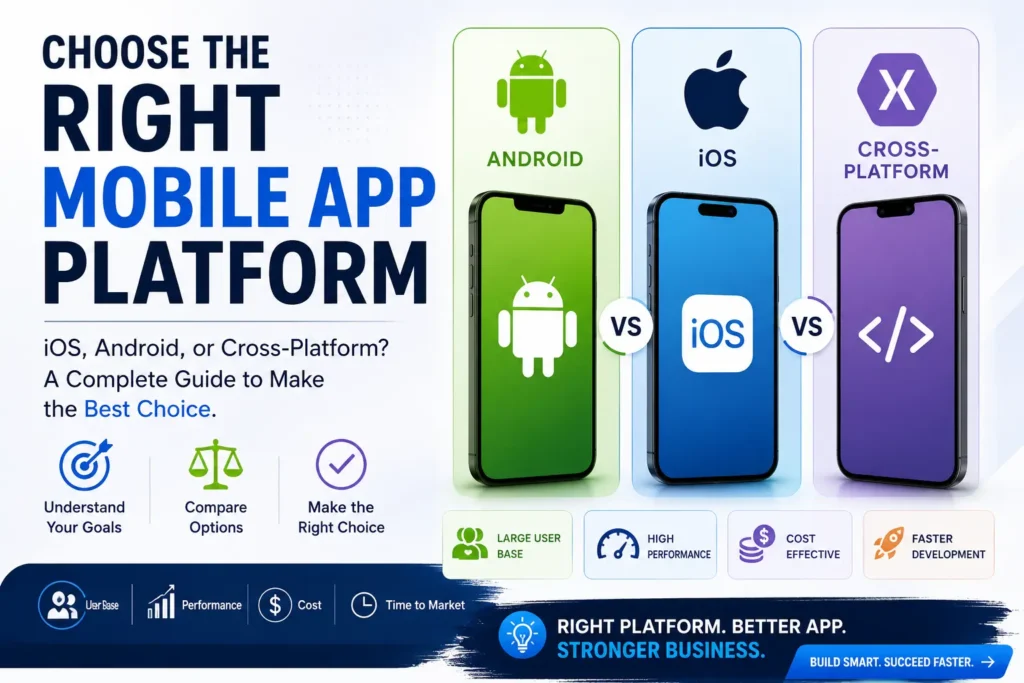
Key Takeaways
Choosing the right mobile app platform requires balancing performance, cost, and market reach to align with your business objectives and technical requirements.
• Cross-platform development cuts costs by 30-40% while delivering near-native performance for most applications • iOS users spend $140 annually on apps versus lower Android spending, but Android reaches 3.9 billion global devices • Native development excels for complex features requiring hardware access, while cross-platform suits MVPs and content-focused apps • Consider your target market demographics: iOS dominates affluent regions, Android leads in emerging markets globally • Validate platform choice through prototyping and user testing before committing development resources
The platform decision isn’t just about technology—it’s about matching your app’s requirements with the right development approach. Whether you choose native iOS, Android, or cross-platform development, success depends on understanding your audience, budget constraints, and long-term scalability needs.

Choosing the right mobile app platform is one of the most critical decisions you’ll make for your app’s success. Whether you’re leaning toward native mobile app development for iOS or Android, or considering cross platform mobile app development, each approach has distinct advantages. In fact, developing one cross-platform app instead of separate native apps can cut development costs by up to 30-40%. The native vs cross-platform mobile app development debate isn’t just about cost, it’s about market reach, performance, and long-term sustainability. We’ll walk you through the key factors to help you make an informed platform choice.
Understanding mobile app platforms: Native vs cross-platform
Before diving into platform selection, understanding the fundamental differences between native and cross-platform approaches is essential. Each development path operates on distinct principles that directly impact your app’s architecture, performance, and market reach.
What is native mobile app development
Native mobile app development means building applications specifically for one operating system using platform-specific programming languages and tools. For iOS, developers write code in Swift or Objective-C, while Android apps are built using Kotlin or Java. This approach allows apps to fully integrate with the device’s hardware and software features, such as the camera, GPS, microphone, and sensors.
The core advantage lies in performance. Native apps are compiled with platform-specific APIs and programming languages, enabling them to run faster and use device resources more efficiently. They also deliver intuitive user experiences because mobile engineers develop them using native SDKs, making the UI look consistent with the platform’s design guidelines. Apps like WhatsApp, Spotify, and Google Maps were built natively to handle heavy traffic loads and access hardware features seamlessly.
However, this approach requires separate development teams with different skill sets for each platform, which adds to both time and cost. Teams must write and maintain two separate apps to support both iOS and Android users, essentially building the product twice.
What is cross-platform mobile app development
Cross-platform mobile app development is the practice of building mobile applications that run on multiple operating systems from a single shared codebase. Instead of writing separate apps for each platform, developers use frameworks like React Native, Flutter, or .NET MAUI to produce one application that works on both iOS and Android.
This approach centers on code reusability. Mobile engineers create a single codebase without needing to write new code for each operating system, accelerating the development process. Teams that adopt cross-platform development consistently report 30-40% lower development costs and significantly faster time to market, because every feature, bug fix, and update only needs to be written once.
Cross-platform frameworks utilize an abstraction layer that translates code into native function calls for the system. React Native uses JavaScript, Flutter operates on Dart, and .NET MAUI employs C# and XAML. Popular apps like Instagram, Skype, Airbnb, and Walmart have successfully leveraged cross-platform frameworks for at least part of their architecture.
Performance concerns that once plagued cross-platform apps have largely been resolved. After major architectural overhauls in both React Native and Flutter, most applications now deliver near-native speed, smooth animations, and efficient resource usage. Both frameworks compile to native code, run animations on the device GPU, and support 120 Hz displays without dropping frames.
Key differences at a glance
The primary distinction lies in the codebase structure. Native development requires separate codebases for each platform, while cross-platform development uses a single codebase shared across multiple platforms. This fundamental difference cascades into several practical implications:
Development resources: Native apps demand two separate teams with platform-specific expertise. Managing large teams of multiple specialists can be challenging, with greater effort required for communication and collaboration. Conversely, cross-platform solutions allow a single team of developers to create sharable code, boosting productivity.
Performance characteristics: Native apps historically offered superior performance, but the gap has narrowed considerably. Cross-platform apps deliver near-native performance for the vast majority of use cases, though they typically have slightly larger file sizes due to additional libraries and runtime environments.
Hardware access: Native apps have direct access to all device-specific hardware capabilities through platform APIs. Cross-platform frameworks now provide access to native features through APIs, plug-ins, and bridges, though not always at the same speeds as native implementations.
Security considerations: Security and privacy are particularly important when building critical mobile apps for business, such as banking and e-commerce applications. Native programming libraries provide developers with tools for creating built-in security features, while cross-platform apps running on web-based technologies may require additional security measures.
If you’re evaluating which approach aligns with your project requirements, explore our comprehensive app solutions to see how we’ve helped businesses navigate these technical decisions. Need guidance on your specific use case? Contact our team for a detailed consultation on native vs cross-platform mobile app development.
iOS vs Android vs cross-platform: Quick comparison
Each mobile app platform brings unique characteristics that affect your development strategy. Understanding these platform-specific differences helps you align technical capabilities with business objectives.
Native iOS development
iOS development centers on Swift 6, Apple’s programming language that introduced improved concurrency handling and safer memory management. Xcode serves as the primary development environment, available exclusively on macOS, and now includes native AI-based code prediction plus full GitHub Copilot support.
The iOS user base represents a financially attractive market. iOS users spend an average of $140 annually on apps in the US, and they account for 68.6% of global consumer app spending despite representing under 30% of users. Subscription-based apps earn 87% more revenue on iOS compared to Android. This spending behavior stems from iOS dominance in affluent regions like North America, Western Europe, and Japan, where market share reaches 58-68%.
The average iPhone lifespan has risen to 5.5 years in 2025, meaning users maintain their devices longer while consistently upgrading to the latest iOS versions. This uniformity simplifies testing, with App Store review times typically ranging from 1-3 days. However, iOS development requires a higher initial investment due to the need for Apple hardware and a $99 annual developer fee.
Native Android development
Android development relies on Kotlin 2.0, which reduces boilerplate code by approximately 40% compared to Java. Android Studio serves as the official IDE with built-in Gemini AI assistance. Kotlin Multiplatform has matured significantly and now allows developers to share business logic between Android and iOS while maintaining native UI performance.
Android holds 71-72% of the global smartphone market share with 3.9 billion active devices, particularly dominating emerging markets in Asia, Africa, and Latin America. This broad reach provides massive user base potential but introduces complexity. Developers must manage device fragmentation across hundreds of manufacturers, multiple screen sizes, various OS versions, and now foldable form factors.
Testing on Android demands significant effort to ensure compatibility across diverse configurations, though Google Play reviews complete within hours to 1 day. Development costs can be lower initially with flexible hardware options and cheaper developer fees, but supporting the wide device range increases testing and maintenance expenses.
Cross-platform development
Modern cross-platform frameworks have closed the performance gap with native apps. React Native now uses the Hermes engine by default, which precompiles JavaScript into bytecode, significantly reducing startup times and memory usage. Flutter holds approximately 46% of the cross-platform market with its Impeller rendering engine enabling smooth 60-120Hz animations.
Developing one cross-platform app instead of separate native apps cuts development costs by 30-40%. Code reusability across platforms eliminates repetitive tasks like API calls, data storage, and analytics implementation. Popular frameworks include React Native (used by Instagram, Skype, Walmart), Flutter (Google Ads, eBay Motors, Alibaba), and .NET MAUI (The World Bank, NBC Sports).
Cross-platform apps typically have larger file sizes due to bundled runtime environments. Developers may also experience delays accessing new OS features until framework updates become available.
Side-by-side comparison table
| Factor | Native iOS | Native Android | Cross-Platform |
|---|---|---|---|
| Languages | Swift, Objective-C | Kotlin, Java | JavaScript, Dart, C# |
| Development Tools | Xcode (macOS only) | Android Studio (cross-OS) | Framework-specific IDEs |
| Global Market Share | ~28% (58-68% in affluent regions) | 71-72% | Reaches both platforms |
| Active Devices | Lower volume, higher value | 3.9 billion devices | Combined reach |
| User Spending | $140/year average (US) | Lower spending per user | Accesses both markets |
| Revenue Advantage | 68.6% of app spending, 87% more subscription revenue | Larger volume, lower per-user value | Balanced approach |
| Development Cost | High (separate team + Apple hardware + $99/year) | Moderate to high (fragmentation increases testing) | 30-40% lower than native |
| Testing Complexity | Low (limited devices) | High (device fragmentation, foldables) | Moderate (single codebase, multi-platform testing) |
| Review Time | 1-3 days | Hours to 1 day | Platform-dependent |
| Performance | Optimal | Optimal | Near-native with modern frameworks |
| Hardware Access | Direct, immediate | Direct, immediate | Available via bridges/plugins |
Understanding these platform characteristics is fundamental, but selecting the right approach requires examining specific factors. If you’re evaluating which mobile app platform aligns with your business goals, explore our app solutions at to see how we’ve helped companies make strategic platform decisions. Need personalized guidance? Contact our team for a consultation tailored to your project requirements.
Key factors to consider when choosing your mobile app platform
Several critical factors determine which mobile app platform aligns with your project goals. Quality, cost, and time shape this decision, but not all organizations can dedicate unlimited resources to app development.
Target audience and market reach
Understanding your intended audience is the foundation of platform selection. In the United States, iOS leads with 55%, outpacing Android’s 45%. iOS dominates wealthier markets like North America, Western Europe, and Australia, where approximately 60% of mobile users opt for Apple devices. Android holds 72% of the global market, particularly in Asia, Africa, and Latin America.
Demographics matter significantly. iPhone users have higher average incomes at $85,000 per year versus $61,000 for Android users. Additionally, 27% of iPhone users hold graduate or PhD degrees compared to 8% of Android users. If 95% of your user base resides in India, investing in native Android apps proves more beneficial since 95% of Indians use Android-based smartphones.
Product complexity and feature requirements
The more complex the app, the more you should lean into native development. Native apps excel at handling complex computations that utilize device features. Developers can use native APIs to direct apps to run UI code on separate processor threads, enabling swift uploads. Simpler apps can leverage cross-platform development without compromising quality.
Budget and development timeline
Cross-platform development saves up to 30% in costs, with most validated builds landing between $80,000 and $200,000. When time is of the essence, cross-platform approaches enable quick programming with close-to-native user experiences. Native development requires lengthy, duplicate development lifecycles for different platforms.
Performance and user experience expectations
Native apps promote higher platform quality, particularly for applications requiring top-notch performance like games or AR/VR experiences. They deliver more seamless user experiences, aligning perfectly with platform-specific features. Cross-platform apps cannot handle ultra-high speeds but support rich media with pleasing UI designs.
Team skills and available resources
Native iOS requires expertise in Swift or Objective-C, while Android demands Kotlin or Java knowledge. Cross-platform frameworks need specific skills—Flutter requires Dart proficiency. If your company targets a broad, diverse audience, native approaches generally require separate developer teams to concurrently build, test, update, and support different app versions. Cross-platform methods allow a single team of web-based developers to create a single, sharable codebase, boosting productivity.
Long-term maintenance and scalability
Native apps are easier to debug and optimize due to access to native APIs and features. However, releasing updates becomes more complex since it involves maintaining two separate codebases. Native development enables better scalability, especially for large-scale projects, as these apps seamlessly grow and shrink as demand requires. Post-production app maintenance balances complexity differently—cross-platform simplifies this with a single codebase.
If you’re weighing these factors for your project, explore our app solutions to see how we’ve helped businesses make strategic platform decisions. Ready to discuss your specific requirements? Contact our team for personalized guidance on native vs cross-platform mobile app development.
When to choose each platform
Selecting the right mobile app platform depends on specific business scenarios and project requirements. Each approach serves distinct use cases that align with different strategic objectives.
Choose iOS first: Best use cases
iOS proves ideal for revenue-focused applications, particularly subscription-based services where iOS generates 87% more revenue than Android. Apps targeting affluent markets in North America, Western Europe, and Japan benefit from iOS users who spend $140 annually on apps. Performance-intensive applications like gaming platforms, AR integration, and real-time processing require native iOS development for optimal control. Startups seeking faster market entry often choose iOS first due to lower device fragmentation and 1-3 days approval times, allowing them to collect data before Android releases.
Choose Android first: Best use cases
Choose Android first if your goal is broad, international reach, especially in emerging markets or global scale. Android’s 72% global market share and 3.9 billion active devices provide massive audience potential across Asia, Africa, and Latin America. The platform suits businesses targeting diverse demographics and those prioritizing market penetration over per-user revenue. Android also enables beta releases accessible to select users before public launch.
Choose cross-platform: Best use cases
Cross-platform development fits MVPs, internal tools, or early-stage products where broad reach matters more than system-specific design. Apps that mostly display content, collect forms, or interact with simple APIs meet these needs with less technical effort. Instagram uses React Native to streamline feature releases and eliminate duplicate engineering. When budget constraints exist or you need simultaneous iOS and Android presence, cross-platform frameworks like Flutter and React Native deliver 30-40% cost savings.
What to avoid with each approach
Avoid cross-platform for apps requiring complex animations, intensive on-device AI processing, or high-compute requirements where native performance is critical. Banking apps and applications handling sensitive data need native development’s built-in security features like file encryption and fraud detection. Conversely, avoid native development when time-to-market is the priority and you need quick user feedback, as native approaches require lengthy, duplicate development lifecycles. Don’t choose iOS-only if your target market is predominantly Android users in developing countries where 95% use Android devices.
Ready to make the right platform choice for your app? Explore our app solutions to see how we’ve guided businesses through native vs cross-platform mobile app development decisions. Contact our team for personalized consultation on ios android cross platform development strategies tailored to your business needs.
Making the final decision: A practical framework
A structured decision framework eliminates guesswork when selecting your mobile app platform. Before committing resources, evaluate talent availability, platform ecosystems, and vendor support requirements.
Questions to ask before committing
Start by assessing your team’s existing skillset. Do you have native developers in-house or need to hire for specific platform expertise? Evaluate whether you prefer convenience within a closed platform like Mendix or flexibility in open ecosystems like React Native. Vendor support matters—75% of enterprise teams require assistance for mobile app development projects.
Creating a platform decision scorecard
Weight each factor according to your priorities. Assign scores for budget constraints, timeline urgency, feature complexity, team capabilities, and target market reach. Compare scores across native iOS, native Android, and cross-platform options to identify your best fit objectively.
Validating your choice with prototypes
Prototyping prevents expensive mistakes before coding begins. Create clickable prototypes to test UX, align stakeholders, pitch investors, and spot logic gaps early. 87% of product managers consider prototyping essential prior to development. Validate with real users through interviews, landing page tests, and MVP releases.
Common mistakes to avoid
Avoid jumping into development without clear strategy or defined goals. Don’t choose platforms based solely on trends rather than long-term suitability. Skipping market research, underestimating timelines, and neglecting proper testing damage user trust. Most critically, don’t assume you know what users want without validation.
Ready to make your platform decision with confidence? Explore our app solutions or contact our team for expert guidance on native mobile app development and cross platform mobile app development strategies.
Conclusion
The mobile app platform you choose directly impacts your project’s success, timeline, and budget. Native development offers superior performance and platform-specific optimization, while cross-platform frameworks deliver 30-40% cost savings with near-native quality. Your decision should align with your target audience, feature complexity, and long-term maintenance capabilities rather than following trends.
We’ve helped dozens of businesses navigate this critical choice. Explore our app solutions to see how strategic platform decisions drive measurable results. Ready to build your app with confidence? Contact our team for personalized guidance on selecting the right development approach for your specific needs.
