 Skip to content
React Native Mobile App Development: Complete 2026 Guide for USA/UK Businesses
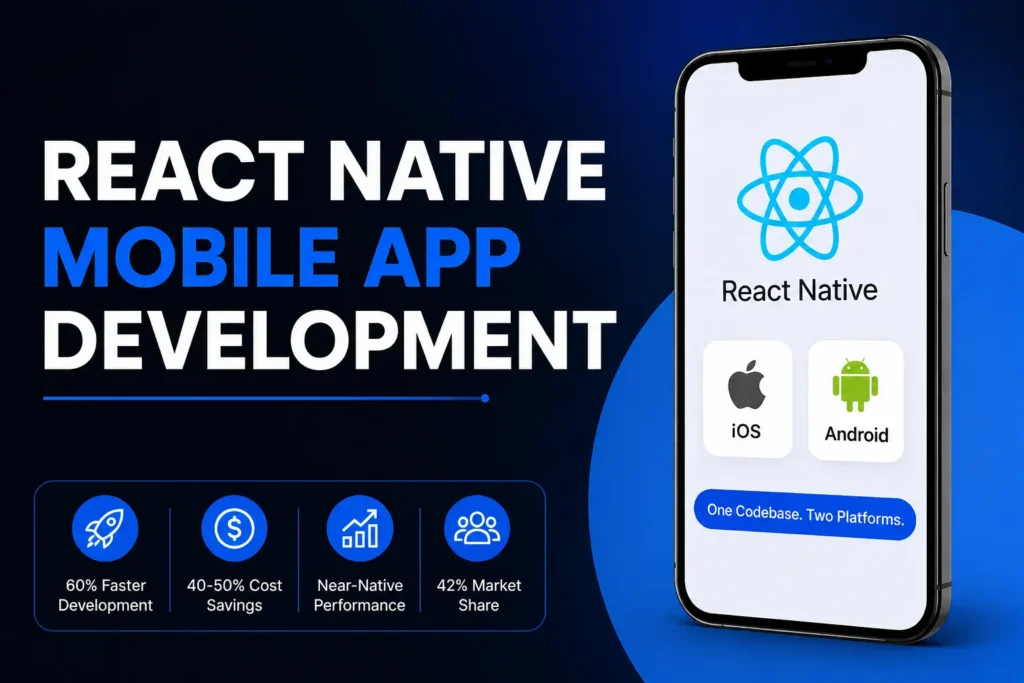
42% of cross-platform mobile apps use React Native. But what is it, and why should YOUR business choose it?
If you’re a startup founder, CTO, entrepreneur, or business owner in the USA or UK, you’ve probably seen terms like React, React Native, Expo, TypeScript, and AI-powered applications everywhere.
The problem is that most resources explain these technologies for developers instead of business decision-makers.
Your business may be facing these challenges:
- Confusion between React and React Native
- Uncertainty about whether React Native is frontend or backend
- No clarity around project costs
- Difficulty choosing the right development company
- Fear of investing in the wrong technology
At PWH Services, we’ve helped businesses build scalable mobile experiences, including productivity solutions like WorkSync, while supporting USA and UK clients with mobile app development, UI/UX design, and web development.
This guide will simplify everything.
You’ll learn React Native basics, 2026 trends, cost breakdowns, ROI expectations, and how to choose the perfect development company.
Bottom line: You’ll know exactly whether React Native mobile app development is the right investment for your business.
What is React Development?
React vs React Native: The Key Difference
Here’s the truth:
React builds websites. React Native builds mobile apps.
React is a JavaScript library for creating web interfaces. React Native uses React principles but builds native iOS and Android applications.
| Feature | React (Web) | React Native (Mobile) |
|---|---|---|
| Purpose | Build websites | Build iOS + Android apps |
| Platform | Web browsers | Mobile devices |
| Output | Web pages | Native mobile apps |
| Components | HTML-based | Native UI components |
| Best For | Web applications | Cross-platform apps |
Both technologies use:
- Components
- JSX
- Props
- State management
Think of React Native as React with superpowers for mobile devices.
Core React Concepts (Simplified)
Components
These are reusable building blocks.
For example:
- Login screen
- Product card
- Navigation menu
JSX
JSX allows developers to write HTML-like code inside JavaScript.
Props
Props pass information between components.
State
State stores information that changes based on user actions.
Virtual DOM
Virtual DOM updates only what changes, making apps extremely fast.
s ReactJS Frontend or Backend?
Direct answer:
ReactJS is frontend technology.
It creates user interfaces.
It does not manage:
- Databases
- Servers
- Authentication systems
For backend development, developers typically use:
- Node.js
- Firebase
- Express.js
Can I Learn React in 2 Months?
Yes.
Typical timelines:
- Beginner basics: 2 months
- Job-ready skills: 3-6 months
- React Native mastery: 4-7 months
The timeline depends on:
- Daily practice
- JavaScript knowledge
- Real projects
Why Choose React Native for Mobile App Development in 2026?
Cross-Platform Development Saves Time
React Native mobile app development uses one codebase for two platforms.
Benefits:
- Build once
- Deploy to iOS
- Deploy to Android
Businesses can reduce development time by 60%.
Near-Native Performance
The 2026 architecture significantly improves speed.
Technologies include:
- TurboModules
- Fabric
- JavaScript Interface (JSI)
Performance reaches approximately 95% of native apps.
Cost Savings
Traditional native development requires:
- One iOS team
- One Android team
React Native only needs one team.
Businesses often save 40%-50%.
Community Support
The ecosystem continues to grow.
2026 statistics:
- 42% market share
- 2 million developers
- Thousands of libraries
The reality:
Hiring JavaScript developers is easier than hiring specialized native developers.
React Native vs Flutter: Which is Better in 2026?
| Feature | React Native | Flutter |
|---|---|---|
| Language | JavaScript | Dart |
| Learning Curve | Easy | Medium |
| Performance | 95% | 97% |
| Speed | 60% faster than native | 55% faster |
| Codebase | Single | Single |
| UI Components | Native | Custom |
| Community | 2M+ | 1M+ |
| Market Share | 42% | 35% |
| Cost | $5k-$50k | $6k-$60k |
| Updates | AI, Expo, New Arch | Material 3 |
| Best For | Web teams | Android focus |
Winner for USA and UK businesses: React Native.
Why?
JavaScript developers are easier to hire.
When NOT to Use React Native
Avoid React Native for:
❌ Complex 3D games
❌ Heavy GPU processing
❌ Hardware-intensive applications
Use React Native for:
✅ E-commerce
✅ Employee management
✅ SaaS platforms
✅ Healthcare apps
✅ Fintech apps
✅ Educational apps
For 90% of business apps, React Native is an excellent choice.
Top React Native Trends for 2026 (What’s New?)
New Architecture
React Native trends 2026 new architecture includes:
TurboModules
Faster communication with native modules.
Fabric
Modern rendering engine.
JSI
Direct JavaScript and C++ communication.
Result:
30% performance improvements.
AI Integration
AI is becoming standard.
Businesses can add:
- Voice assistants
- Smart recommendations
- Image recognition
- Chatbots
React Native now integrates with TensorFlow.js and AI APIs.
Expo Framework
Expo simplifies development.
Benefits:
- Over-the-Air updates
- Easier deployments
- Faster testing
Businesses no longer wait for app store approvals for every minor update.
TypeScript Adoption
By 2026, 70% of projects use TypeScript.
Benefits:
- Fewer bugs
- Cleaner code
- Better scalability
Serverless Applications
Popular integrations:
- AWS Lambda
- Firebase
Benefits:
- Lower infrastructure costs
- Automatic scaling
- Faster deployment
How to Start React Native Development: Step-by-Step Guide (2026)
Step 1: Install Build Tools
Open your terminal.
Run:
- npm create vite@latest
- Name project
- npm install
- npm run dev
Step 2: Choose Your Environment
Install:
- Visual Studio Code
- Node.js
- Android Studio
- Xcode
Step 3: Learn Core Concepts
Recommended resources:
- React documentation
- W3Schools
- roadmap.sh
- freeCodeCamp
Step 4: Build a Small Project
Start with:
- Calculator
- To-do list
- Notes app
Then add:
- State
- Components
- Navigation
Step 5: Hire Experts
If you’re a business owner, don’t spend six months learning development.
Instead, partner with professionals.
React Native App Development Cost for USA/UK Businesses (2026)
Cost Breakdown
| Project Type | Cost | Timeline | Features |
| Simple | $5k-$15k | 2-3 months | Login, basic screens |
| Medium | $15k-$35k | 3-5 months | Payments, APIs |
| Complex | $35k-$50k | 5-8 months | AI, advanced features |
| Enterprise | $50k-$100k+ | 8-12 months | Multi-user systems |
What Affects Cost?
Five major factors:
- Number of screens
- API integrations
- UI/UX complexity
- Backend infrastructure
- Team location
ROI Calculator Example
Example:
E-commerce company.
Investment:
$25,000
Result:
- $10,000 additional monthly revenue
- Break-even in 3 months
- Year one profit: $95,000
Bottom line: Mobile apps become revenue-generating assets.
How to Choose the Right React Native Development Company: 7-Point Checklist
The 7-Point Checklist
1. Relevant Experience
Ask:
Have they built similar apps?
2. Strong Technology Stack
Look for:
- React Native
- TypeScript
- Expo
- Firebase
3. UI/UX Expertise
Great apps aren’t just functional.
They are enjoyable to use.
4. USA/UK Portfolio
Verify:
- Client testimonials
- Compliance knowledge
- Communication processes
5. Post-Launch Support
Expect:
- Bug fixes
- Security updates
- Performance optimization
6. Transparent Pricing
Avoid hidden fees.
Demand milestone-based pricing.
7. Strong Communication
Look for:
- Weekly updates
- Agile methodology
- Dedicated project managers
Why PWH Services is Different
PWH Services combines three disciplines under one team:
- Mobile app development
- Web development
- UI/UX design
Advantages:
✅ 50+ completed projects
✅ USA & UK client experience
✅ Transparent communication
✅ 12-month support
Learn more:
Explore mobile solutions:
https://pwhservices.tech/app-solutions
Contact the team:
https://pwhservices.tech/contact-us/
Get Started with React Native Development Today
Ready to build your app?
PWH Services helps USA and UK businesses launch modern applications with:
✅ 60% faster development
✅ 40-50% cost savings
✅ 50+ completed projects
✅ 12-month support
What You Get
- Free consultation
- Project roadmap
- Transparent pricing
- Dedicated support
Explore services:
https://pwhservices.tech/app-solutions
Become a partner:
https://pwhservices.tech/partner/
Book a call: https://calendly.com/pwhservices-tech/30min
Your app idea deserves a strategic partner, not just a developer.
Frequently Asked Questions About React Native Development
What is React Native mobile app development?
It is a JavaScript-based approach to building iOS and Android apps from one codebase.
React Native vs React: What’s different?
React builds websites. React Native builds mobile applications.
How much does React Native cost?
Projects range from $5,000 to $100,000+.
Is React Native better than Flutter?
For USA and UK businesses, yes. JavaScript talent is easier to find.
Can I build both iOS and Android apps?
Yes. One codebase supports both.
What are 2026 trends?
AI, Expo, TypeScript, TurboModules, Fabric, and serverless systems.
How do I choose a development company?
Use the 7-point checklist discussed earlier.
Is React Native worth it?
Yes. Faster development and lower costs deliver strong ROI.
