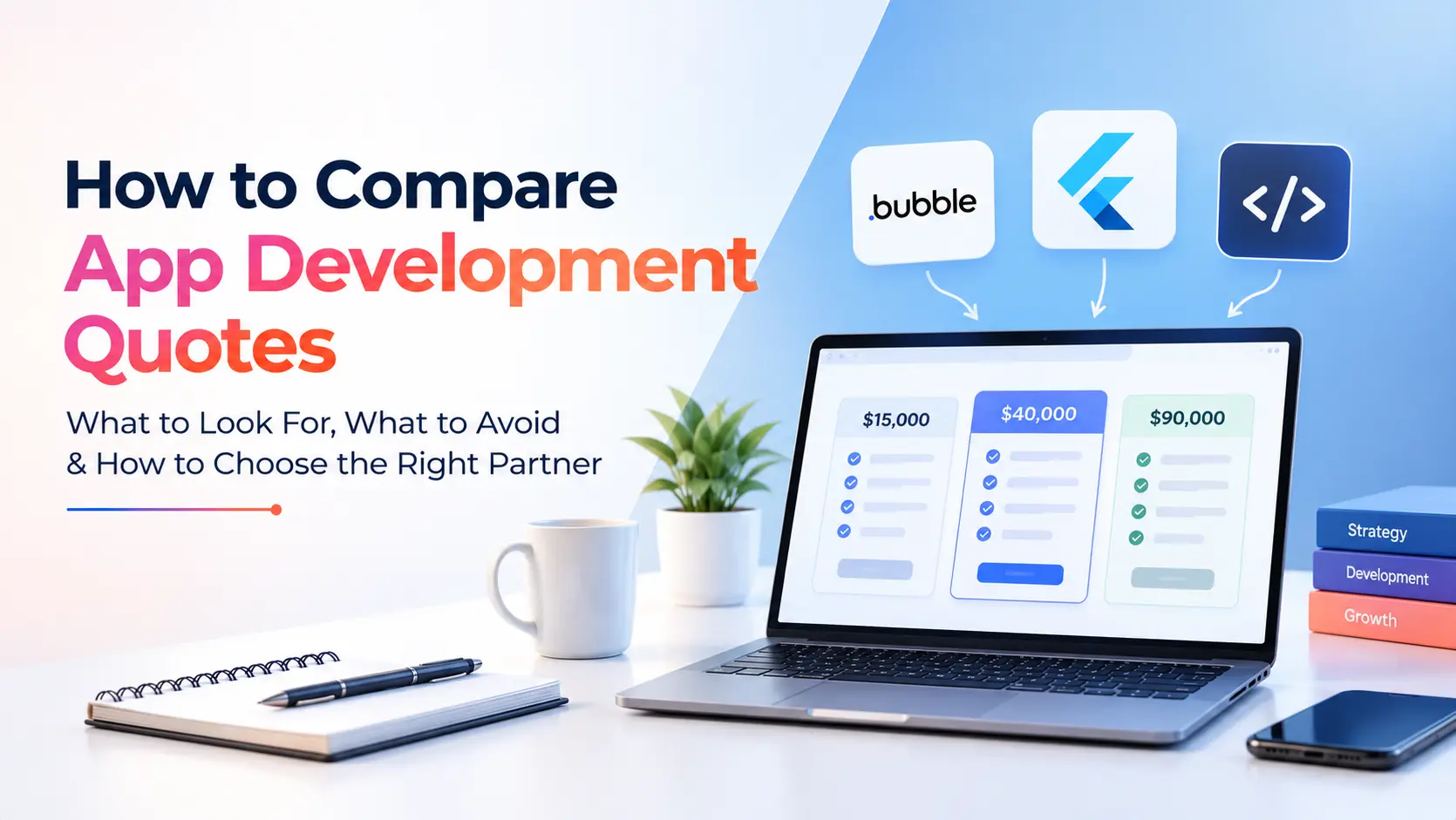
You asked three agencies to price the same app. One came back at $15,000, one at $40,000, and one at $90,000. They can’t all be right, and the cheapest one isn’t automatically the bargain.
An app development quote is only as useful as what it actually includes. This guide from PWH Services shows you what a good quote should contain, how to compare offers line by line, which pricing model fits your project, and the red flags that tell you to walk away before you sign.
In this guide:
- The Short Answer
- Why app development quotes vary so much
- What a good app development quote should include
- Example: three quotes for the same app
- Fixed price vs hourly vs dedicated team
- Questions to ask before you sign
- Red flags in an app development quote
- When the cheapest quote is the right one
- FAQs
The Short Answer
Never compare quotes by the final number alone. Line them up feature by feature and check what each one includes and excludes: platforms, design, admin panel, testing, post-launch support, timeline, payment schedule, and who owns the code and app store accounts. Most price gaps come from different assumptions about scope, not from one agency being honest and another being greedy.
A trustworthy quote is itemized, lists exclusions clearly, ties payments to milestones you approve, and confirms that you own the code from day one. If a quote can’t answer those points in writing, its price doesn’t mean much yet.
Why App Development Quotes Vary So Much
Two agencies can read the same one-page brief and imagine two very different apps. One prices a basic MVP with a single platform and no admin panel. Another prices a production app for iOS and Android with a dashboard, push notifications, analytics, and three months of support.
The most common reasons quotes differ:
- Scope assumptions. A vague brief invites very different interpretations.
- Platforms. iOS only, Android only, both, or web as well.
- Design depth. A ready-made UI kit versus custom UX research and prototypes.
- Backend and admin panel. Many low quotes leave these out entirely.
- Testing and QA. Dedicated testing time is often the first thing cut.
- Team location and seniority. Rates vary widely by region and experience.
- Support after launch. Bug fixes, OS updates, and store resubmissions cost time.
The fix starts before you request quotes: send every agency the same written scope, so you’re comparing like with like.
What a Good App Development Quote Should Include
Use this as your checklist. If a quote is missing something, ask about it before you compare prices.
| Item | What to look for | If it’s missing |
|---|---|---|
| Feature list | Every screen and feature named, ideally with user roles | You can’t tell what you’re paying for |
| Platforms | iOS, Android, web, or a cross-platform framework like Flutter | Second platform may be billed later |
| Design | Number of screens, revision rounds, prototype or not | Design often becomes an extra invoice |
| Backend and admin panel | Database, APIs, and an admin dashboard | Common hidden cost in low quotes |
| Third-party integrations | Payments, maps, login, analytics, named one by one | “Integrations” alone is too vague |
| Testing and QA | Testing on real devices for both platforms | Bugs surface after launch, at your cost |
| Timeline and milestones | Phases with dates and deliverables | No way to track progress |
| Payment schedule | Payments tied to approved milestones | Large upfront payments raise your risk |
| Post-launch support | What’s covered and for how long | Every fix becomes a new quote |
| Ownership | Code, repository, app store accounts, hosting, domain, and third-party services such as Firebase and payment gateways in your name | You may not fully own your product |
| Exclusions and assumptions | A clear list of what’s not included | Surprises appear mid-project |
| Change requests | How new features are scoped and priced | Scope changes get expensive and messy |
Example: Three Quotes for the Same App
Here is an illustrative example of how three quotes for one booking app can look completely different once you line them up. The numbers are typical market ranges, not real proposals.
| Quote A: $15,000 | Quote B: $40,000 | Quote C: $90,000 | |
|---|---|---|---|
| Platforms | Android only | iOS and Android with Flutter | Separate native iOS and Android apps |
| Design | Template UI | Custom UI, two revision rounds | Custom UX research, prototypes, design system |
| Admin panel | Not included | Basic dashboard | Advanced dashboard with reports |
| Testing | “Included,” no detail | Device testing for both platforms | Dedicated QA team and automated tests |
| Timeline | 6 weeks, no milestones | 12 weeks, four milestones | 20 weeks, six milestones |
| Payments | 50% upfront | Per approved milestone | Monthly |
| Support | None | 60 days of bug fixes | 6 months, plus a maintenance plan |
| Code ownership | Not mentioned | Transferred to client | Transferred to client |
Quote A isn’t necessarily a scam, and Quote C isn’t necessarily overpriced. They simply describe three different projects. Once you know which one matches what you actually need, the right choice gets much clearer. Quote A’s real cost may rise once you add iOS, an admin panel, and testing.
Already holding a few quotes? Send us your scope or the quotes you received, and we’ll give you an itemized fixed quote within 24 hours so you can compare like with like. Get a second quote.
Fixed Price vs Hourly vs Dedicated Team
The pricing model matters as much as the number. Each one suits a different kind of project.
| Fixed price | Hourly (time and materials) | Dedicated team | |
|---|---|---|---|
| Best for | A clearly defined build, such as an MVP | Projects where scope will change often | Ongoing development and scaling |
| Budget certainty | High | Low to medium | Predictable monthly cost |
| Flexibility | Changes need a new estimate | Very flexible | Very flexible |
| Your effort | Low once scope is agreed | High, you track hours | Medium, you set priorities |
| Main risk | Weak scope leads to change requests | Costs can drift | Paying for capacity you don’t use |
For a first version with a clear feature list, a fixed price with milestone payments gives most founders the best balance of certainty and control. For ongoing work after launch, a dedicated setup often makes more sense. Our guides on how to hire dedicated Flutter developers, WordPress developers, and Laravel developers cover that model in detail.
Questions to Ask Before You Sign
Send these to every agency on your shortlist and compare the answers side by side:
- Can you break this quote down by feature and phase?
- What exactly is excluded, and what would each exclusion cost?
- Which platforms and devices will you test on?
- Who specifically will work on my project, and at what seniority?
- How are payments tied to milestones, and what do I approve at each one?
- What happens if the project runs late, or if I want to change a feature?
- What support is included after launch, and for how long?
- Will the code, repository, and app store accounts be in my name from the start?
A good agency answers these quickly and in writing. Hesitation on ownership or payment terms is worth more attention than the price itself.
Red Flags in an App Development Quote
- A single total with no breakdown. You can’t compare or negotiate what you can’t see.
- “Everything included” without a list. If it isn’t written down, it isn’t promised.
- Large upfront payments. More than about a third upfront, with no milestone tied to it, shifts most of the risk to you.
- No mention of testing or support. Both cost real time, so silence usually means they’re missing.
- Guaranteed launch dates or app store approval. Nobody controls Apple’s or Google’s review process.
- Unclear ownership. Your code, repository, and developer accounts should belong to you. Both Apple and Google let you hold your own developer accounts and invite agencies as team members.
- A price far below every other quote with the same scope. Ask what was left out before you celebrate.
When the Cheapest Quote Is the Right One
Here is the honest part. The lowest quote isn’t always a trap.
Choose it, with confidence, when:
- You’ve confirmed line by line that the scope matches the other quotes.
- The team shows relevant past work and clear references.
- Payments are tied to milestones, so your risk stays small.
- You’re building a simple first version to test demand, not a complex product.
A lower price can simply reflect a different location, a leaner process, or reusable components. The goal isn’t to pay more. It’s to pay for exactly what you need, with no surprises later. If you’re still testing an idea, a no-code or AI-built prototype may be enough for now, and our guide on how to migrate from Bubble explains when it’s time to move to custom development.
Get a Second App Development Quote in 24 Hours
At PWH Services, every quote is itemized by feature and phase, lists what’s not included, and ties payments to milestones you approve. You own the code and the app store accounts from day one. Send us your scope or the quotes you already have, and we’ll return a fixed quote within 24 hours, even if it only helps you negotiate with someone else.
- See our mobile app development services
- Request a fixed quote
- Book a 30-minute call
- Agency or consultant? Join our partner program.
Frequently Asked Questions
What should an app development quote include?
A good quote lists every feature and screen, the platforms, design scope, backend and admin panel, integrations, testing, a timeline with milestones, a payment schedule, post-launch support, exclusions, and confirmation that you own the code and accounts.
Why do app development quotes vary so much?
Mostly because each agency makes different assumptions about scope, platforms, design depth, testing, and support. Sending every agency the same written scope is the fastest way to make quotes comparable.
How many app development quotes should I get?
Three is usually enough. Fewer makes it hard to spot outliers, and many more takes time without adding much clarity.
Is a fixed-price app development quote better than hourly?
For a clearly defined first version, a fixed price with milestone payments usually gives better budget certainty. Hourly billing suits projects where the scope will change often and you can track progress closely.
How much upfront payment is normal for app development?
Many agencies ask for a deposit at the start, but the safest arrangements tie most payments to milestones you approve. Be cautious when a large share of the total is due before any work is delivered.
Should I always choose the cheapest app development quote?
No, but don’t rule it out. If the scope, references, and payment terms match the other quotes, a lower price can be the right choice. If it’s much lower for the same scope, ask what was left out.
Can I get a second opinion on a quote I already received?
Yes. Share the scope or the quote with another agency and ask for an itemized estimate for the same features. It’s one of the quickest ways to check whether a price is fair.
Written by the PWH Services team, who design and build mobile apps, websites and AI products for startups and growing businesses.