 Skip to content
Meditation App Development: The Wild Sound Case Study
Most apps are fighting for your attention. Wild Sound was built to give it back.
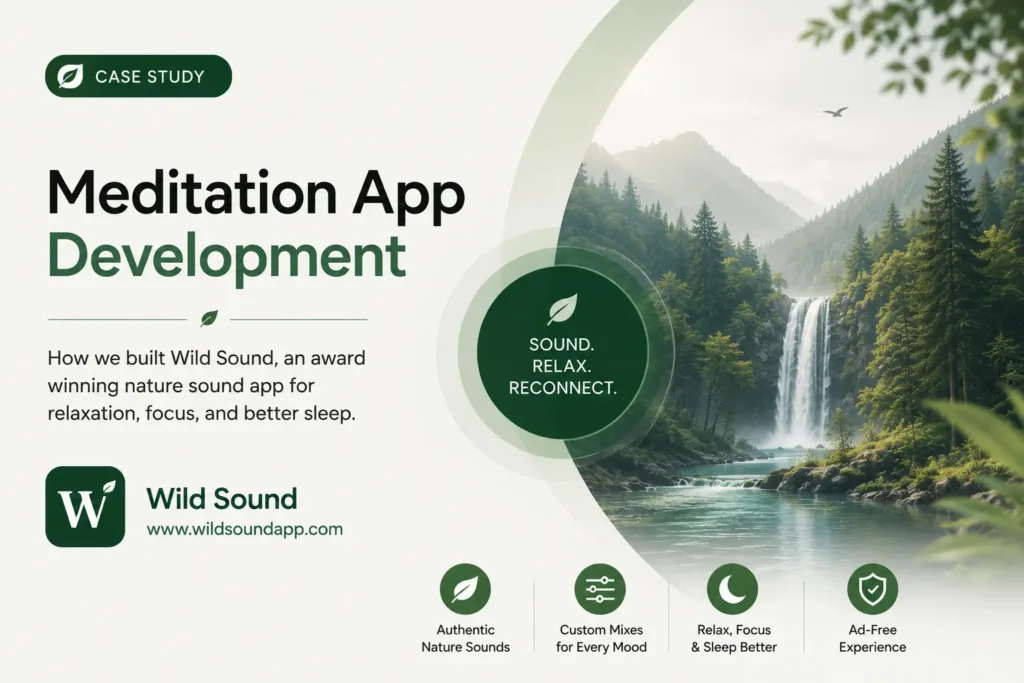
In a world of endless notifications and noise, the idea was almost stubbornly simple: what if an app’s only job was to help someone feel calm for a few minutes, nothing more, nothing louder. That’s the entire premise behind Wild Sound, a mobile app we built at PWH Services, and it’s become one of our favorite real-world examples of Meditation App Development done with real restraint, doing one thing beautifully instead of doing many things adequately.
Here’s how it came together, what made it genuinely difficult to build, and what it taught us about designing for calm instead of engagement.
The Idea Behind Wild Sound
Wild Sound is built around a simple, honest premise. The world is loud, fast, and full of notifications, and a lot of people just want a way to step out of that for a few minutes. The app connects users to real, authentic soundscapes from rivers, rainforests, and natural environments around the world, giving them a space to relax, focus, or fall asleep without ads, without clutter, and without anything competing for their attention.
What makes Wild Sound stand out further is its conservation angle. Every user supports real-world environmental preservation through partner NGOs, so listening to the sound of a specific river or rainforest is tied to actually helping protect it. The app went on to be recognized as the 2024 FlutterFlow App of the Year, a genuine reflection of both its design quality and the strength of the idea itself.
What the Project Actually Needed to Deliver
Before writing a single line of code, the goals were clear:
- A mobile app that genuinely promotes relaxation, mindfulness, and focus through sound, not just another app that claims to
- A minimal, intuitive interface with nothing distracting the user from the actual experience
- The ability for users to customize and mix soundscapes to match their own mood or routine
- A completely ad-free experience, smooth and consistent across both Android and iOS
That last point mattered more than it might seem. A relaxation app that interrupts itself with an ad isn’t a relaxation app anymore. Every design and technical decision had to protect that uninterrupted experience.
Where It Actually Got Difficult
Building a calm-feeling app sounds simple. Building one that stays calm under real technical constraints is a different problem entirely, and this is where most of our actual engineering effort went.
Sound layering and playback quality. Wild Sound lets users mix multiple ambient sounds together, rain with distant wind, ocean waves with soft melodies, and getting that layered playback to sound genuinely smooth and natural, rather than glitchy or robotic, took real audio engineering work, not just dropping in some sound files.
Performance with high-quality audio. Rich, immersive natural audio means larger files and more processing, and a relaxation app that lags, stutters, or drains a phone’s battery quickly defeats its own purpose. We had to keep the app lightweight and responsive while still preserving genuine audio quality, which is a real balancing act, not a given.
Designing calm, not just “clean.” There’s a difference between a minimal interface and one that actually feels peaceful to use. Soft tones, simple icons, and intuitive controls all had to work together so the interface itself contributed to the feeling of relaxation, rather than just getting out of the way.
How We Approached It
Research and discovery. We looked closely at what already existed in the mindfulness and ambient sound space, not to copy it, but to understand what genuinely helps people relax versus what just looks like it should. Early user feedback consistently pointed to the same three things: personalization, simplicity, and an experience with zero interruptions.
Information architecture. Rather than building out a sprawling menu of features, we structured the entire app around three core actions: Listen, Mix, and Relax. That’s it. Every user flow was designed so someone could open the app and be listening to something calming within seconds, not hunting through settings first.
Design and development. We built Wild Sound with Flutter for smooth, consistent performance across both iOS and Android from a single codebase, and used Supabase for efficient backend management and data handling. The sound library itself was curated carefully, rain, ocean waves, forest winds, gentle melodies, and paired with a UI/UX design built around soft tones and minimal visual noise, so the interface never competes with the audio experience it’s supporting.
What Wild Sound Actually Delivers
- A genuinely calming, emotionally resonant app that brings the feeling of being in nature into a few taps on a phone
- A curated library of natural and ambient soundscapes users can explore and personalize
- Full mixing and customization, so the experience matches the user’s actual mood, not a fixed playlist
- A completely clean, ad-free, distraction-free listening experience
- Smooth, stable, high-quality playback across both Android and iOS
What Users Actually Say
“Wild Sound is my go-to app for relaxation. The soundscapes are beautiful and the interface is so calming.”
“I use Wild Sound every night to help me sleep. The rain and ocean waves are incredibly soothing.”
That kind of feedback is exactly what the project set out to earn, not just downloads, but a genuine place in someone’s nightly routine.
What Wild Sound Teaches About Meditation App Development
A few things became clear working on this project that apply to almost any relaxation, meditation, or sound-based app, not just this one.
| Generic Wellness App Approach | What Actually Works (Wild Sound Approach) |
|---|---|
| Packed with features and settings | Built around 2–3 core actions users can find instantly |
| Stock or generic sound libraries | Curated, high-quality, authentic soundscapes |
| Ad-supported, interrupts the experience | Fully ad-free, protects the emotional experience |
| Bright, busy visual design | Soft, minimal design that reinforces calm |
| One-size-fits-all playlists | Real mixing and personalization to match mood |
The pattern is consistent: restraint is a feature. Every choice we made on Wild Sound was in service of removing friction and noise, not adding capability for its own sake, and that discipline is exactly what made the final product feel genuinely different from a typical app in this category.
Thinking About Building Something Similar?
If you’re building a wellness, meditation, mindfulness, or sound-based app, the lessons from Wild Sound apply directly: get the core experience right before adding features, protect it from anything that interrupts it, and invest in the audio and interaction details that most teams skip. That’s exactly the kind of Meditation App Development and UI/UX design work we specialize in at PWH Services.
👉 Get your free quote here, or book a free 30-minute call to talk through your app idea directly.
If you’re an agency, designer, or wellness brand looking to collaborate on a project like this, our partner program is worth a look.
FAQs
What technology was Wild Sound built with?
Wild Sound was built with Flutter for smooth, consistent performance across both iOS and Android, with Supabase handling backend management and data.
What makes a meditation or relaxation app successful?
Based on building Wild Sound, the strongest factor is restraint, a focused set of core actions, curated high-quality content, zero ads or interruptions, and a minimal interface that reinforces the calm the app is trying to create, rather than working against it.
How long does it typically take to build an app like Wild Sound?
A focused wellness or sound app MVP with core listening, mixing, and personalization features typically takes 10 to 16 weeks, depending on the depth of the audio library and customization features involved.
Why is cross-platform development like Flutter a good fit for wellness apps?
Flutter allows a single codebase to deliver a consistent, smooth experience on both iOS and Android, which matters especially for audio-based apps where playback reliability and performance need to feel identical across devices.
Can an app like this be built without ads and still be viable?
Yes. Wild Sound is fully ad-free by design, since interruptions directly undermine a relaxation app’s core value. Sustainable models for this kind of app typically rely on subscriptions, one-time purchases, or, as with Wild Sound, a mission-driven angle like conservation partnerships.
What was the biggest technical challenge in building Wild Sound?
Achieving smooth, natural-sounding audio layering when users mix multiple soundscapes together, while keeping the app lightweight and responsive despite handling high-quality audio files.
