 Skip to content
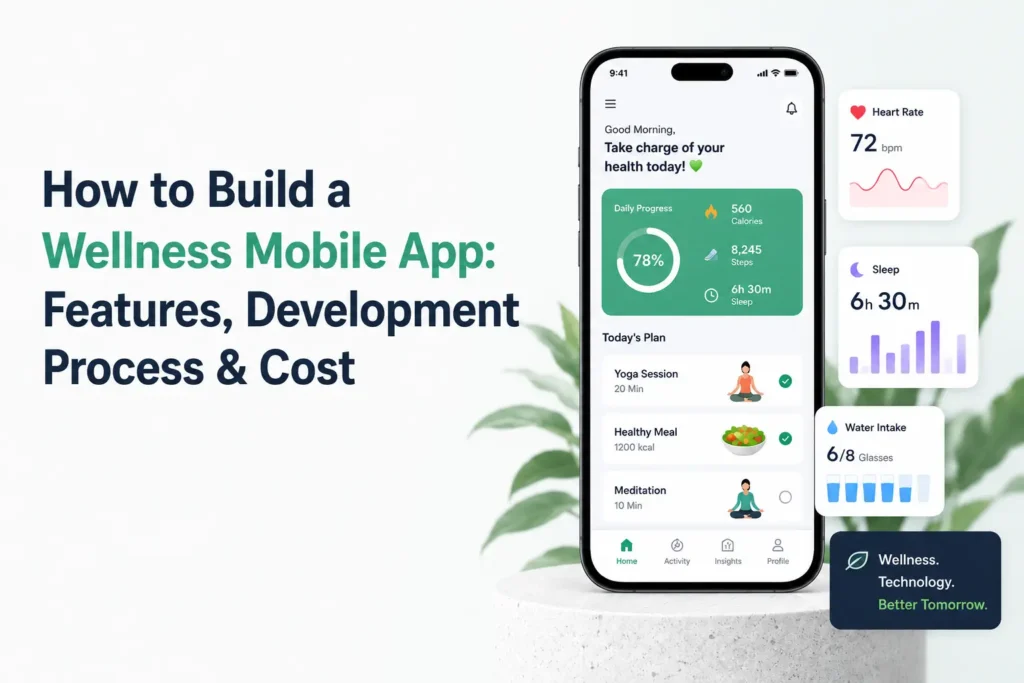
How to Build a Wellness Mobile App: Features, Development Process & Cost
Key Takeaways
- The global demand for wellness mobile apps continues to grow as users prioritize healthier lifestyles and personalized digital experiences.
- Building a successful wellness app starts with solving a real user problem—not simply adding features.
- A scalable wellness application requires thoughtful planning, intuitive UI/UX, secure architecture, AI-powered personalization, and seamless integrations.
- Businesses that invest in user-first wellness solutions can create long-term customer relationships and recurring revenue opportunities.
- Partnering with an experienced development company can significantly reduce technical risks and accelerate your product’s journey from idea to launch.
The wellness industry has undergone a remarkable digital transformation over the past few years. What once relied heavily on in-person coaching, fitness centers, nutritionists, and wellness clinics has evolved into an always-accessible digital experience powered by smartphones and wearable technology.
Today, millions of people use wellness mobile apps to improve their physical fitness, monitor sleep, manage stress, build healthier habits, practice mindfulness, and receive personalized health recommendations—all from the palm of their hand.
For businesses and startups, this growing demand presents a valuable opportunity. Consumers are no longer looking for generic health applications—they expect intelligent, personalized, and engaging experiences that genuinely help them achieve their wellness goals.
If you’re considering launching your own wellness application, understanding the complete development process is essential. Building a successful app involves much more than writing code. It requires market research, strategic planning, intuitive design, secure architecture, scalable infrastructure, and continuous product improvement.
In this article, you’ll learn how to build a wellness mobile app, the features users expect, the development process, cost factors, common mistakes to avoid, and the best practices for creating a product that delivers long-term value for both users and businesses.
If you’re new to digital wellness, we also recommend reading our article on Wellness Mobile Apps, which explains why these applications are transforming health and everyday life before diving into the development process.
Why Are Businesses Investing in Wellness Mobile Apps?
The digital wellness market continues to expand because consumer expectations are changing. People increasingly want convenient, personalized, and technology-driven solutions that help them live healthier lives without disrupting their daily routines.
This shift has encouraged businesses across multiple industries—including healthcare, fitness, insurance, education, corporate wellness, and nutrition—to invest in wellness mobile applications that create meaningful digital experiences.
Several factors are driving this rapid growth.
Growing Consumer Awareness
People are becoming more proactive about their health than ever before. Rather than waiting until problems arise, users now seek tools that help them improve fitness, reduce stress, sleep better, and maintain healthier lifestyles.
Wellness apps provide this support by making health management more accessible and personalized.
The Rise of Personalized Experiences
Modern users expect applications to adapt to their individual goals and preferences.
Instead of providing identical recommendations to every user, successful wellness apps deliver personalized experiences based on:
- Lifestyle habits
- Activity levels
- Fitness goals
- Sleep patterns
- Nutrition preferences
- Daily routines
- Progress history
Artificial Intelligence has further enhanced personalization by analyzing user behavior and providing recommendations that evolve over time.
Increased Adoption of Wearable Technology
Smartwatches and wearable fitness devices have become part of everyday life for millions of users.
By integrating with these devices, wellness apps can automatically collect valuable health data, including:
- Daily activity
- Heart rate
- Calories burned
- Sleep quality
- Workout sessions
- Recovery metrics
This real-time information creates a more engaging and data-driven user experience.
Subscription-Based Business Models
One reason wellness apps continue attracting investors is their ability to generate recurring revenue.
Rather than relying solely on one-time purchases, many businesses successfully monetize their applications through:
- Monthly subscriptions
- Premium memberships
- Personalized coaching
- Digital wellness programs
- Online consultations
- In-app purchases
This recurring revenue model provides long-term business sustainability while continuously delivering value to users.
What Is a Wellness Mobile App?
A wellness mobile app is a digital application designed to help individuals improve their overall well-being through technology-driven tools, personalized guidance, and health-focused experiences.
Unlike traditional healthcare applications that primarily focus on treating medical conditions, wellness apps emphasize prevention, healthy habits, and lifestyle improvement.
Depending on their purpose, wellness applications may include features related to:
- Fitness tracking
- Nutrition planning
- Mental wellness
- Meditation
- Sleep improvement
- Habit formation
- Hydration reminders
- Stress management
- Corporate wellness
- Women’s wellness
- Chronic condition support
Many modern wellness applications combine several of these capabilities into a single platform, giving users a more comprehensive wellness experience.
Step 1: Identify the Problem Your Wellness App Will Solve
One of the biggest mistakes businesses make is starting development before validating the problem they’re trying to solve.
Technology alone doesn’t create successful products—solving meaningful user problems does.
Before designing screens or selecting a technology stack, ask yourself:
- Who is your target audience?
- What wellness challenge are they facing?
- What solutions are currently available?
- Where do existing applications fall short?
- How will your app provide a better experience?
Answering these questions early helps create a product with a clear value proposition rather than another generic wellness application.
For example:
| User Problem | Possible Wellness App Solution |
|---|---|
| Difficulty maintaining workout consistency | Personalized fitness plans with reminders and progress tracking |
| High daily stress levels | Guided meditation, breathing exercises, and mood tracking |
| Poor sleep habits | Sleep monitoring with personalized recommendations |
| Unhealthy eating patterns | AI-powered meal planning and nutrition tracking |
| Lack of daily motivation | Habit tracking, goal setting, rewards, and progress visualization |
The stronger your understanding of user pain points, the more valuable your application becomes.
Step 2: Research the Market Before Development
Before investing in development, study the existing wellness app market.
Competitor research isn’t about copying successful products—it’s about identifying opportunities to build something better.
When analyzing competitors, pay attention to:
User Reviews
App store reviews often reveal recurring frustrations that businesses can address through improved design and functionality.
Look for comments about:
- Poor navigation
- Missing features
- Performance issues
- Expensive subscriptions
- Inaccurate tracking
- Limited personalization
These complaints represent opportunities to differentiate your product.
Feature Comparison
Create a list of features offered by leading wellness apps and identify gaps that your application could fill.
Ask questions such as:
- Which features appear in every successful app?
- Which features users repeatedly request?
- What unique value can your application provide?
- Which technologies are competitors not fully utilizing?
This analysis helps prioritize features that deliver genuine value instead of simply increasing development costs.
Understand Your Target Audience
Every successful wellness app is built for a clearly defined audience.
Examples include:
- Fitness enthusiasts
- Busy professionals
- Parents
- College students
- Older adults
- Healthcare providers
- Corporate employees
- Nutrition-conscious users
Trying to build an app for everyone usually results in an app that resonates with no one.
The most successful wellness products begin by solving one specific problem exceptionally well before expanding into additional features and audiences.
Step 3: Define Your Core Features Before Writing a Single Line of Code
One of the biggest reasons mobile apps fail is feature overload. Many businesses try to launch with every possible feature, which increases development time, raises costs, and often creates a confusing user experience.
Instead, focus on building a Minimum Viable Product (MVP)—an app that includes only the essential features needed to solve the user’s primary problem. Once you gather feedback from real users, you can gradually introduce advanced functionality.
A successful MVP allows you to:
- Launch your product faster.
- Validate your idea with real users.
- Reduce development costs.
- Improve features based on user feedback.
- Minimize business risk.
Essential Features Every Wellness Mobile App Should Include
Although every wellness application has unique goals, certain features have become industry standards because users expect them.
User Registration & Secure Authentication
The first interaction users have with your app is the onboarding experience.
Provide simple and secure sign-up options such as:
- Email authentication
- Google Sign-In
- Apple Sign-In
- Phone number verification
- Multi-factor authentication
A smooth onboarding process reduces drop-off rates and improves user retention from day one.
Personalized User Profiles
Every wellness journey is different.
Allow users to personalize their experience by setting information such as:
- Age
- Gender
- Height and weight
- Activity level
- Wellness goals
- Dietary preferences
- Fitness experience
- Health interests
This information helps deliver more relevant recommendations throughout the app.
Goal Setting & Progress Tracking
One of the biggest motivations for users is seeing measurable progress.
Your wellness app should allow users to:
- Set daily, weekly, and monthly goals.
- Track completed activities.
- Monitor long-term progress.
- Celebrate milestones.
- View personalized reports.
Visual progress dashboards help users stay engaged and committed to their wellness journey.
AI-Powered Personalization
Artificial Intelligence has become one of the most valuable features in modern wellness applications.
Instead of showing identical content to every user, AI analyzes user behavior and recommends experiences tailored to individual needs.
Examples include:
- Personalized workout plans.
- Nutrition recommendations.
- Meditation sessions based on stress levels.
- Habit suggestions.
- Sleep improvement advice.
- Wellness coaching.
AI transforms a wellness app from a simple tracking tool into a personalized digital wellness companion.
Push Notifications & Smart Reminders
Consistency is one of the biggest challenges in maintaining healthy habits.
Thoughtfully designed notifications can remind users to:
- Complete workouts.
- Drink water.
- Practice meditation.
- Log meals.
- Track sleep.
- Continue habit streaks.
The key is personalization. Notifications should encourage users—not overwhelm them.
Wearable Device Integration
Today’s users expect wellness apps to work seamlessly with wearable devices.
Popular integrations include:
- Apple Health
- Google Health Connect
- Fitbit
- Garmin
- Samsung Health
- Smartwatches
- Fitness trackers
These integrations allow automatic synchronization of activity, heart rate, sleep, calories burned, and workout data, creating a more complete wellness experience.
Analytics Dashboard
Users appreciate seeing their achievements in one place.
An effective dashboard can display:
- Daily activity
- Weekly performance
- Goal completion
- Calories burned
- Sleep quality
- Wellness score
- Habit streaks
Clear visualizations make progress easy to understand and motivate continued engagement.
Designing an Intuitive User Experience (UI/UX)
Great functionality alone isn’t enough. Even the most advanced wellness app can fail if users find it confusing or difficult to navigate.
User experience should always come before visual complexity.
A successful wellness app should feel:
- Simple
- Clean
- Fast
- Accessible
- Personalized
- Consistent
Users should be able to complete key actions with minimal effort, whether they’re logging meals, starting a workout, or checking their progress.
Investing in thoughtful UI/UX design improves satisfaction, increases retention, and reduces user frustration.
Choosing the Right Technology Stack
Selecting the right technology stack has a direct impact on your app’s performance, scalability, and long-term maintenance.
While the ideal stack depends on your business requirements, many successful wellness applications include:
Frontend
- Flutter
- React Native
- Swift (iOS)
- Kotlin (Android)
Backend
- Node.js
- Laravel
- .NET
- Django
Database
- PostgreSQL
- MySQL
- Firebase
- Supabase
Cloud Services
- AWS
- Google Cloud
- Microsoft Azure
The right combination should support scalability, security, and future feature expansion without unnecessary complexity.
Native vs. Cross-Platform Development
One of the most common questions businesses ask is whether they should build separate apps for iOS and Android or choose a cross-platform framework.
| Feature | Native Development | Cross-Platform Development |
|---|---|---|
| Performance | Excellent | Excellent for most apps |
| Development Cost | Higher | More cost-effective |
| Time to Market | Longer | Faster |
| Maintenance | Separate codebases | Single codebase |
| User Experience | Platform-specific | Consistent across platforms |
| Best For | Complex enterprise apps | Startups, MVPs, and most business apps |
For many startups and growing businesses, cross-platform development offers an excellent balance between performance, cost, and faster deployment.
Security & Privacy Should Never Be an Afterthought
Wellness applications often collect sensitive user information, making security one of the most important aspects of development.
To build user trust, consider implementing:
- Secure authentication
- Encrypted data storage
- Role-based access control
- Secure APIs
- Regular security updates
- Data backup strategies
- Privacy-first architecture
If your application targets regulated industries or specific regions, additional compliance requirements may also apply. Planning for security early helps avoid costly changes later in the development process.
How Long Does It Take to Build a Wellness Mobile App?
The development timeline depends on the complexity of your product.
A basic MVP with essential features can often be completed much faster than a feature-rich enterprise platform with AI, wearable integrations, and advanced analytics.
Typical factors that influence the timeline include:
- Number of features.
- Platform choice (iOS, Android, or cross-platform).
- UI/UX complexity.
- Third-party integrations.
- AI capabilities.
- Testing requirements.
- Security implementation.
Rather than rushing to launch, focus on building a stable, scalable foundation that can evolve as your user base grows.
How Much Does It Cost to Build a Wellness Mobile App?
One of the most common questions businesses ask is, “How much does it cost to build a wellness mobile app?”
The answer depends on several factors, including the app’s complexity, features, design requirements, third-party integrations, and the development team’s expertise. Rather than thinking of development as a fixed expense, it’s better to view it as an investment in a digital product that can create long-term value for both your business and your users.
Some of the biggest factors that influence development costs include:
- Number of features and screens
- Platform selection (iOS, Android, or cross-platform)
- UI/UX design complexity
- AI-powered personalization
- Wearable device integrations
- Backend infrastructure
- Security requirements
- Quality assurance and testing
- Ongoing maintenance and feature updates
Starting with a well-planned MVP allows businesses to validate their idea, gather user feedback, and expand the product strategically without overspending during the initial launch.
Common Mistakes to Avoid When Building a Wellness Mobile App
Even the best app ideas can struggle if the development process isn’t planned carefully. Avoiding these common mistakes can save significant time, money, and resources.
Trying to Build Everything at Once
Adding every possible feature before launch often delays development and increases costs. Focus on solving one core problem exceptionally well, then expand based on real user feedback.
Ignoring User Experience
A feature-rich application won’t succeed if users find it confusing or difficult to navigate.
Prioritize:
- Simple navigation
- Fast loading times
- Accessible design
- Clear user journeys
- Consistent interface
A positive user experience is one of the biggest drivers of user retention.
Skipping Market Validation
Building an app without understanding your audience increases the risk of creating a product users don’t actually need.
Before development begins, validate your idea by:
- Conducting user interviews
- Researching competitors
- Reviewing app store feedback
- Identifying gaps in existing solutions
Overlooking Scalability
Many startups focus only on launching their first version. However, successful products are designed with future growth in mind.
Your application should be capable of supporting:
- More users
- New features
- Additional integrations
- Increased data volume
- Business expansion
Planning for scalability from the beginning reduces future redevelopment costs.
Treating Security as an Afterthought
Trust is essential for wellness applications.
Users expect their personal information to remain secure, making strong authentication, encrypted data storage, and secure APIs critical components of every successful wellness platform.
Why Choosing the Right Development Partner Matters
Building a wellness mobile app requires much more than technical expertise. It requires strategic planning, user-centered design, scalable architecture, and a clear understanding of the market you’re entering.
An experienced development partner helps you:
- Validate your product idea.
- Define the right feature set.
- Create an intuitive user experience.
- Select the most suitable technology stack.
- Build scalable infrastructure.
- Launch faster with fewer technical risks.
- Continuously improve the product after launch.
Choosing the right team early can significantly improve both the quality of your application and its long-term success.
Build Your Wellness Mobile App with PWH Services
If you’re planning to launch a wellness mobile application, partnering with the right technology team can make all the difference.
At PWH Services, we specialize in developing secure, scalable, and user-focused digital products that help businesses transform innovative ideas into successful applications.
Whether you’re building:
- A fitness tracking app
- A meditation platform
- A nutrition application
- A sleep tracking solution
- A habit-building app
- A corporate wellness platform
- Or a complete digital health ecosystem
our experienced developers, designers, and strategists can guide you through every stage of the development journey—from product discovery and UI/UX design to development, testing, deployment, and ongoing support.
To learn more about our expertise, visit PWH Services.
Explore our Custom App Development Services to discover how we build high-performance mobile applications tailored to business goals.
Interested in a long-term collaboration? Learn more about our Technology Partnership Program.
If you’re ready to discuss your idea, Contact Our Team and let’s explore the best approach for your project.
Prefer a one-on-one conversation? Book a Free 30-Minute Consultation with our experts to discuss your wellness app vision, business goals, and development roadmap.
If you haven’t already, we also recommend reading our previous article on Wellness Mobile Apps, where we explore why digital wellness solutions are transforming health and everyday life.
Final Thoughts
The wellness industry is evolving rapidly, creating exciting opportunities for businesses to deliver meaningful digital experiences that improve people’s lives.
However, building a successful wellness mobile app requires much more than a good idea. It demands careful planning, user-focused design, modern technology, strong security, and continuous improvement.
By understanding your audience, validating your concept, prioritizing essential features, and working with an experienced development partner, you can build a product that not only attracts users but also creates long-term business value.
As consumer demand for personalized health and wellness solutions continues to grow, businesses that invest in innovative, scalable, and user-centric applications today will be well-positioned to lead the future of digital wellness.
Frequently Asked Questions
What is a wellness mobile app?
A wellness mobile app is a digital application that helps users improve their physical, mental, and emotional well-being through features such as fitness tracking, nutrition planning, meditation, sleep monitoring, and personalized health recommendations.
How do you build a wellness mobile app?
The process typically involves market research, defining your target audience, validating your idea, designing the user experience, developing core features, testing the application, launching the product, and continuously improving it based on user feedback.
How much does it cost to build a wellness mobile app?
Development costs vary depending on the app’s complexity, features, design requirements, AI capabilities, integrations, and platform selection. Starting with an MVP is often the most cost-effective approach.
What features should a wellness mobile app include?
Most successful wellness apps include secure authentication, personalized user profiles, goal tracking, AI-powered recommendations, wearable integrations, progress dashboards, reminders, and robust security measures.
Should I build a native or cross-platform wellness app?
The right approach depends on your goals, budget, and timeline. Many startups choose cross-platform development because it offers faster deployment and lower maintenance costs while still delivering excellent performance.
Why are wellness mobile apps becoming so popular?
Consumers increasingly value convenient, personalized solutions that help them improve their health, build better habits, and monitor their well-being from anywhere using their smartphones.
Why should I hire a professional development company?
An experienced development partner helps reduce technical risks, improve product quality, accelerate development, and ensure your application is built on a secure and scalable foundation.
