 Skip to content
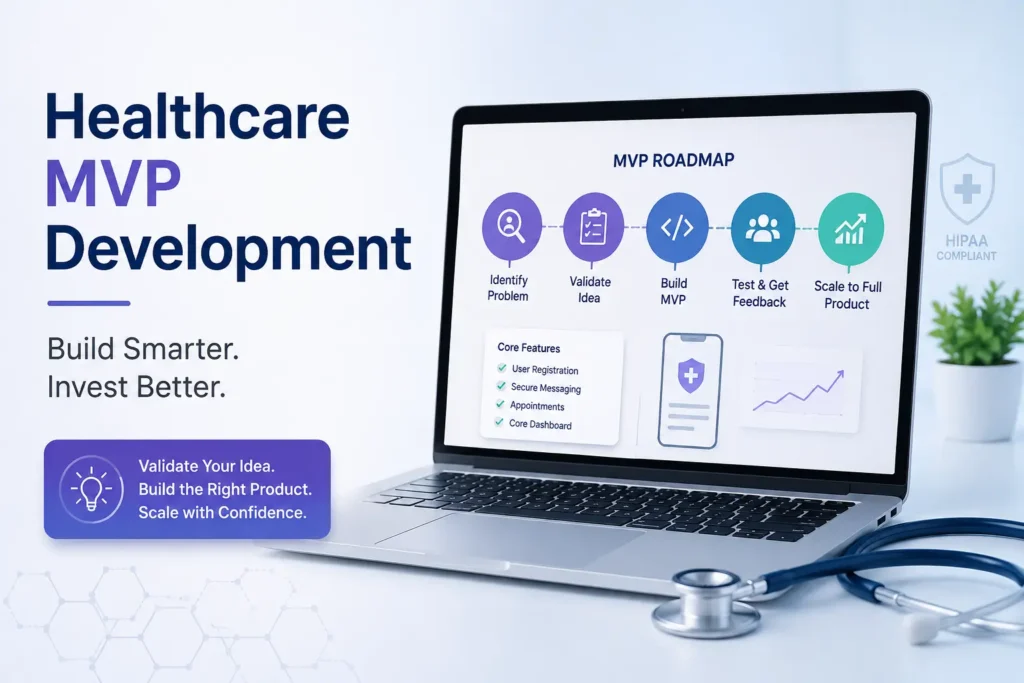
How to Build a Healthcare MVP Before Investing in Full Product Development
Building a healthcare application is a significant investment. Whether you’re creating a telemedicine platform, patient engagement app, AI-powered diagnostic solution, remote patient monitoring system, or digital health marketplace, jumping straight into full-scale product development can be risky.
Many healthcare startups spend months building features their users never requested. Others invest heavily in complex integrations before validating whether the core product actually solves a real problem.
That’s why successful HealthTech founders rarely start with a fully featured platform.
They start with a Healthcare Minimum Viable Product (MVP).
A healthcare MVP allows you to validate your idea with real users, collect feedback, attract investors, and reduce development costs before committing to a complete healthcare software product.
In this guide, you’ll learn exactly how to build a healthcare MVP, what features should be included, common mistakes to avoid, and how to prepare for full product development once your concept has been validated.
Key Takeaways
- A healthcare MVP helps validate your product idea before making a large financial investment.
- Building fewer—but more valuable—features leads to faster market validation.
- Compliance planning should begin during MVP development, not after launch.
- User feedback from an MVP shapes a stronger final healthcare product.
- Investors often prefer startups that have validated their solution with an MVP.
- Choosing the right healthcare software development partner can significantly reduce technical and compliance risks.
Why Healthcare Startups Should Build an MVP First
Healthcare is one of the most regulated and technically demanding industries to build software for.
Unlike many other sectors, healthcare applications often involve:
- Patient data
- Healthcare providers
- Regulatory requirements
- Clinical workflows
- Third-party integrations
- Security and privacy considerations
Because of this complexity, many founders assume they need to launch with every feature already built.
In reality, that approach usually increases both cost and risk.
A Healthcare MVP allows you to answer one critical question before investing hundreds of thousands of dollars:
“Will healthcare professionals or patients actually use this solution?”
Until that question has been answered, adding advanced functionality usually creates unnecessary expense rather than additional value.
Instead of trying to build the perfect healthcare platform from day one, an MVP focuses on validating your core idea as quickly as possible.
What Is a Healthcare MVP?
A Healthcare Minimum Viable Product (MVP) is the simplest version of your healthcare software that solves one important problem for a specific group of users.
It isn’t an unfinished product.
It isn’t a prototype.
And it certainly isn’t low quality.
A healthcare MVP is a fully functional application with only the essential features required to validate your business idea.
For example:
Instead of building an entire hospital management system, an MVP might only include:
- Secure patient registration
- Appointment booking
- Doctor availability
- Video consultation
- Basic patient dashboard
Everything else billing, AI recommendations, electronic prescriptions, analytics, insurance integration—can come later once you’ve confirmed users actually need them.
Why Healthcare MVP Development Reduces Business Risk
One of the biggest reasons healthcare startups fail isn’t poor technology.
It’s building products that don’t match market demand.
A healthcare MVP helps reduce this risk by allowing founders to:
Validate Product-Market Fit
Instead of making assumptions, you collect real feedback from clinics, hospitals, physicians, or patients.
That feedback becomes the foundation of future product decisions.
Reduce Development Costs
Building a complete healthcare platform requires significant investment.
An MVP allows you to focus your budget on solving the most valuable problem first.
If adjustments are needed, they’re much easier—and less expensive—to make during the MVP stage.
Launch Faster
Healthcare markets evolve quickly.
Launching an MVP enables your startup to enter the market sooner, learn from early adopters, and improve continuously instead of spending a year building features that may never be used.
Improve Investor Confidence
Investors are increasingly looking for evidence that founders understand their market.
A healthcare MVP demonstrates that you’ve tested your assumptions with real users instead of relying solely on business plans and presentations.
Even a small group of active users can provide valuable validation when raising funding.
Common Mistakes Healthcare Founders Make
Over the years, one pattern appears repeatedly among early-stage healthcare startups.
They try to build everything.
A founder may start with a simple telemedicine idea but quickly adds:
- AI diagnosis
- Electronic Health Record integrations
- Wearable device support
- Insurance verification
- Online pharmacy
- Appointment scheduling
- Patient messaging
- Advanced analytics
- Billing systems
Individually, each feature sounds useful.
Together, they dramatically increase cost, complexity, and development time.
By launch day, the startup has invested significant resources—but still hasn’t answered the most important question:
Do users actually want the product?
Healthcare MVP development encourages founders to solve one problem exceptionally well before expanding into additional capabilities.
Start With the Problem—Not the Technology
Many founders become excited about artificial intelligence, blockchain, wearable devices, or other emerging technologies.
While these innovations have tremendous potential, they shouldn’t define your product.
Your users should.
Instead of asking:
“How can we use AI in healthcare?”
Ask:
“What problem do healthcare professionals face every day that technology can solve?”
For example:
Weak approach
“We want to build an AI healthcare platform.”
Better approach
“We want to reduce physician documentation time by automating clinical notes.”
The second statement immediately identifies a measurable problem that an MVP can validate.
The technology simply becomes the tool used to solve it.
Define One Core User
One of the most common reasons healthcare software becomes overly complicated is trying to serve everyone at once.
Healthcare applications often involve multiple user groups:
- Patients
- Physicians
- Nurses
- Hospital administrators
- Clinics
- Care coordinators
- Insurance providers
Attempting to build for every stakeholder in the first release almost always delays development.
Instead, identify your primary audience.
Ask yourself:
- Who experiences the problem most frequently?
- Who benefits the most from solving it?
- Who is most likely to adopt the product early?
- Who makes the purchasing decision?
A focused user base leads to a focused MVP and a stronger product overall.
