 Skip to content
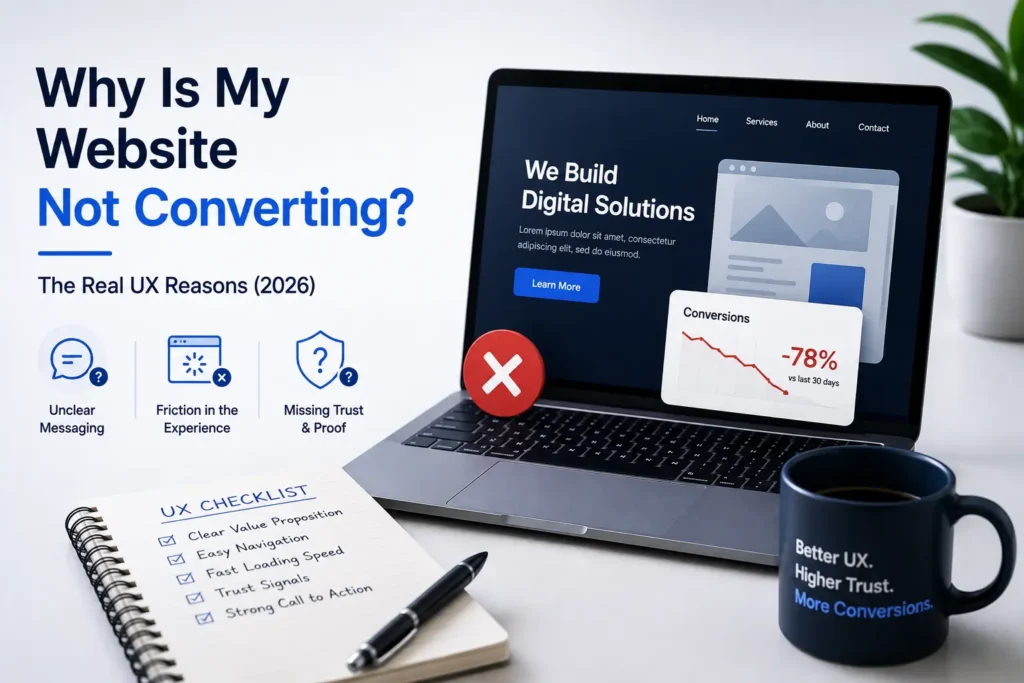
Why Is My Website Not Converting? The Real UX Reasons (2026)
“The site looks great, but nobody’s converting.” If that sentence sounds familiar, you’re not alone, and you’re not imagining it. Traffic without conversions is one of the most common, and most misunderstood, problems in business right now. It rarely comes down to one big broken thing. It’s usually a handful of small friction points quietly working against you at the same time.
At PWH Services, this is one of the most common conversations we have with businesses that already have a working site and real traffic, but can’t figure out why visitors aren’t turning into leads or customers. Here’s the honest breakdown of what’s actually going on, and what fixing it really costs.
The Three Real Reasons People Leave Without Converting
After auditing enough sites, the causes almost always sort into three categories. It’s rarely just one.
1. Unclear Messaging and Value
Visitors decide whether they understand what you do within about five seconds. If your headline is vague, or your copy talks about your company instead of the visitor’s actual problem, people leave before they even get to the friction points below. A weak call to action makes this worse. “Contact Us” is not a compelling reason for anyone to act right now.
2. Friction in the Experience Itself
This is the part most people think of first when they hear “bad UX.” Slow-loading pages cause immediate drop-off. Long forms that ask for too much information too early feel like a wall. A mobile layout that technically works but feels cramped or awkward frustrates the growing share of visitors browsing on their phones. Confusing navigation with too many choices makes it hard for anyone to find the next step.
3. Missing Trust and Proof
This is the piece most businesses genuinely overlook, and it’s often the biggest one. If there are no reviews or testimonials visible, visitors have no evidence the risk of buying or contacting you is worth taking. Hidden or unclear pricing breaks confidence at exactly the moment someone is close to deciding. And a missing or buried call to action leaves an otherwise interested visitor with no clear next step, so they simply leave instead of guessing.
Trust signals aren’t decoration. They’re often the single missing piece between a visitor who’s interested and a visitor who actually converts.
Why This Matters More Than It Seems
None of these three categories look dramatic on their own. A slightly vague headline. One extra form field. A missing testimonial section. But visitors don’t experience your site as a checklist, they experience the whole thing at once, and friction compounds. A site with two or three of these issues doesn’t lose 2 or 3 percent of conversions. It often loses far more, because each issue reinforces the others, and hesitation at any single point is usually enough for someone to simply close the tab.
How to Actually Diagnose It
Before assuming you need a full redesign, it helps to separate a traffic problem from a conversion problem. If you’re getting visitors but almost nobody converts, the site itself, not your marketing, is the likely place to look first. A few things worth checking:
- Where in your funnel are people actually dropping off? Analytics should show a specific step, not just general low engagement.
- Are you getting clicks from ads or search but no conversions? That’s often a mismatch between what the click promised and what the landing page delivers, combined with the trust and friction issues above.
- Would a first-time visitor understand what you do and why they should trust you, within five seconds, with no context from you explaining it?
UX Audit Cost, By Provider Type
Audit pricing varies more than most people expect, because “UX audit” means very different things depending on who’s doing it and how deep they go.
| Provider Type | Typical Cost | What You Actually Get |
|---|---|---|
| Automated AI tools | $0–$500/month | Instant, rule-based checks. Fast, but no human context or judgment. |
| Freelance UX specialists | $1,500–$5,000 | A focused heuristic review of one or two critical flows or a small site. |
| Boutique agencies | $8,000–$25,000 | Full evaluation including user testing, analytics review, accessibility checks, and a prioritized fix roadmap. |
| Enterprise consultancies | $30,000- $75,000+ | Deep, multi-platform assessments for complex or heavily regulated products. |
Most small and mid-size businesses get the best return from the freelance specialist or boutique agency tiers. Automated tools are useful for a quick surface-level check, but they miss the messaging and trust issues that usually matter most. Enterprise-level audits are built for a different scale of problem entirely.
What Actually Determines Where You Land in That Range
How many flows are being reviewed. A focused audit of just your signup or checkout flow costs far less than a full-site evaluation covering every major page and path.
Whether real user testing is included. A heuristic review, an expert evaluating your site against known usability principles, is faster and cheaper. Adding real user interviews and moderated testing costs more, but surfaces issues an expert review alone can miss.
What the deliverable actually is. Basic written notes are cheaper than a full, prioritized, dev-ready roadmap with wireframes showing exactly how to fix each issue.
Fixing It Without Overcommitting
The sensible order is diagnosis before prescription. Start with a focused audit that identifies your specific friction points, messaging, trust, or usability, rather than assuming a full rebuild is required. In most cases we’ve seen, a handful of targeted fixes across messaging clarity, trust signals, and one or two friction points recovers the majority of lost conversions, without touching the entire product.
A full UI/UX redesign is the right call when the underlying structure itself no longer fits how your business or users have evolved, not as the default first step for a site that’s simply underperforming.
Ready to Find Out What’s Actually Costing You Conversions?
Tell us where visitors are dropping off, and we’ll help you figure out whether it’s a messaging issue, a trust issue, a friction issue, or some combination, before you commit to any fix. That’s how we approach every UI/UX project, diagnosis first, so you’re never paying for more than the actual problem requires.
👉 Get your free quote here OR Book a Free Call and get an honest read on what’s holding your conversions back, no obligation, no pressure.
If you’re an agency or freelancer who wants to offer UX audits as part of your own client work without building out a design team, our partner program is worth a look.
FAQs
Why is my website getting traffic but no conversions?
This usually points to the site itself rather than your marketing. Common causes include unclear messaging that doesn’t explain your value fast enough, friction in forms or checkout, and missing trust signals like reviews or clear pricing.
Why am I getting clicks but no conversions
Often a mismatch between what the ad or search result promised and what the landing page actually delivers, combined with weak trust signals or an unclear next step once visitors arrive.
How much does a UX audit cost?
Freelance specialists typically charge $1,500 to $5,000 for a focused review. Boutique agencies offering full evaluations with user testing run $8,000 to $25,000. Automated tools are cheaper but miss messaging and trust issues that usually matter most.
How do I increase conversions on my website?
Start by clarifying your headline and value proposition, reducing unnecessary friction in forms and checkout, and adding visible trust signals like testimonials, clear pricing, and an obvious next step.
Do I need a full redesign to fix a conversion problem?
Not usually. Most conversion problems come from a specific, identifiable set of issues that a focused audit can uncover and fix without redesigning the entire site.
What’s the difference between a traffic problem and a conversion problem?
A traffic problem means not enough people are visiting your site. A conversion problem means people are visiting but not taking action once they arrive, which points to the site experience itself, not how visitors are finding you.
