 Skip to content
SaaS MVP Development: What to Build, What to Skip & How Much It Costs
You have a SaaS idea.
Maybe it solves a problem your team has experienced firsthand. Maybe you’ve already talked to potential customers. Maybe you’ve even mapped out 30 or 40 features that you want in the final product.
The problem is that your first version probably shouldn’t include all of them.
That’s where SaaS MVP development becomes important.
A good SaaS MVP isn’t simply a cheaper version of your final product. It is the smallest useful version of your product that allows real users to experience the core value, while giving you enough information to decide what should be built next.
The challenge is knowing what belongs in that first version and what should wait.
This guide explains how to scope a SaaS MVP, which features are usually essential, what you can safely postpone, how much SaaS MVP development can cost, how long it can take, which technical decisions matter early, and how to move from an MVP to a scalable SaaS product without wasting your budget.
What Is a SaaS MVP?
A SaaS MVP, or Minimum Viable Product, is the first usable version of a Software-as-a-Service product designed to solve a specific customer problem and generate real-world feedback.
The important word here is usable.
An MVP should not feel like a collection of unfinished screens. It should allow a real user to complete the core task your product was created to solve.
For example, imagine you’re building a SaaS platform that helps small businesses manage customer appointments.
Your long-term roadmap might include:
- AI scheduling
- Advanced analytics
- Team management
- Automated reminders
- Customer segmentation
- Mobile apps
- Accounting integrations
- Custom reports
- Multiple subscription plans
- Advanced automation
But your first SaaS MVP may only need:
Create account → Add services → Create appointments → Manage customers → Send basic notifications
That can be enough to test whether businesses actually find the product useful.
The goal isn’t to build less just for the sake of saving money.
The goal is to build enough to learn something valuable.
SaaS MVP vs. Prototype: They Are Not the Same Thing
This distinction is often misunderstood.
A prototype demonstrates how a product could work.
An MVP allows people to actually use the product.
A prototype might contain clickable screens showing:
Sign Up → Dashboard → Create Project → Reports
But an actual SaaS MVP needs the underlying functionality to make those actions work.
That can include:
- Authentication
- Database
- User accounts
- Core business logic
- Permissions
- Data storage
- Basic administration
- Error handling
- Notifications
- Billing, if customers need to pay
- Production hosting
So when someone says, “We only need a few screens,” that doesn’t necessarily mean the project is small.
The complexity is often behind those screens.
Why SaaS MVP Development Is Different From a Normal MVP
A SaaS product has some requirements that a basic application MVP may not have.
A normal MVP could theoretically demonstrate a workflow with a single user.
A SaaS product needs to work for multiple customers.
That introduces questions such as:
- How are customers separated?
- Who can access which data?
- How are subscriptions managed?
- What happens when someone upgrades?
- What happens when a payment fails?
- How does an administrator manage customers?
- How are different user roles handled?
- How will the application behave when the number of users increases?
This is why SaaS MVP development requires more than simply building the visible interface.
The architecture needs to support the business model as well as the product.
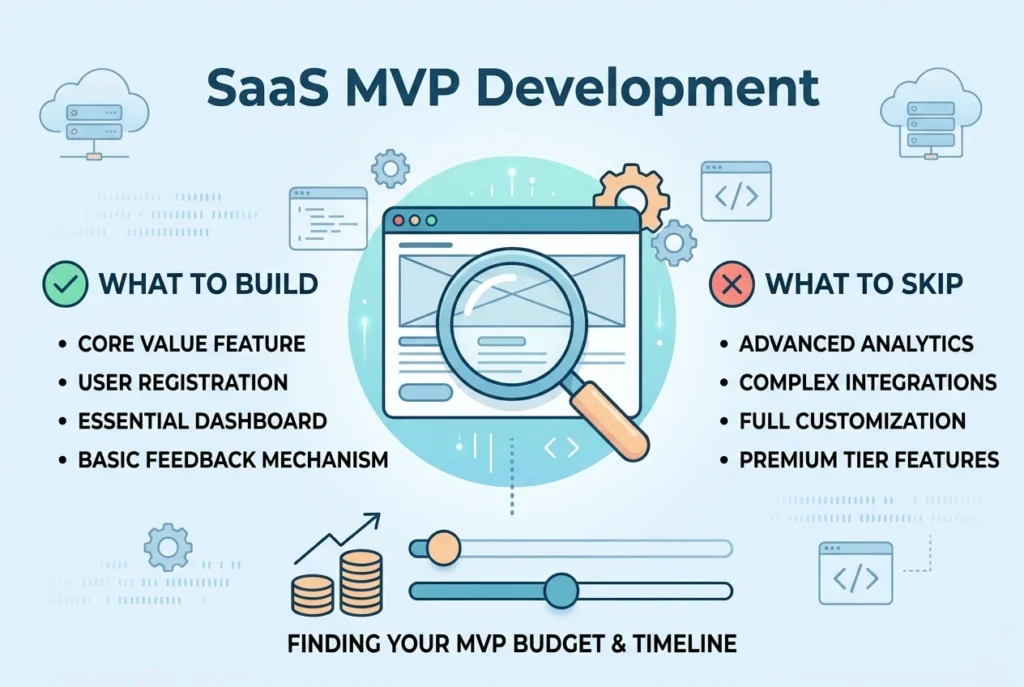
What Should You Build in a SaaS MVP?
The right feature set depends on the product, but most SaaS MVPs need a few fundamental building blocks.
1. User Authentication
If your product requires customer accounts, users need a reliable way to:
- Sign up
- Log in
- Log out
- Reset passwords
- Manage basic account information
You don’t necessarily need advanced authentication on day one.
For example, enterprise SSO may be unnecessary if your first customers are small businesses.
Start with the authentication your target customers actually need.
2. The Core Product Workflow
This is the most important part of your MVP.
Ask yourself:
What is the one thing the customer is paying this product to accomplish?
Build that workflow properly.
For a project management SaaS, it might be:
Create project → Add tasks → Assign tasks → Track progress
For a CRM:
Add lead → Track interaction → Move through pipeline → Convert customer
For an accounting product:
Add transaction → Categorize → Generate report
Your MVP should make that core journey useful from beginning to end.
A common mistake is building five partially working workflows instead of building one excellent workflow.
3. Basic Dashboard
Most SaaS products benefit from a simple dashboard that helps users understand what is happening.
But “dashboard” doesn’t mean you need twenty charts.
Your first dashboard may only need:
- Important metrics
- Recent activity
- Current tasks
- Alerts
- Primary actions
If users can understand the state of their account within a few seconds, the dashboard is doing its job.
4. Basic User Roles
If your SaaS is designed for teams, you may need basic roles.
For example:
Admin → Manager → Team Member
Each role should only see and perform the actions it actually needs.
You don’t necessarily need extremely granular permission systems in the first release.
Start with the smallest permission structure that protects customer data and supports your workflow.
5. Billing and Subscription Management
If your business model depends on paid subscriptions, billing cannot simply be treated as a future feature.
Your MVP may need:
- Subscription plans
- Checkout
- Payment processing
- Trial period
- Subscription status
- Upgrade/downgrade
- Cancellation
- Payment confirmation
You can keep the first billing system simple without making it fragile.
The important thing is that the customer can understand what they’re paying for and the business can reliably collect payments.
6. Basic Admin Functionality
Your customers aren’t the only people who need to use the product.
Your internal team needs a way to manage it.
A basic admin panel can help you:
- View users
- Manage accounts
- Check subscriptions
- Review activity
- Handle problems
- Manage important settings
You may not need a huge internal management system initially.
But having no way to manage your own SaaS after launch can create unnecessary operational problems.
7. Transactional Emails
Users expect important actions to produce clear communication.
Examples include:
- Welcome emails
- Password reset emails
- Email verification
- Payment receipts
- Subscription notifications
- Important account alerts
These aren’t glamorous features, but they contribute significantly to whether the product feels complete and trustworthy.
8. Basic Analytics and Error Monitoring
You don’t need an enterprise analytics stack on day one.
But you should know:
- How users are signing up
- Which core features they’re using
- Where users stop
- Whether important actions are completing
- Whether the application is producing errors
This information becomes extremely valuable after launch because your MVP is also a learning system.
What Should You Skip From Your SaaS MVP?
This is where founders can save significant time and money.
The easiest feature to add is usually the feature someone thinks “would be nice to have.”
The problem is that dozens of “nice-to-have” features quickly become a large development project.
Here are features that often belong later unless your business specifically depends on them.
Advanced AI Features
AI can be powerful, but you don’t need to add an AI assistant, AI recommendations, AI reports, and AI agents simply because your competitors have them.
Ask:
Does AI solve the customer’s main problem?
If the answer is no, it may belong in a later release.
Enterprise SSO
SAML, enterprise identity providers, advanced authentication policies, and enterprise security requirements can be valuable.
But if your first customers are startups and small businesses, building all of these before you have an enterprise customer may be unnecessary.
Build them when the market requires them.
Advanced Reporting
Your first users probably don’t need 40 report types.
Start with the reports that directly support the product’s core value.
Once you see which metrics customers actually use, expand the reporting system.
Complex Permission Systems
A platform with 25 permission combinations can become difficult to design, test, and maintain.
If your MVP can work with two or three clear roles, don’t create 20.
Native Mobile Apps
A SaaS product doesn’t automatically need iOS and Android applications.
If customers primarily use the product from their desktop browser, a responsive web application may be enough for the MVP.
Mobile apps can come later when usage data proves they are necessary.
Dozens of Integrations
Founders often want their SaaS to integrate with:
- Slack
- Salesforce
- HubSpot
- QuickBooks
- Zapier
- Google Workspace
- Microsoft 365
- Shopify
- Stripe
- dozens of other platforms
Don’t build all of them immediately.
Start with the integration that removes the biggest barrier for your first customers.
A Simple Build vs. Skip Framework
Before adding any feature, ask four questions:
| Question | If the answer is “Yes” | Recommendation |
|---|---|---|
| Does the feature deliver the core product value? | Yes | Strong MVP candidate |
| Do customers need it to complete the main workflow? | Yes | Strong MVP candidate |
| Do customers need it to pay for the product? | Yes | Consider including it |
| Can we validate the idea without it? | Yes | Probably postpone i |
This framework is more useful than simply asking whether a feature is “important.”
A feature can be important eventually and still be unnecessary for version one.
How Do You Decide Which SaaS Features to Build First?
Instead of starting with your feature list, start with your customer journey.
Imagine the first person who will use your product.
What happens from the moment they discover your SaaS?
Step 1: Sign up
Can they create an account without unnecessary friction?
Step 2: Understand
Can they immediately understand what the product does?
Step 3: Set up
Can they provide the information required to use the product?
Step 4: Experience value
Can they complete the main workflow?
Step 5: Return
Is there a reason for them to come back?
Step 6: Pay
If it’s a paid product, can they understand and complete the subscription process?
This journey is often a better starting point than a 50-item feature spreadsheet.
How Much Does SaaS MVP Development Cost in 2026?
There isn’t one universal SaaS MVP development cost.
Current 2026 market estimates vary widely because “MVP” can mean anything from a simple proof-of-concept to a production-ready multi-tenant SaaS platform. Recent industry estimates range from roughly $15,000–$60,000 for many focused SaaS MVPs, while more complex products with enterprise requirements, integrations, or advanced architecture can go considerably higher.
A practical planning model looks like this:
| SaaS MVP Type | Typical Scope | Planning Range |
|---|---|---|
| Lean MVP | One core workflow, authentication, basic dashboard | $10,000–$25,000+ |
| Standard SaaS MVP | Core workflow, billing, roles, admin, multi-tenancy | $20,000–$60,000+ |
| Complex SaaS MVP | Multiple workflows, integrations, advanced permissions | $50,000–$100,000+ |
| Enterprise-oriented MVP | SSO, advanced security, integrations, compliance | $100,000+ |
These are planning ranges, not fixed quotations.
Your actual SaaS MVP development cost depends on what you’re building, who will use it, how many systems it needs to connect to, and how much infrastructure needs to exist before launch.
What Actually Drives SaaS MVP Development Cost?
The number of screens is not necessarily the biggest factor.
Some of the most expensive parts of a SaaS product are the systems users don’t see.
Multi-Tenancy
If multiple companies use your SaaS, their information needs to remain properly separated.
That requires careful database and authorization architecture.
Retrofitting multi-tenancy later can be significantly more difficult than considering it during the initial architecture. Current SaaS MVP guidance repeatedly identifies tenant isolation as one of the areas founders underestimate.
Billing
Recurring payments create more complexity than a simple checkout page.
You may need to handle:
- Trials
- Failed payments
- Renewals
- Upgrades
- Downgrades
- Cancellations
- Refunds
- Invoices
Integrations
Every external system adds another dependency.
A product connected to one external API is fundamentally simpler than one dependent on eight different services.
User Roles
The number of user types and permission combinations can have a major effect on development and testing.
Custom Design
A highly customized product experience requires more design and frontend development than a product built around an established component system.
AI
AI features can introduce additional API, infrastructure, evaluation, security, and monitoring requirements.
Compliance
Healthcare, financial services, and other regulated industries may require additional security and compliance work.
How Long Does It Take to Build a SaaS MVP?
A focused SaaS MVP can often take 8–16 weeks, but the actual timeline depends on scope, team size, design requirements, integrations, and technical complexity. Current 2026 guides commonly place focused SaaS MVPs within this general range, while more complex products can take substantially longer.
A realistic process might look like:
Weeks 1–2: Discovery, requirements and UX planning
Weeks 2–4: UI/UX design and technical architecture
Weeks 4–10: Core development
Weeks 8–12: Testing, fixes and integration
Weeks 11–14: Production preparation and launch
For a larger MVP, these stages may overlap or extend.
The important point is that a shorter timeline isn’t automatically better.
If a team promises to build a complex multi-tenant SaaS with billing, integrations, analytics and advanced permissions in a few weeks, ask what has been excluded from that estimate.
What Does a SaaS MVP Development Process Look Like?
A good SaaS MVP development process should reduce uncertainty before increasing development scope.
1. Product Discovery
Start with the problem.
Who is the customer?
What problem are they experiencing?
What are they doing today?
What would make them switch?
What would make them pay?
These questions are more important than deciding whether your frontend should use one framework or another.
2. Define the Core Value Proposition
Write the product’s value in one sentence.
For example:
“Our platform helps small agencies turn client requests into organized projects without managing everything across spreadsheets, email, and chat.”
If you can’t explain the core value clearly, your feature list is probably not ready.
3. Map the Core User Journey
Document the steps required for a customer to experience the product’s main value.
This creates the foundation for your MVP scope.
4. Prioritize Features
Divide features into:
Must have: Required to deliver the core value.
Should have: Useful but not essential for launch.
Could have: Valuable after validation.
Later: Features that belong on the roadmap rather than in version one.
This prevents scope creep from quietly turning your MVP into a full product.
5. Design the Product
Create wireframes and UI designs around the prioritized workflows.
Good MVP design isn’t about making every screen impressive.
It’s about making the important journey easy to understand.
6. Choose the Technical Architecture
The team then determines:
- Frontend
- Backend
- Database
- Authentication
- Hosting
- APIs
- Billing
- Analytics
- Monitoring
- Security
The objective should be to choose technology that supports the MVP without creating unnecessary complexity.
7. Develop the MVP
Development should focus on the agreed core scope rather than continuously adding new ideas.
This is where disciplined product management matters.
8. Test With Real Scenarios
Testing shouldn’t only ask:
“Does the button work?”
It should ask:
“Can a real customer successfully accomplish the job they came here to do?”
That means testing complete workflows, permissions, payments, edge cases, performance, and error states.
9. Launch With a Small User Group
Your first launch doesn’t need to reach thousands of people.
A small group of relevant users can provide much more useful feedback than a large audience that doesn’t represent your target market.
10. Measure and Improve
After launch, monitor:
- Activation
- User engagement
- Retention
- Conversion
- Feature usage
- Support requests
- Churn
- Customer feedback
Then use that information to decide what to build next.
How Do You Validate a SaaS MVP?
Building an MVP doesn’t automatically validate your idea.
You need to put it in front of the right people.
Start by defining a clear target customer.
Then test whether they:
- Understand the problem you’re solving.
- Recognize the value of your solution.
- Can successfully use the core workflow.
- Return to the product.
- Are willing to pay for it.
One of the biggest mistakes is treating downloads, signups, or website traffic as validation by themselves.
A thousand free signups can be less valuable than ten businesses that actively use the product and are willing to pay.
What Metrics Should You Track After Launch?
The right metrics depend on your SaaS business model, but some useful early indicators include:
Activation rate
How many new users reach the first meaningful value point?
Retention
Do users return after their first experience?
Conversion rate
How many users become paying customers?
Churn
How many customers stop paying?
Feature adoption
Which features are actually being used?
Customer acquisition cost
How much does it cost to acquire a customer?
Lifetime value
How much revenue does an average customer generate over time?
The point of MVP analytics isn’t to create beautiful dashboards.
It’s to help you make better product decisions.
Should You Build AI Into Your SaaS MVP?
This is one of the biggest questions founders face in 2026.
The answer is:
Only if AI contributes directly to the product’s value.
AI can make sense for:
- Automated content generation
- Intelligent search
- Recommendations
- Document processing
- Customer support
- Workflow automation
- Data analysis
- Forecasting
- AI agents
But adding an AI chatbot to a SaaS product simply because AI is popular doesn’t create product-market fit.
AI should answer a real customer need.
The wider SaaS market is also changing as AI agents increasingly perform tasks that traditionally required people to interact directly with software. That means founders should think carefully about whether AI is a feature, a workflow, or part of the product’s fundamental architecture.
Can AI Make SaaS MVP Development Faster?
AI-assisted development can speed up certain development activities, particularly repetitive coding, documentation, testing, and prototyping.
But faster code generation doesn’t automatically mean a faster product launch.
You still need:
- Product decisions
- Architecture
- UX
- Testing
- Security
- Integration work
- Deployment
- Monitoring
- Human review
In other words:
AI can accelerate development work. It doesn’t remove the need for product engineering.
A poorly defined product built faster is still a poorly defined product.
SaaS MVP Development: Agency vs. Freelancer vs. In-House
The right development approach depends on your stage.
| Approach | Best For | Main Advantage | Main Challenge |
|---|---|---|---|
| Freelancer | Small, focused products | Lower initial cost | Limited specialization |
| Agency | Complex MVPs | Multi-disciplinary team | Higher budget |
| In-house | Long-term product companies | Maximum internal control | Higher ongoing cost |
| No-code/Low-code | Early validation | Fast experimentation | Platform limitations |
A freelancer can make sense if you have a technically simple product and clear requirements.
An agency can make more sense when you need product strategy, UX/UI, frontend, backend, QA, cloud infrastructure, and ongoing support.
An in-house team becomes more attractive when SaaS development is a core long-term capability of the company.
There is no universal winner.
The right question is:
Which approach matches the complexity and stage of your product?
If you’re comparing partners, our guide to choosing between MVP development companies covers costs, questions to ask, and red flags.
Common SaaS MVP Mistakes That Waste Money
Building the entire roadmap
Your roadmap is not your MVP.
Your roadmap represents where you might go.
Your MVP represents what you need to learn first.
Confusing “minimum” with “cheap”
An MVP should be lean, but it shouldn’t be unreliable.
Cut unnecessary scope, not the fundamentals that make customers trust your product.
Ignoring architecture
A quick launch is useful only if the product can survive the next stage.
Adding too many integrations
Build the integrations that your initial customers actually need.
Building for everyone
If your product is for everyone, your MVP will probably try to solve too many problems.
Choose a clear initial customer.
Designing around assumptions
Talk to users before making major product decisions.
Ignoring post-launch costs
Hosting, APIs, maintenance, support, monitoring, and future development all affect the total cost of ownership.
What Should You Prepare Before Hiring a SaaS Development Team?
You don’t need a 100-page technical specification.
But you should be able to explain:
Who: Who is the target customer?
Problem: What problem are they experiencing?
Solution: How does your SaaS solve it?
Core workflow: What is the main thing users need to accomplish?
Business model: How will you make money?
Platforms: Web only, or web plus mobile?
Integrations: Which external systems are essential?
Timeline: Is there a specific launch deadline?
Budget: What range are you comfortable investing?
The more clearly you can answer these questions, the easier it becomes for a development partner to give you a useful estimate.
How to Keep Your SaaS MVP Within Budget
You don’t necessarily need to find the cheapest development team.
You need to control scope.
Start with one customer type.
Choose one core problem.
Build one strong workflow.
Limit integrations.
Use proven technologies.
Avoid unnecessary custom infrastructure.
Postpone advanced features.
Launch with a measurable hypothesis.
Then expand based on evidence.
This approach usually produces a healthier product than trying to build the entire vision before the market has had a chance to respond.
From SaaS MVP to Full Product
Your MVP is not the destination.
It is the first meaningful step.
After launch, you may discover that customers repeatedly ask for a particular integration. You may find that one feature is far more valuable than expected. You may discover that customers don’t use a feature you thought was essential.
That’s valuable information.
Your second version should be shaped by those discoveries.
The evolution can look like:
Idea → MVP → Real Users → Feedback → Product-Market Signals → V2 → Scale
This is much healthier than:
Idea → 12-month development project → Launch → Discover nobody wants it
The purpose of SaaS MVP development is therefore not simply to launch quickly.
It is to reduce uncertainty before making a larger investment.
When Should You Stop Adding Features to Your MVP?
A useful stopping point is when your product can:
- Solve the core customer problem
- Support the primary user journey
- Handle the necessary accounts and permissions
- Process payments if required
- Protect customer data
- Operate reliably
- Collect meaningful usage feedback
- Be used by your first real customers
At that point, additional features should be evaluated against evidence.
If a feature doesn’t improve acquisition, activation, retention, revenue, or the core user experience, ask whether it really belongs in the next release.
A Better Way to Think About SaaS MVP Development
The traditional question is:
“How many features can we build within our budget?”
A better question is:
“What is the smallest product we can build that gives us a meaningful answer about whether this business idea works?”
That shift changes everything.
You stop measuring progress by the number of screens.
You start measuring progress by what you’ve learned.
You stop building for imaginary future customers.
You start building for a clearly defined first customer.
And you stop treating the MVP as a smaller final product.
You start treating it as a focused, usable product designed to create evidence.
Need Help Turning Your SaaS Idea Into an MVP?
If you have a SaaS idea but aren’t sure what should actually go into version one, this is exactly where early product planning can save time and development budget.
PWH Services can help you move from product idea and feature planning to UX/UI design, development, testing, deployment, and ongoing improvements.
You can also explore PWH Services’ App Solutions if your SaaS product will eventually require web and mobile applications.
Before development begins, the most useful conversation isn’t always:
“How much will my SaaS cost?”
It is:
“What should I actually build first?”
If you want to discuss your idea, scope your MVP, or understand what the development process could look like, book a free 30-minute consultation with PWH Services.
Final Takeaway
A successful SaaS MVP isn’t the product with the most features.
It’s the product that solves one important problem well enough for real customers to use, evaluate, and potentially pay for it.
Build the core.
Skip the distractions.
Protect the architecture.
Launch with a clear hypothesis.
Listen to your users.
Then let evidence decide what you build next.
That is how SaaS MVP development becomes more than a development project, it becomes a way to make a smarter investment in your product.
Frequently Asked Questions About SaaS MVP Development
What is SaaS MVP development?
SaaS MVP development is the process of building the first usable version of a Software-as-a-Service product with enough functionality to solve its core customer problem, launch to real users, and validate the business idea.
What features should a SaaS MVP have?
Most SaaS MVPs need authentication, the core product workflow, appropriate user permissions, basic dashboard functionality, administration, and billing if the product is paid. The exact requirements depend on the business model.
What should I skip when building a SaaS MVP?
Advanced AI features, enterprise SSO, complex reporting, large numbers of integrations, highly granular permissions, and native mobile apps can often wait unless they are essential to your initial customer or business model.
How much does it cost to build a SaaS MVP?
A focused SaaS MVP can commonly fall somewhere around $10,000–$60,000+, while more complex products can exceed $100,000. The final SaaS MVP development cost depends on scope, architecture, integrations, user roles, billing, security, and other requirements.
How long does SaaS MVP development take?
A focused SaaS MVP commonly takes around 8–16 weeks, although simple products can launch sooner and complex products can take several months.
Is a SaaS MVP the same as a prototype?
No. A prototype demonstrates an idea or user flow. A SaaS MVP is a working product that real users can actually use to experience the core value.
Do SaaS MVPs need multi-tenant architecture?
If multiple customers or organizations will use the same SaaS platform, tenant isolation needs to be considered early. The exact architecture depends on the product, data model, security requirements, and expected scale.
Should I include AI in my SaaS MVP?
Only if AI directly contributes to the product’s core value or is necessary to validate your business hypothesis. AI should solve a real customer problem rather than simply being included as a trend-driven feature.
Can I build a SaaS MVP without coding?
No-code and low-code tools can be useful for prototypes and certain early products. However, products with complex multi-tenancy, billing, integrations, security, or scalability requirements may eventually require custom engineering.
Should I hire a SaaS development company for my MVP?
It depends on the complexity of the product and your internal team. A SaaS development company can be useful when you need product strategy, UX/UI, engineering, QA, infrastructure, and post-launch support without building the entire team internally.
What should I do before hiring a SaaS development company?
Define your target customer, core problem, main workflow, business model, essential features, required integrations, preferred platform, timeline, and approximate budget. You don’t need every technical decision finalized before speaking with a development partner.
