 Skip to content
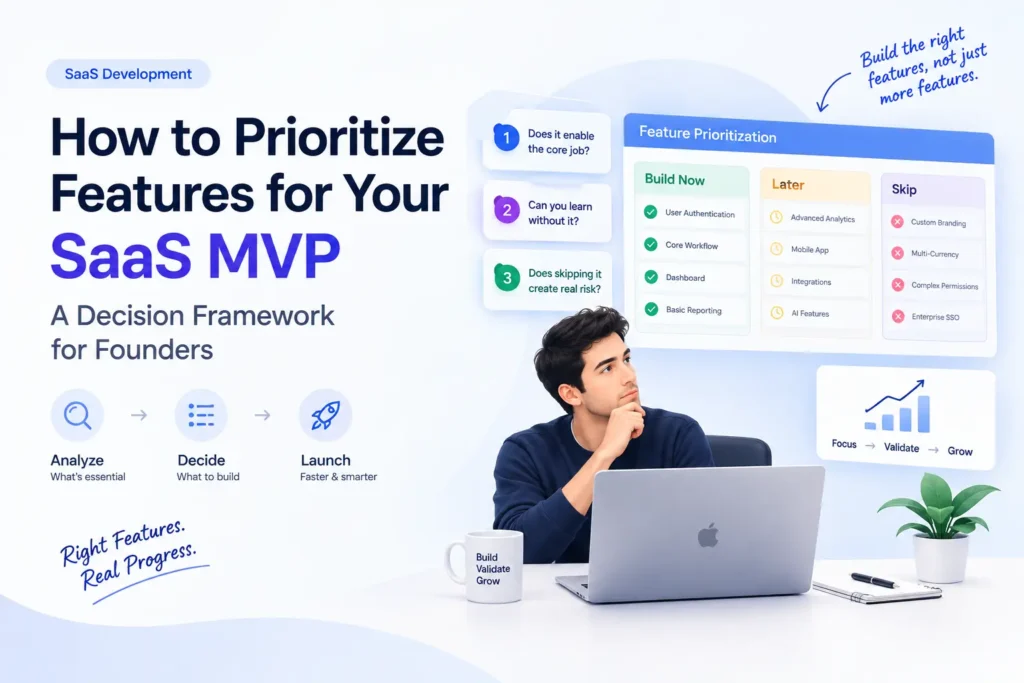
How to Prioritize Features for Your SaaS MVP: A Decision Framework for Founders
We recently asked our audience what they’d prioritize first when building a SaaS product. More than half said MVP and core features, which makes sense, everyone knows the MVP matters. What nobody agrees on is how you actually decide which features belong in it. That gap, between knowing MVP matters and knowing how to scope one, is where most SaaS founders get stuck, and it’s what this framework is built to solve.
Why “Just Build the Core Features” Isn’t Actually Helpful Advice
Every founder already knows they shouldn’t build everything at once. The real problem isn’t a lack of discipline, it’s that almost every feature on a founder’s list feels essential when you’re the one who dreamed up the product. A billing dashboard feels essential. So does a mobile app. So does that integration your first prospective customer asked about in a sales call. Generic advice to “focus on core features” doesn’t help you when everything on your list feels core.
The Decision Framework: Three Questions, In Order
Instead of ranking every feature against every other feature, which gets overwhelming fast, run each feature idea through these three questions, in this specific order, and stop as soon as one of them gives you a clear answer.
Question 1: Does This Feature Let a User Complete the Core Job, or Does It Make That Job Better?
Every SaaS product exists to help someone complete one primary job. A project management tool exists to help someone track and complete tasks. A feature either directly enables that core job (task creation, assignment, status tracking) or it improves the experience of doing it (custom themes, keyboard shortcuts, advanced filtering). Core-job features go in the MVP. Experience-improving features almost always wait, no matter how nice they’d be to have.
Question 2: Can You Learn What You Need to Learn Without It?
The entire point of an MVP is learning whether your product is worth building further, not shipping a finished product. For each feature, ask directly, if this feature didn’t exist yet, would you still learn whether users find your core product valuable? If yes, it can wait. This single question eliminates more “nice to have” features than any prioritization scoring system, because it forces founders to separate what they want to build from what they actually need to learn.
Question 3: Does Skipping It Create a Real Risk, or Just an Inconvenience?
Some features feel optional but actually protect against a real risk, data loss, a security gap, a compliance requirement your specific market genuinely needs from day one. Others are just inconvenient to not have yet, a missing bulk-edit feature is annoying, not risky. Real risk earns a place in the MVP. Inconvenience gets a place on the roadmap instead.
Applying the Framework: A Worked Example
Imagine a SaaS product for freelancers to send and track invoices. Here’s how a few common feature ideas run through the framework:
- Creating and sending an invoice — enables the core job directly. In the MVP.
- Automatic payment reminders — improves the experience, but a founder can learn whether freelancers actually want to send invoices through the product without it yet. Waits.
- Multi-currency support — depends entirely on your actual early users. If your first real customers are in one country, this is a later addition. If your signups are already international, it may shift into “real risk” territory, since ignoring it could mean losing early users entirely.
- A polished custom-branded invoice template — feels important, but users can validate the core workflow with a plain, functional template first. Waits, unless your specific market treats branding as the actual reason they’d pay at all.
Notice the framework doesn’t give a fixed answer for every product, it gives you a repeatable way to think it through for your specific one.
A Quick Comparison to Other Prioritization Methods
You may have come across other frameworks for this exact problem. Here’s how they compare:
| Framework | How It Works | Best For |
|---|---|---|
| This 3-question framework | Sequential yes/no questions per feature | Early-stage founders scoping a first MVP quickly |
| MoSCoW Method | Sorts features into Must, Should, Could, Won’t | Teams with many features to sort at once |
| RICE Scoring | Scores Reach, Impact, Confidence, Effort numerically | Teams with existing usage data to score against |
| Value vs Effort Matrix | Plots features on a simple value/effort grid | Visual thinkers, teams prioritizing a larger backlog |
None of these are wrong, they solve slightly different problems. MoSCoW and RICE work well once you already have a long list of features and existing data to weigh them against. The three-question framework here is built specifically for the earlier, harder moment: when you have a blank page and everything still feels essential.
The Real Cost of Getting This Wrong
Feature creep at the MVP stage doesn’t just delay your launch, it directly inflates your development cost and, worse, muddies your feedback once you do launch. If your first version has ten features instead of four, you won’t know which one actually mattered to the users who stuck around. Every unnecessary feature is both money spent and a data point you’ll never cleanly get back.
When This Framework Isn’t Enough on Its Own
This framework helps you decide what belongs in your MVP. It doesn’t replace the technical judgment of understanding what those features actually cost to build well, particularly for SaaS-specific requirements like multi-tenant architecture or subscription billing, which carry real technical weight even when they look like a single line item on a feature list. That’s usually the point where founders bring in a development partner who’s actually built SaaS products before, not just to build the features, but to sanity-check the scope itself. If you’re at that stage, our guide on choosing the right SaaS development company covers exactly what to look for, and our breakdown of SaaS MVP development costs is worth reading alongside this framework, not after you’ve already committed to a feature list.
Ready to Turn This Framework Into an Actual Scope?
If you’ve run your feature list through this framework and want a second, technical opinion on what’s realistic to build first, we’re happy to walk through it with you, free, no obligation. That’s exactly the kind of scoping conversation we have before quoting any SaaS project.
👉 Get your free quote here, or book a free 30-minute call to talk through your MVP scope directly.
If you’re an agency or freelancer looking to collaborate on SaaS builds, our partner program is worth a look.
FAQs
How do I decide what features to include in my SaaS MVP?
Run each feature through three questions in order: does it enable the core job or just improve it, can you learn what you need to learn without it, and does skipping it create real risk or just inconvenience. Features that pass the first or third question belong in the MVP; most others can wait.
What’s the difference between MoSCoW and a simple decision framework for MVP features?
MoSCoW sorts an existing list of features into priority buckets, which works well once you have many features to organize. A sequential decision framework is more useful earlier, when you’re still deciding what belongs on the list at all.
How many features should a SaaS MVP have?
There’s no universal number, but successful MVPs typically focus on a small, tightly scoped set of features, often three to six, that directly enable the product’s core job, rather than a broad feature set.
What happens if I include too many features in my SaaS MVP?
Feature creep increases development cost and time, and it makes it harder to learn which specific feature actually drove user engagement, since feedback gets diluted across too many things at once.
Should technical complexity affect which features I prioritize?
Yes, in combination with user value, not instead of it. A high-value feature with unusually high technical complexity for SaaS-specific concerns like billing or multi-tenancy may need a real cost and timeline conversation with a development partner before committing to it in the MVP.
Can I change my MVP feature list after I’ve started building?
Yes, and you often should, based on real early user feedback. The goal of the MVP is to learn quickly, and that learning should genuinely influence what gets built next, not just confirm your original list.
