If you are planning a first version of your product, the first question is almost always the same: how much does it cost to build an MVP? The honest answer is that it depends on what you build, who builds it and how much of it truly needs to exist at launch. This guide gives you realistic 2026 price ranges, explains what pushes the cost up or down, and shows how to get a fixed quote you can actually plan around.
The Short Answer
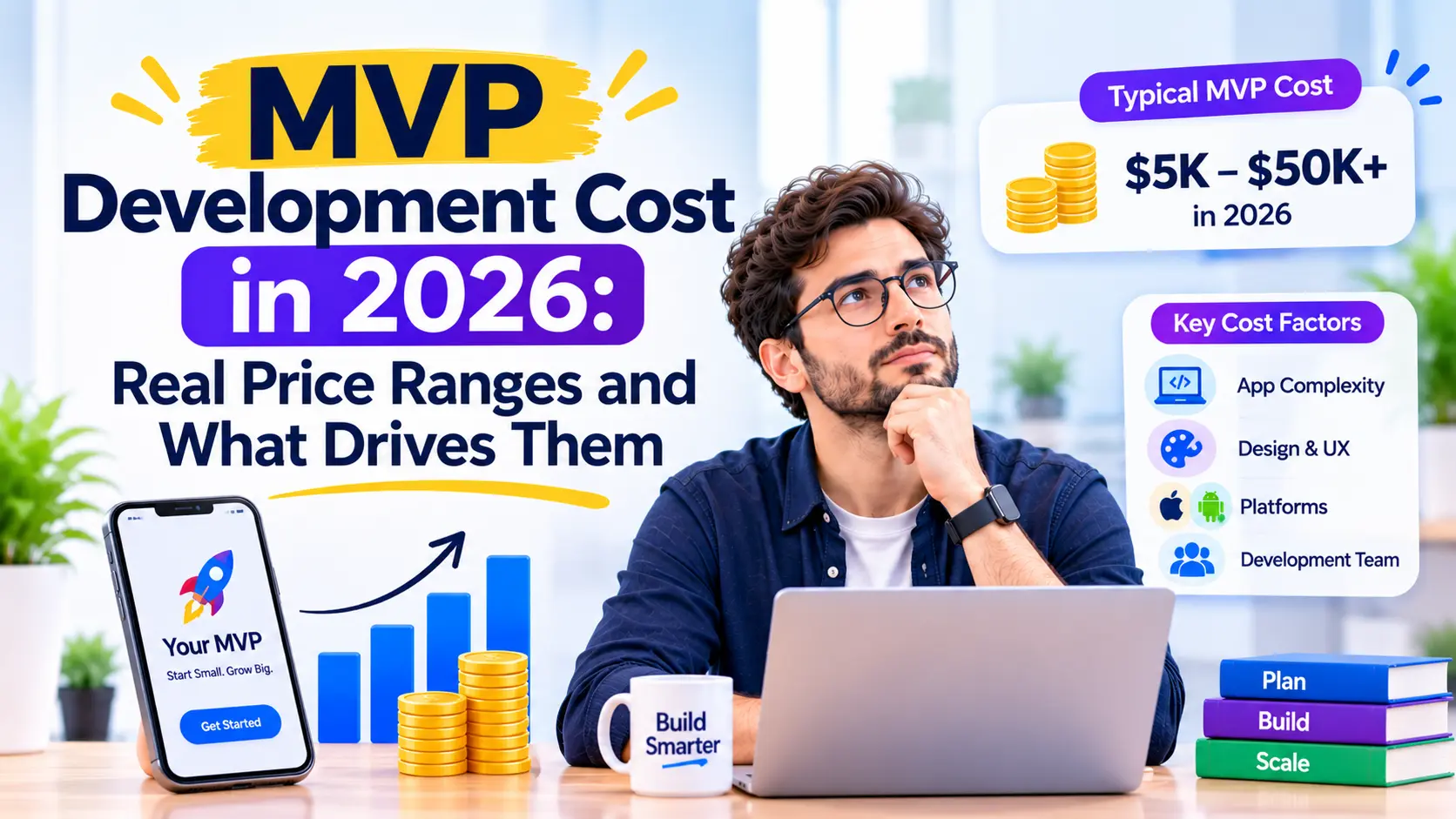
A typical app MVP costs $15,000 to $60,000 and takes 8 to 16 weeks to build. A no-code MVP can start around $3,000, while a complex SaaS MVP with integrations and advanced permissions can pass $100,000. The biggest factors are the number of platforms, the number of features in your first version, integrations, and who you hire.
Key Takeaways
- Most app MVPs cost $15,000 to $60,000 and take 8 to 16 weeks.
- Development is usually the largest part of the budget, followed by design and testing.
- Healthcare, fintech and AI-heavy products cost more because of compliance, security and testing.
- Ongoing costs such as hosting, third-party services and maintenance should be planned from day one.
- A fixed, itemized quote with milestones is the safest way to control an MVP budget.
MVP Development Cost by Type
These planning ranges match what we see across real projects and recent industry estimates. Use them as a starting point, not a final price.
| MVP type | Typical scope | Planning range |
|---|---|---|
| No-code MVP | One simple workflow built with tools like Bubble or FlutterFlow | $3,000 to $25,000 |
| Single-platform app MVP | One core user journey on iOS or Android, or a web app | $15,000 to $35,000 |
| iOS and Android MVP (Flutter) | One codebase for both stores, accounts, core features, admin | $20,000 to $60,000 |
| Lean SaaS MVP | One core workflow, login, basic dashboard | $10,000 to $25,000+ |
| Standard SaaS MVP | Core workflow, billing, user roles, admin panel | $20,000 to $60,000+ |
| Complex SaaS MVP | Several workflows, integrations, advanced permissions | $50,000 to $100,000+ |
MVP Timeline by Type
Time and cost move together. The longer the build, the higher the budget, so a realistic timeline is part of any MVP estimate.
| MVP type | Typical timeline | What takes the time |
|---|---|---|
| No-code MVP | 2 to 6 weeks | Setting up workflows and testing with first users |
| Single-platform app or web MVP | 6 to 10 weeks | One core journey, design, back end and testing |
| iOS and Android MVP (Flutter) | 8 to 16 weeks | Two app stores, accounts, admin panel and store review |
| SaaS MVP | 8 to 16 weeks | Billing, user roles, dashboards and integrations |
| Complex or regulated MVP | 16 weeks or more | Compliance, security reviews and several workflows |
MVP Cost by Who Builds It
The same MVP can cost very different amounts depending on the team. Here is how the main options usually compare.
| Who builds it | Typical MVP budget | Main trade-off |
|---|---|---|
| Freelancer or small freelance team | $5,000 to $30,000 | Lowest cost, but the project stalls if one person leaves |
| Offshore agency | $15,000 to $60,000 | Full team at lower cost, needs a clear process |
| Nearshore agency | $35,000 to $120,000 | More time zone overlap at a higher price |
| US-based agency | $60,000 to $200,000+ | Same time zone, highest cost |
For a deeper comparison, read our guide to choosing an MVP development company.
MVP Cost by Development Phase
Every MVP goes through the same main phases. The share of budget below is a typical planning guide; your split will depend on how much design and integration work your product needs.
| Phase | What happens | Typical share of budget |
|---|---|---|
| Discovery and scoping | Define users, the core journey, features and success metrics | 5 to 10 percent |
| UI/UX design | Wireframes, clickable prototype and final screens | 10 to 15 percent |
| Development | Front end, back end, database, admin panel and integrations | 50 to 60 percent |
| Testing and QA | Functional, device and security testing, bug fixing | 10 to 15 percent |
| Launch | App store submission, deployment, monitoring setup | About 5 percent |
Skipping discovery to save money is one of the most expensive mistakes founders make. A few days of scoping prevents weeks of rework later.
MVP Cost by Industry
Your industry changes the cost because of rules, security and the type of features users expect.
| Industry | Cost impact | Why |
|---|---|---|
| Consumer apps and marketplaces | Medium | Two-sided flows, payments, ratings and notifications |
| Internal business tools | Low to medium | Fewer users and simpler design, but more integrations |
| Healthcare | High | HIPAA or GDPR compliance, secure data storage, audit logs |
| Fintech | High | Payment security, KYC checks, regulatory requirements |
| Education | Medium | Content management, video, progress tracking |
| AI-first products | Medium to high | Model costs, accuracy testing and safety guardrails |
What AI Features Add to an MVP Budget
In 2026, many founders want AI inside their first version. AI features add cost in three places:
- Build cost: connecting models such as OpenAI, Claude or Gemini, writing prompts and handling errors.
- Testing cost: checking answers for accuracy and safety with real examples before launch.
- Running cost: AI APIs are billed by usage, so costs grow with every user and request.
A simple AI chatbot adds far less than an AI agent that takes actions across several systems. For realistic numbers, see our guide on AI integration costs for small businesses.
POC vs Prototype vs MVP: What Should You Budget For?
- Proof of concept (POC): answers whether something can be built. It is small and usually internal.
- Prototype: a clickable design that tests whether the flow makes sense. It costs a fraction of an MVP.
- MVP: a working product that real customers use. This is where most of your budget goes.
If your idea depends on new technology, start with a POC. If you are unsure about the user flow, start with a prototype. If you already know both, go straight to the MVP.
Example: Estimating a Simple Booking App MVP
Here is how a typical scope turns into a budget. This is an illustrative example, not a quote.
- Scope: customers sign up, browse services, book a time slot and pay; the business owner manages bookings in an admin panel.
- Platform: iOS and Android with Flutter, plus a web admin panel.
- Integrations: payments, email and push notifications.
- Likely range: $20,000 to $35,000 over about 10 to 12 weeks.
Add chat between users, a loyalty program or AI recommendations, and the budget and timeline grow. Remove the admin panel and use a ready-made tool instead, and they shrink.
Questions to Ask Before You Get an MVP Quote
- What is the one user journey my MVP must support at launch?
- Which features can wait for version two?
- Do I need iOS, Android and web on day one?
- Which third-party services will I rely on, and what do they cost monthly?
- Who will own the code, hosting and app store accounts?
- What happens after launch, and is support included?
What Drives the Cost of an MVP
1. Number of features
Every extra feature adds design, development and testing time. The cheapest MVPs focus on one complete user journey, the path a user takes to get the main value of your product.
2. Platforms
Building for iOS, Android and the web separately costs the most. A cross-platform framework like Flutter lets one codebase run on both app stores, which usually lowers the cost of a mobile MVP.
3. Integrations
Payments, maps, calendars, CRMs and other third-party services each add setup and testing work, especially when data needs to sync both ways.
4. AI features
Chatbots, recommendations or document processing add API costs and extra testing to make sure answers are accurate and safe.
5. Design depth
A clean, simple interface is enough for most MVPs. Custom animations, illustrations and many screen states increase the design budget.
6. Compliance and security
Healthcare, finance and enterprise products often need extra security, audit logs and compliance work, such as HIPAA, which raises the cost from day one.
Hidden Costs Founders Often Miss
- App store accounts: Apple charges $99 per year and Google charges a one-time $25 fee.
- Hosting and databases: usually small at launch, but they grow with your users.
- Third-party services: email, SMS, maps, payments and AI APIs are often billed monthly or per use.
- Maintenance: a common rule of thumb is to budget 15 to 20 percent of the build cost per year for updates, fixes and OS changes.
- Changes after launch: real users will ask for improvements, so keep part of your budget for version two.
How to Reduce Your MVP Cost Without Hurting Quality
- Build one core user journey first and move nice-to-have features to version two.
- Use Flutter for iOS and Android instead of two separate native apps when possible.
- Use proven services for payments, login and email instead of building them from scratch.
- Start with a clickable prototype to test the flow before writing code.
- Choose a team that gives a fixed, itemized quote, so the scope is clear before work starts.
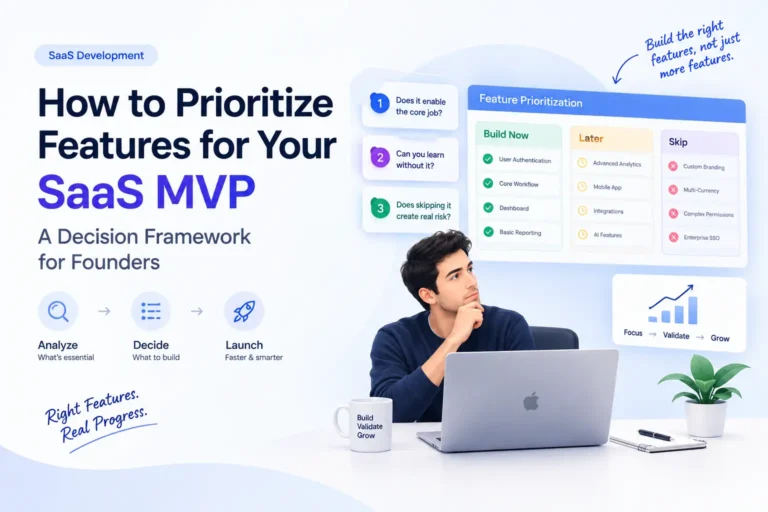
Not sure what belongs in your first version? Read what an MVP in app development should include and how to prioritize features for a SaaS MVP.
Fixed Price vs Hourly: Which Is Better for an MVP?
For most first-time founders, a fixed price with milestones is safer. You know the total cost upfront, you see working progress at every stage, and changes are agreed before they are added. Hourly billing can work for ongoing products with changing priorities, but it makes budgeting harder for a first launch.
How PWH Services Prices an MVP
At PWH Services, we start by defining the one user journey worth building, then send a fixed, itemized quote within 24 hours. You pay per milestone and approve each stage after seeing a working demo. You own the code, repository and app store accounts from day one, and every project includes post-launch support. We have delivered 87+ projects for clients in 14+ countries.
Want a clear number for your idea? Explore our MVP development services or book a free 30-minute call.
Frequently asked questions
Most app MVPs cost $15,000 to $60,000. No-code MVPs can start around $3,000, and complex SaaS MVPs can exceed $100,000.
A typical MVP takes 8 to 16 weeks from scoping to launch. See our guide on how long it takes to build an app for timelines by app type.
Usually yes at the start, but no-code platforms can limit custom features and scaling. Many founders later move to custom code once the idea is proven.
Limit the first version to one core user journey, use a cross-platform framework and rely on existing services for payments and login.
A fixed price with milestones is usually safer for a first launch because you know the total cost and approve each stage before you pay.
Written by the PWH Services team, who design and build mobile apps, websites and AI products for startups and growing businesses.