
Introduction: The Real Problem is Not Execution
At PWH Services, we’ve worked alongside product leaders, engineering teams, and UX designers across different industries. And we’ve seen the same uncomfortable pattern your team has likely felt too. Transformation efforts stall. Not because people aren’t working hard. Not because sprints aren’t happening. But because leadership often misdiagnoses the problem.
Too many organizations introduce Agile, Lean UX, and Design Thinking as bandaids for slow delivery. That misses the point entirely. These approaches weren’t born to make you faster. They were built to help you navigate uncertainty—something that static roadmaps and annual plans simply cannot handle.
When Agile fails, it’s rarely a team skill issue. It’s a mindset gap. Without that shift, Agile becomes a calendar of ceremonies, UX becomes a handoff, and quality becomes a final inspection instead of a shared habit.
We’ve seen teams hit every sprint commitment. Velocity charts looked beautiful. But customers were unhappy, and the product lost relevance. Execution was fine. Strategy was missing.
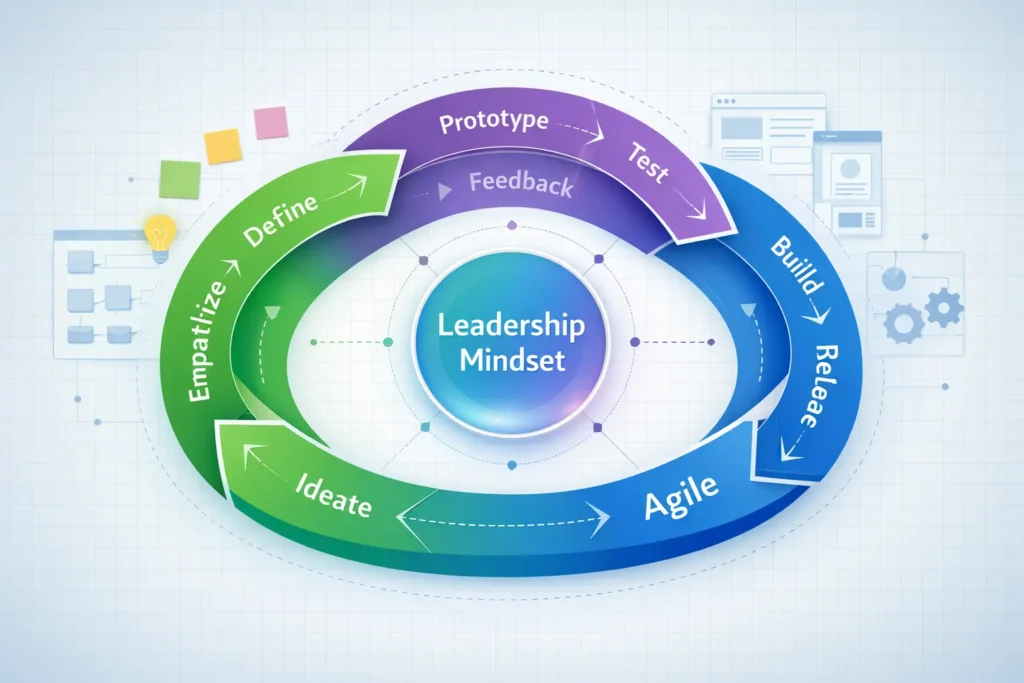
This post explores how Agile, Lean UX, and Design Thinking work best as one integrated system—not separate silos. When combined, they create a leadership mindset that prioritizes learning, quality, and long-term value.
Agile is Not a Methodology. It is a Leadership Philosophy
Let’s clear this up right away. Agile is not Jira. It’s not stand-ups or story points. At PWH Services, we’ve learned that treating Agile as just a methodology guarantees mediocrity.
Agile is actually a belief system. It assumes you cannot know everything upfront. Change is not a failure—it’s information. And the people doing the work usually have the best answers.
This aligns closely with Carol Dweck’s growth mindset. You embrace uncertainty. You treat mistakes as learning, not shame.
A fixed mindset wants guarantees. It avoids change and hides failure.
We once consulted for a team that did every Agile ceremony perfectly. But every meaningful decision still came from a manager outside the team. When user research revealed late insights, leadership called it “scope creep.” On paper, they looked Agile. In reality, nothing changed.
Organizations that “do Agile” without “being Agile” keep old command structures. They demand accurate estimates but also flexibility. They measure output, not outcomes.
That mismatch hurts quality. Teams move faster but break more things. UX gets squeezed. Testing becomes firefighting.
Why the Agile Manifesto Still Matters to Executives
The Agile Manifesto is over twenty years old. That’s ancient in tech years. But its values haven’t aged a day.
Why? Because it doesn’t prescribe tactics. It protects priorities:
People over process
Outcomes over artifacts
Collaboration over contracts
Adaptation over plans
These aren’t engineering tips. They are leadership principles.
At PWH Services, we’ve seen marketing teams launch campaigns using Agile thinking. Instead of spending a full budget upfront, they ran small experiments. Within weeks, they knew what messaging worked. That’s Agile outside software.
Executives sometimes ask if Agile still applies to them. The answer is yes—anywhere uncertainty exists.
Early Value is a Risk Strategy, Not a Speed Tactic
Here’s a common misunderstanding. “Deliver early and often” does not mean “go faster.” It means reduce risk.
Smaller releases lower the cost of being wrong. They shorten feedback loops. They expose bad assumptions before you’ve spent millions.
We once saw a product delayed for months to make it “perfect.” When it finally launched, users couldn’t complete basic tasks. A small, early release would have revealed those problems in weeks, not months, at a fraction of the cost.
That’s not slow vs. fast. That’s learning vs. guessing.
For quality and governance, this matters deeply. Big, late releases hide risks—usability, security, compliance. Early delivery lets you validate direction before doubling down.
Waterfall and Agile Reflect Different Beliefs About Control
Waterfall believes control comes from prediction. Agile believes control comes from adaptation.
Waterfall fixes requirements upfront. Testing happens late. Success = following the plan.
Agile evolves requirements. Testing is continuous. Success = delivering value.
Neither is wrong. Waterfall works when problems are simple and stable. Agile shines when uncertainty is high.
The real pain happens when leadership thinks in Waterfall but asks teams to execute in Agile. That tension burns UX and QA the most—because they depend on early learning and feedback.
Why Agile Without UX Creates False Confidence
An Agile team can deliver working software on time, every time. But working software is not the same as a successful product.
Without strong UX integration:
Teams optimize for internal efficiency, not user happiness
Usability issues are found late and cost a fortune to fix
Quality metrics go up while customer satisfaction goes down
We’ve seen releases pass every test, hit every performance target, and still fail within days because users couldn’t figure out basic workflows. That’s not a bug problem. That’s a discovery problem.
Design Thinking: Governing the Problem Space
Design Thinking asks one simple, powerful question: Are we solving the right problem?
Before jumping to solutions, it pushes teams to understand users. Build empathy. Define the problem clearly. Explore options before committing.
For leaders, this is a risk management tool. It prevents you from investing months of work into a solution nobody needs.
At PWH Services, we’ve seen this bring clarity to QA and product teams too. When the problem is well understood, acceptance criteria write themselves. Surprises drop dramatically.
Design Thinking doesn’t replace Agile. It guides it.
Lean UX: Governing Assumptions Through Evidence
Lean UX changes how you treat ideas. Instead of requirements as fixed commands, you treat them as hypotheses to test.
Documentation takes a backseat. Experiments drive decisions. Opinions get replaced by real user evidence.
Lean UX asks: Are we building the right thing?
We once watched a team debate a design for two weeks. Personal opinions flew everywhere. Then they tested a simple prototype with five real users. The main assumption was wrong in two days. That small test saved weeks of development.
By validating early, Lean UX reduces waste and aligns product, design, and engineering. Failure becomes learning, not blame.
From a quality view, this is gold. Usability risks surface earlier. Tests match real user behavior.
Agile: Governing Execution Under Change
Once you understand the problem and have validated the direction, Agile becomes your execution engine.
Now the question shifts to: Are we building it correctly?
Agile gives you incremental delivery, continuous integration, frequent testing, and the ability to pivot when needed.
But Agile alone is dangerous. You can build the wrong thing very efficiently. That’s why Design Thinking and Lean UX must come first. Together, they create a continuous learning loop.
UX inside Scrum: From Support Function to Strategic Role
In too many Scrum teams, UX is treated as a shared service. Someone to hand designs to. That model consistently delivers poor outcomes.
A mature model treats UX as:
A full-time embedded team member
An equal partner in decisions
A daily advocate for user value
When we’ve helped teams integrate UX fully, backlog prioritization improves, acceptance criteria get clearer, and rework drops noticeably. Quality improves by design, not by inspection.
Actionable Strategy: Learning as a Management Discipline
An actionable strategy is not a 50-page document locked in a drive. It is:
Lightweight
Quick to adapt
Focused on learning
Measurement exists to inform decisions, not control people. Ask one question honestly: Is it working?
Organizations that act to learn consistently outperform those that plan to predict.
Why the Sequence Matters
These three practices follow a natural order:
Design Thinking – Explore and understand the problem
Lean UX – Test assumptions and validate solutions
Agile – Deliver in small, adaptable increments
Skip a step, and risk multiplies. Change the order, and you build waste. Leaders who protect this sequence invest based on evidence and stay flexible.
Strategy as Continuous Learning
A great strategy stays alive. It changes when the market changes. It breathes.
The best strategies we’ve seen at PWH Services are:
Lightweight enough to adjust weekly
Focused on learning, not forecasting
Measured by value delivered, not activities completed
Measurement is not a control tool. It’s a decision tool. Ask: Is this working? Then act on the answer.
Conclusion: From Delivery to Value Creation
Agile, Lean UX, and Design Thinking are not trends. They are mature responses to uncertainty.
Used alone, they help a little. Used together, they form a learning system that produces quality, innovation, and trust.
At PWH Services, we’ve seen quality emerge—not from checklists or gates—but from clarity, early learning, and shared ownership.
The real promise of Agile isn’t speed. It’s sustained value. And that’s a leadership conversation, not a team task.