 Skip to content
Mobile App Monetization Strategies: How to Price Your App for Maximum Revenue
Key Takeaways
- Choosing the right mobile app monetization strategy before development can significantly increase revenue and reduce costly product changes later.
- The most effective app monetization models include subscriptions, freemium, in-app purchases (IAPs), advertising, paid apps, and enterprise licensing.
- Subscription-based apps typically generate the highest lifetime value (LTV) when paired with strong user retention.
- Freemium models work best for apps with large audiences and viral growth potential.
- Rewarded video ads deliver better user experience and higher revenue than traditional banner ads.
- Metrics such as ARPU, LTV, churn rate, and conversion rate are essential for measuring monetization success.
- Successful monetization starts during product planning—not after launch.
Why Mobile App Monetization Strategy Matters More Than Features
Many startups focus on features, design, and development timelines. However, one of the biggest reasons mobile apps fail is poor monetization planning.
A monetization strategy isn’t just about pricing. It influences:
- User onboarding experience
- Feature prioritization
- Product architecture
- Payment infrastructure
- Customer retention
- Long-term profitability
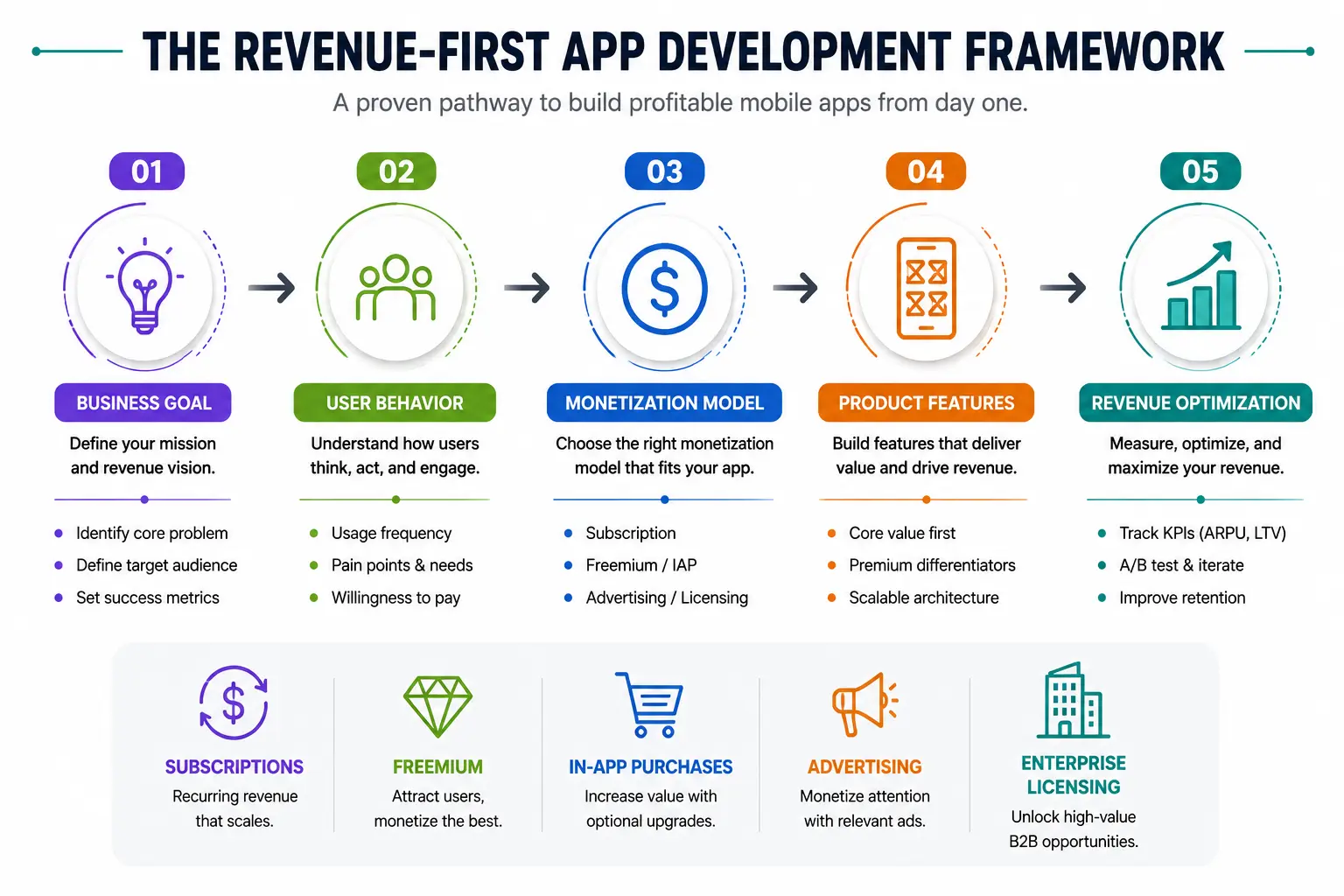
The most successful apps build their revenue model into the product from day one.
At PWH Services, our mobile app development team designs products with revenue generation in mind, ensuring businesses can scale sustainably after launch.
The Revenue-First App Development Framework
What Are the Main Mobile App Monetization Strategies?
The six most common mobile app monetization strategies are:
| Monetization Model | Best For | Revenue Potential | User Friction |
|---|---|---|---|
| Subscription | Productivity, Fitness, SaaS | High | Medium |
| Freemium | Social, Community Apps | High | Low |
| In-App Purchases | Gaming, Utilities | High | Low |
| Paid Apps | Professional Tools | Medium | High |
| Advertising | High-Traffic Apps | Medium | Low |
| Enterprise Licensing | B2B Applications | Very High | Low |
1. Subscription Model
What is a Subscription App?
A subscription model charges users recurring monthly or annual fees for continued access.
Examples:
- Notion
- Headspace
- Calm
- Duolingo
Why Subscriptions Generate the Highest Revenue
Subscriptions create predictable recurring revenue while increasing customer lifetime value.
Benefits include:
- Consistent cash flow
- Higher retention opportunities
- Better investor appeal
- Easier revenue forecasting
Best For
- Productivity apps
- Health and fitness apps
- Learning platforms
- SaaS mobile applications
Recommended Pricing Structure
| Plan | Example Price |
| Monthly | $7.99-$14.99 |
| Annual | $59-$99 |
Annual plans should offer 30-50% savings to encourage long-term commitment.
2. Freemium Model
What is Freemium?
Freemium apps offer basic functionality for free while charging for premium features.
Popular examples include:
- LinkedIn Premium
- Spotify
- Dropbox
When Should You Use Freemium?
Choose freemium if:
- You need rapid user acquisition
- Your market is highly competitive
- Your app benefits from network effects
- Viral growth is possible
Freemium vs Subscription
| Factor | Freemium | Subscription |
|---|---|---|
| User Acquisition | Excellent | Moderate |
| Revenue Predictability | Medium | High |
| Scalability | High | High |
| Conversion Required | Yes | Yes |
3. In-App Purchases (IAP)
What Are In-App Purchases?
In-app purchases allow users to buy digital products within the app.
Types include:
Consumable Purchases
Users can buy repeatedly.
Examples:
- Coins
- Tokens
- Credits
- Extra lives
Non-Consumable Purchases
One-time purchases.
Examples:
- Premium tools
- Feature unlocks
- Ad removal
Best Practices for IAP Success
- Show purchase options after users experience value
- Create multiple pricing tiers
- Offer limited-time promotions
- Avoid aggressive upselling
4. In-App Advertising
How Do Free Apps Make Money?
Many free apps generate revenue through advertising.
Popular formats include:
| Ad Type | Revenue Potential | User Experience |
|---|---|---|
| Banner Ads | Low | Moderate |
| Interstitial Ads | Medium | Disruptive |
| Native Ads | Medium | Better |
| Rewarded Video | High | Excellent |
When Does Advertising Work?
Advertising works best when:
- You have over 100,000 monthly active users
- Sessions occur frequently
- Users consume content regularly
When Should You Avoid Ads?
Avoid ads in:
- Healthcare apps
- Finance apps
- Productivity apps
- Enterprise applications
These categories rely heavily on trust and focus.
5. Paid Apps
Should Users Pay Before Downloading?
Paid apps require users to purchase before installation.
This model works best when:
- The app solves a specialized problem
- The audience understands the value
- Competition is limited
Examples:
- Professional tools
- Industry-specific utilities
- Creative applications
While this model offers immediate revenue, it typically limits user acquisition.
6. Enterprise Licensing
How Does B2B App Monetization Work?
Enterprise apps are often sold through annual contracts rather than app store purchases.
Common pricing models include:
- Per-user licensing
- Usage-based pricing
- Annual enterprise contracts
Enterprise buyers prioritize:
- Security
- Compliance
- Single Sign-On (SSO)
- SLA guarantees
- Dedicated support
For B2B mobile applications, enterprise licensing often produces the highest revenue per customer.
How Do You Choose the Right Monetization Strategy?
The PWH Revenue Architecture Framework™
Use these four questions:
1. How Often Will Users Use Your App?
- Daily → Subscription
- Weekly → Freemium
- Occasionally → Paid App
2. How Large Is Your Market?
- Large audience → Freemium
- Niche audience → Premium pricing
3. What Problem Are You Solving?
- Ongoing problem → Subscription
- One-time need → Paid app
4. How Will You Acquire Users?
- Organic growth → Freemium
- Paid acquisition → Subscription
- Sales-driven → Enterprise licensing
Decision Matrix
| User Frequency | Market Size | Recommended Model |
|---|---|---|
| High | Large | Freemium + Subscription |
| High | Small | Subscription |
| Low | Large | Freemium + In-App Purchases (IAP) |
| Low | Small | Paid App |
What Metrics Measure Monetization Success?
ARPU (Average Revenue Per User)
Formula:
Revenue ÷ Active Users
Measures revenue efficiency.
LTV (Lifetime Value)
Formula:
Average Revenue × Customer Lifetime
Shows long-term profitability.
Churn Rate
Measures subscriber loss.
Healthy benchmark:
- Consumer apps: 3%-7%
- SaaS apps: 1%-3%
Free-to-Paid Conversion Rate
Measures how effectively free users become paying customers.
Typical benchmark:
- Freemium apps: 2%-5%
- Productivity apps: 5%-15%
Why Businesses Choose PWH Services for Mobile App Development
Building a profitable mobile application requires more than coding. It requires a revenue strategy aligned with user behavior, market demand, and long-term growth.
At PWH Services, we help businesses design, develop, and optimize mobile applications with monetization built into the product strategy from day one.
Our approach includes:
- Revenue model planning
- Mobile app strategy workshops
- Subscription architecture
- In-app purchase implementation
- Payment gateway integration
- Analytics and KPI tracking
- App Store and Google Play optimization
Whether you’re building a startup MVP, SaaS platform, enterprise solution, or consumer mobile application, our team helps transform ideas into revenue-generating products.
Explore our Mobile App Development Services and discover how a strategic monetization approach can maximize your app’s growth and profitability.
Contact Our Mobile App Development Team
OR
