 Skip to content
Key Takeaways
- Healthcare businesses are investing in better software to improve patient experiences, streamline operations, and prepare for future growth.
- Modern healthcare software helps reduce manual work, improve communication, automate repetitive tasks, and provide better access to patient information.
- From clinics and hospitals to wellness centers and healthcare startups, organizations are replacing outdated systems with smarter digital solutions.
- Investing in the right software is no longer just an IT decision—it’s a business strategy that improves efficiency, patient satisfaction, and long-term competitiveness.
- Choosing the right technology partner is just as important as choosing the right software.
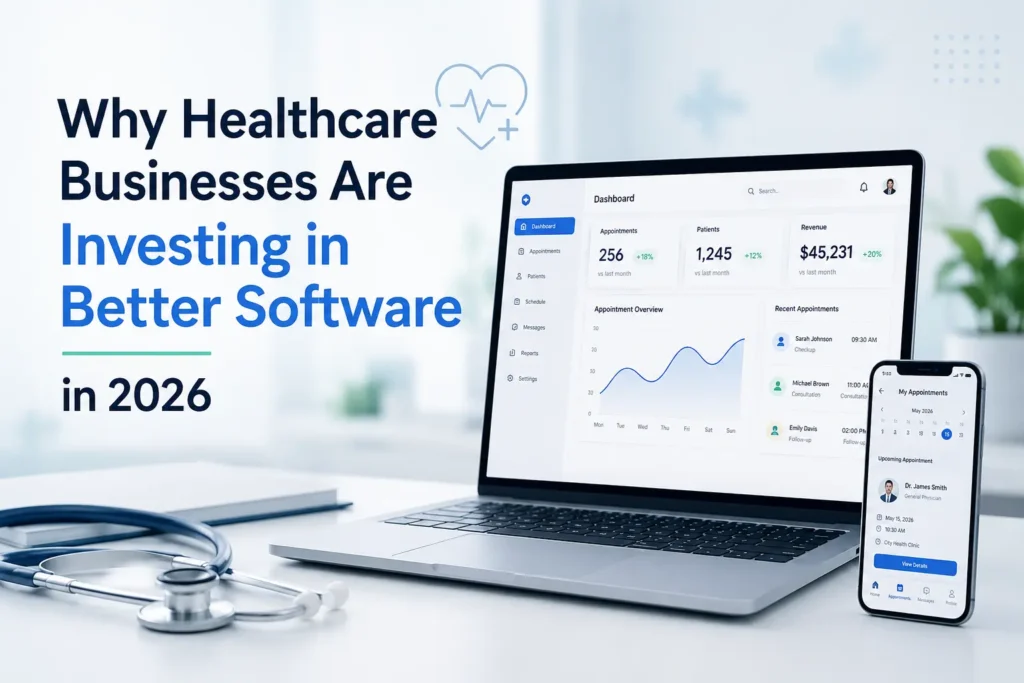
Why Healthcare Businesses Are Investing in Better Software in 2026
Healthcare has changed dramatically over the past few years.
Patients now expect the same digital convenience from healthcare providers that they receive from banks, online retailers, and food delivery apps. They want to book appointments online, receive instant reminders, access medical records securely, and communicate with healthcare providers without unnecessary delays.
At the same time, healthcare businesses face growing operational challenges.
Managing appointments, maintaining patient records, coordinating staff, handling billing, and ensuring data security have become increasingly complex. Many clinics and healthcare organizations still rely on outdated software or worse, spreadsheets and manual processes that slow down daily operations and make it difficult to deliver a modern patient experience.
This is why more healthcare businesses are investing in better software in 2026.
They’re not upgrading technology simply to stay current they’re investing because better software helps solve real business problems.
Whether it’s a private clinic, hospital, diagnostic center, physiotherapy practice, wellness business, or healthcare startup, the right software can improve productivity, reduce administrative workload, and create a smoother experience for both staff and patients.
In this guide, you’ll learn:
- Why healthcare businesses are replacing outdated systems
- The biggest benefits of investing in modern healthcare software
- What features organizations should prioritize
- How better software supports long-term business growth
- What to consider before choosing a software development partner
If you’re planning to modernize your healthcare business, this article will help you understand why software has become one of the most valuable investments organizations can make in 2026.
The Digital Transformation of Healthcare
Healthcare is no longer driven by paperwork and manual administration.
Digital transformation has become a necessity rather than a competitive advantage.
Across the healthcare industry, businesses are embracing technology to improve patient care while simplifying internal operations.
Today’s healthcare organizations are adopting digital solutions such as:
- Online appointment scheduling
- Electronic patient records
- Mobile healthcare applications
- Telemedicine platforms
- Secure patient portals
- AI-powered administrative tools
- Automated appointment reminders
- Business intelligence dashboards
These technologies don’t replace healthcare professionals—they allow them to spend less time on administrative work and more time focusing on patients.
Organizations that delay digital transformation often experience:
- Longer waiting times
- Scheduling conflicts
- Duplicate data entry
- Poor communication
- Higher administrative costs
- Lower patient satisfaction
Meanwhile, healthcare providers investing in modern software are improving efficiency while creating better experiences for everyone involved.
Why Better Software Matters More Than Ever
Technology should make healthcare easier—not more complicated.
Unfortunately, many organizations continue to use software that no longer supports the way they operate.
Some businesses use multiple disconnected systems that don’t communicate with one another.
Others rely on outdated platforms that cannot grow alongside their business.
These challenges lead to unnecessary frustration for both employees and patients.
Modern healthcare software helps eliminate these problems by bringing essential operations into one secure and easy-to-manage platform.
Instead of switching between multiple tools, healthcare teams can manage appointments, patient information, communication, reporting, and daily workflows from a centralized system.
The result is faster operations, fewer errors, and more time to focus on delivering quality care.
Signs Your Healthcare Business Needs Better Software
Many healthcare organizations don’t realize how much outdated systems are costing them until problems begin affecting daily operations.
If any of the following situations sound familiar, it may be time to upgrade your technology.
Your Staff Spends Too Much Time on Administrative Tasks
Receptionists and administrators often spend hours every week:
- Confirming appointments
- Updating patient information
- Managing paperwork
- Coordinating schedules
- Answering repetitive questions
Modern healthcare software automates many of these routine tasks, allowing staff to focus on higher-value work.
Patients Expect More Than Your Current System Can Deliver
Today’s patients expect convenience.
They want to:
- Book appointments online
- Receive automatic reminders
- Access information digitally
- Communicate through secure channels
- View their healthcare history when needed
If your current system can’t support these expectations, patients may choose providers who offer a better digital experience.
Your Business Is Growing Faster Than Your Software
Growth is exciting—but it also exposes limitations.
As healthcare businesses expand, they often add:
- More staff
- Additional services
- Multiple locations
- Larger patient databases
- New operational processes
Software that worked for a single clinic may struggle to support a growing organization.
Investing in scalable healthcare software ensures your technology grows with your business rather than becoming an obstacle.
Manual Processes Are Increasing Errors
Human errors become more common when teams rely on paper records, spreadsheets, or disconnected systems.
Common problems include:
- Double bookings
- Missing patient information
- Scheduling conflicts
- Billing mistakes
- Lost documentation
Better software helps reduce these issues by centralizing information and automating repetitive workflows.
Better Software Is an Investment—Not Just an Expense
Many business owners initially view software as another operational cost.
In reality, the right healthcare software often becomes one of the highest-return investments an organization can make.
Instead of simply replacing old technology, better software helps businesses:
- Save staff time
- Improve patient satisfaction
- Reduce operational costs
- Increase efficiency
- Support long-term growth
- Stay competitive in an increasingly digital healthcare industry
The question is no longer whether healthcare businesses should invest in better software—it’s how to choose the right solution for their future.
The Biggest Benefits of Investing in Better Healthcare Software
Modern healthcare software does much more than digitize paperwork.
It transforms the way healthcare businesses operate by improving efficiency, strengthening patient relationships, and creating a foundation for long-term growth.
Let’s explore the biggest reasons why healthcare organizations are making this investment.
1. Better Patient Experience
Patient expectations continue to evolve.
People expect healthcare services to be as convenient as booking a hotel or ordering food online.
Modern healthcare software makes this possible by offering:
- Online appointment booking
- Automated appointment reminders
- Digital registration forms
- Secure patient portals
- Faster communication
- Mobile-friendly experiences
When patients spend less time waiting and more time receiving care, overall satisfaction improves.
A positive digital experience also increases patient trust and encourages long-term loyalty.
2. Less Administrative Work
Administrative tasks consume a significant portion of a healthcare team’s day.
Receptionists and administrative staff often spend hours:
- Managing appointments
- Answering repetitive phone calls
- Updating patient records
- Sending reminders
- Preparing reports
Modern software automates many of these routine processes.
Instead of manually confirming appointments, the system can automatically send SMS or email reminders.
Instead of maintaining spreadsheets, patient information is securely stored in one centralized platform.
Automation saves valuable time while reducing the risk of human error.
3. Improved Team Productivity
When healthcare professionals have quick access to the information they need, they can focus on delivering better care.
Better healthcare software enables staff to:
- Access patient records instantly
- View appointment schedules
- Coordinate with team members
- Generate reports
- Track daily operations
Rather than searching through paperwork or multiple disconnected systems, everything is available in one organized dashboard.
This improves collaboration and helps teams work more efficiently.
4. Smarter Business Decisions Through Data
Every healthcare business generates valuable information every day.
The challenge is turning that information into meaningful insights.
Modern healthcare software provides reporting and analytics that help businesses understand:
- Appointment trends
- Patient retention
- Revenue performance
- Staff utilization
- No-show rates
- Service demand
Instead of relying on assumptions, business owners can make informed decisions based on real data.
5. Better Data Security
Healthcare organizations handle highly sensitive patient information.
Protecting that information is essential for maintaining trust and ensuring business continuity.
Modern healthcare software includes features such as:
- Secure authentication
- Role-based access control
- Encrypted databases
- Regular backups
- Activity logs
- Cloud security
These measures help reduce security risks while protecting confidential healthcare data.
6. Easier Business Growth
Many clinics begin with a small team and a single location.
As the business grows, operational complexity increases.
Modern software supports growth by making it easier to:
- Add new staff
- Open additional locations
- Expand services
- Increase patient capacity
- Integrate new technologies
Instead of replacing systems every few years, scalable software grows alongside your business.
Features Every Modern Healthcare Software Solution Should Include
Choosing better software isn’t about finding the platform with the longest feature list.
It’s about selecting features that genuinely improve daily operations.
Some of the most valuable features include:
Appointment Scheduling
Patients should be able to book appointments online while staff manage schedules from a centralized dashboard.
Patient Management
Healthcare teams need secure access to:
- Patient profiles
- Visit history
- Treatment notes
- Contact information
Everything should be organized and easy to retrieve.
Staff Management
Managing practitioner availability becomes much easier when schedules, shifts, and calendars are connected within one platform.
Billing and Payments
Integrated billing systems simplify payment tracking, invoicing, and financial reporting while reducing administrative workload.
Patient Communication
Built-in messaging, email notifications, and appointment reminders improve communication while reducing missed appointments.
Mobile Accessibility
Healthcare professionals increasingly rely on mobile devices.
Modern software should provide responsive web applications or dedicated mobile apps that allow staff to access important information wherever they are.
AI-Powered Automation
Artificial Intelligence is becoming a valuable addition to healthcare software.
Examples include:
- Intelligent appointment scheduling
- Automated patient reminders
- Smart document processing
- Predictive reporting
- Workflow automation
- AI-powered chat assistants
These tools help organizations reduce repetitive work while improving operational efficiency.
Better Software Is Also Better for Patients
Technology investments don’t just benefit healthcare providers—they improve the patient journey as well.
Patients appreciate software that makes healthcare more convenient.
Simple improvements such as:
- Online booking
- Faster check-in
- Digital forms
- Secure communication
- Mobile access
- Appointment reminders
can significantly improve the overall experience.
Satisfied patients are more likely to:
- Return for future visits
- Recommend your services
- Leave positive online reviews
- Build long-term relationships with your healthcare organization
In today’s competitive healthcare environment, patient experience has become just as important as clinical excellence.
Connecting Technology with Business Growth
Healthcare businesses that invest in better software aren’t simply adopting new technology—they’re building a stronger foundation for future growth.
Modern software helps organizations operate more efficiently, respond faster to patient needs, and scale confidently as demand increases.
How to Choose the Right Healthcare Software for Your Business
Investing in better healthcare software is an important decision—but choosing the right solution is even more important.
Not every healthcare business has the same requirements.
A single-doctor clinic, a multi-location hospital, a diagnostic laboratory, and a wellness startup all have different workflows and long-term goals.
Instead of asking, “Which software is the best?”, ask:
“Which software is the best fit for my business?”
Here are the key factors to consider before making your investment.
Understand Your Business Goals First
Technology should solve business problems.
Before comparing software providers or features, clearly define what you want to improve.
For example:
- Reduce appointment scheduling issues
- Improve patient communication
- Manage patient records more efficiently
- Automate repetitive administrative tasks
- Support multiple clinic locations
- Launch a patient mobile application
- Improve reporting and business insights
When your goals are clear, choosing the right software becomes much easier.
Choose Software That Can Grow with You
Many healthcare businesses buy software that works for today—but not for tomorrow.
As your organization grows, you’ll likely need:
- More users
- More locations
- Additional services
- Mobile applications
- AI-powered automation
- Third-party integrations
- Advanced reporting
Choosing scalable software from the beginning saves both time and money in the future.
Prioritize User Experience
The best healthcare software is software your team actually enjoys using.
A clean, intuitive interface means:
- Faster staff training
- Fewer mistakes
- Higher productivity
- Better patient service
If employees struggle to use the system, efficiency quickly decreases.
Always prioritize usability over unnecessary complexity.
Look Beyond Features
A long list of features doesn’t always mean better software.
Focus on features that solve real problems.
For example:
Instead of asking:
“Does it have 100 features?”
Ask:
“Will these features save my staff time and improve patient care?”
The right software should simplify your daily operations, not make them more complicated.
Think Long-Term, Not Short-Term
Some businesses choose software based only on upfront cost.
However, the lowest-priced solution isn’t always the most valuable.
Think about:
- Future upgrades
- Ongoing support
- Scalability
- Integration capabilities
- Security updates
- Long-term ownership
A solution that supports your business for years often delivers a much better return on investment.
Why Many Healthcare Businesses Choose Custom Software
Off-the-shelf healthcare software can work well for organizations with simple and standardized workflows.
However, as businesses expand, many discover that generic platforms no longer meet their needs.
Common challenges include:
- Limited customization
- Paying for features they don’t use
- Missing features they actually need
- Difficult integrations
- Restricted scalability
- Generic patient experiences
This is why many healthcare organizations eventually invest in software built specifically around their business.
Custom healthcare software gives organizations the flexibility to create workflows that match how they actually operate.
Instead of changing your processes to fit the software, the software is designed around your processes.
How PWH Services Helps Healthcare Businesses
At PWH Services, we believe healthcare technology should solve business challenges, not create new ones.
We work with healthcare providers, wellness businesses, startups, and growing organizations to design and develop software that improves operations while delivering exceptional user experiences.
Our healthcare solutions include:
- Healthcare Web Applications
- Healthcare Mobile Apps
- Clinic Management Systems
- Hospital Management Platforms
- Patient Portals
- Appointment Booking Systems
- AI Integration & Automation
- Business Process Automation
- Custom Software Development
Every solution is designed with scalability, security, and usability in mind so your business can continue growing without technology becoming a limitation.
If you’re exploring healthcare technology solutions, you can discover our App Solutions to learn about the platforms we build, browse our Portfolio to see completed client projects, or explore our Partner Program if you’re looking to collaborate on innovative digital healthcare solutions.
Whether you’re planning your first healthcare platform or upgrading an existing system, our team can help you identify the right technology strategy for your goals.
You can also Contact PWH Services directly or Book a Free 30-Minute Consultation with our experts. We’ll discuss your project, answer your questions, and recommend the best approach based on your business—not a one-size-fits-all solution.
Final Thoughts
Healthcare is becoming more digital every year, and businesses that embrace modern technology are better positioned to deliver exceptional patient care while operating more efficiently.
Better software isn’t simply about replacing outdated systems.
It’s about creating a smarter, faster, and more connected healthcare experience for patients, staff, and business owners alike.
Whether your goal is improving appointment management, launching a healthcare mobile app, streamlining operations, or preparing your organization for future growth, investing in the right software can become one of the most valuable business decisions you make.
The healthcare organizations leading the industry in 2026 aren’t necessarily the largest.
They’re the ones using technology to work smarter, serve patients better, and continuously adapt to changing healthcare needs.
