
You have a startup idea. You understand the problem, and you may already know who your first customers are. What you don’t have is a technical co-founder, and every way of getting a product built looks risky.
If that sounds familiar, you are in good company. Most first-time founders start here. The good news is that building an MVP as a non-technical founder is very doable. The hard part is not the code. It is choosing the right way to build it and the right people to build it with.
This guide walks you through that choice in plain language.
In this guide, you’ll learn:
- What an MVP really is (and what it is not)
- How to define your first version on a single page
- How agencies, freelancers, no-code tools and AI builders compare
- When no-code is enough and when you need real developers
- How to judge a development team when you can’t read code
- What drives MVP cost and timeline
- The mistakes that waste most first-time budgets
Quick answer: If your idea needs a custom app or platform, a small experienced agency or a vetted freelancer is usually the safest start. If you only need to test whether people want the idea, a no-code tool can get you there faster and cheaper. Whichever route you pick, fix your scope first and pay against clear milestones.
What an MVP really is
MVP stands for minimum viable product. It is the smallest version of your product that lets real users do the one thing it promises, so you can learn whether they want it. The idea was popularised by The Lean Startup.
An MVP is not a rough draft, a clickable mockup with nothing behind it, or a cut-down copy of your dream product. It is a real product with a very small scope. For the longer definition, read our guide on what an MVP is in app development.
Why does this matter? CB Insights’ research on startup failures keeps listing lack of market need among the top causes (see the analysis). An MVP is the cheapest way to find that out before you spend your whole budget.
Step 1: Define one problem and one user
Before you talk to any developer, write down three things in plain words:
- Who is the user? Be specific. ‘Independent clinic owners’ beats ‘healthcare businesses’.
- What problem do they have right now?
- How do they solve it today, and why is that painful?
If you can’t answer these in a few sentences, no developer can build the right thing either. Talk to five to ten real people from your target group first. It costs almost nothing and often changes the plan. Paul Graham’s essay Do Things That Don’t Scale makes a strong case for learning from users by hand before you build.
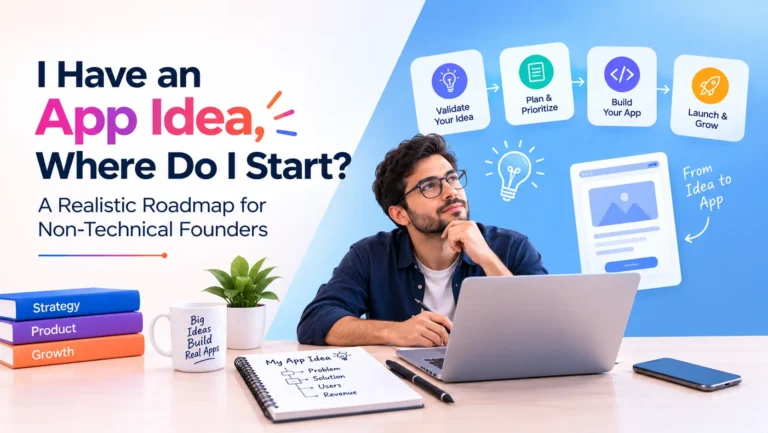
Still at the ‘I have an idea’ stage? Start with our roadmap for non-technical founders and come back here.
Step 2: Write a one-page scope
A good MVP scope fits on one page. Include:
- The one core workflow a user must complete (for example: book, pay, get a confirmation)
- A must-have list of five to seven features at most
- A not now list for everything else
- The platform: web, iOS, Android, or both mobile stores
- Any integrations you can’t avoid, such as payments, maps or AI features
The ‘not now’ list matters as much as the must-have list. Most MVPs go over budget because of features that sounded small. Social login, an admin panel, push notifications and chat each add real time. Ask yourself whether your first 50 users truly need them.
Four ways to build an MVP as a non-technical founder
You have four realistic options. Here is how they compare.
| Option | Best for | Cost | Speed | Main risk |
|---|---|---|---|---|
| Development agency | Custom apps and platforms, with one team handling everything | Medium to high | Steady | Cost goes up if the scope is vague |
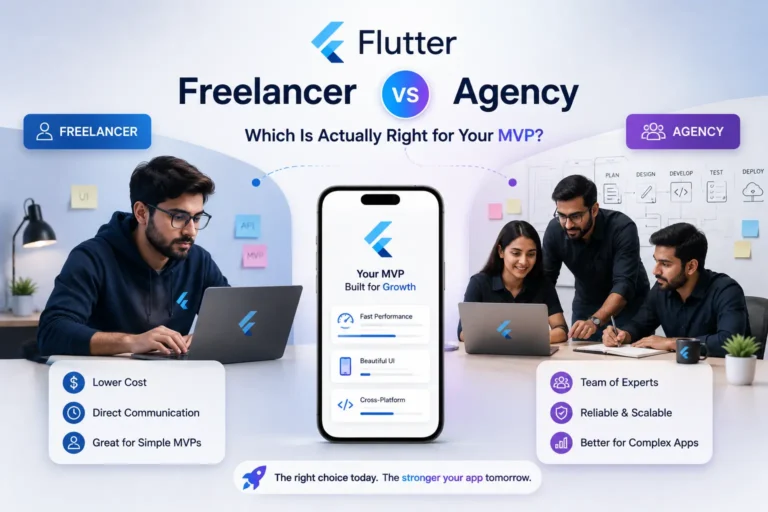
| Freelancer | Small, well-defined builds | Low to medium | Quick to start | One person is a single point of failure |
| No-code tools | Testing demand with a simple workflow | Low | Fast | Limits on custom features and scaling |
| AI app builders | Quick demos and early prototypes | Low | Very fast | Messy code and security gaps at launch |
1. A development agency
An agency gives you a full team: product thinking, design, development, testing and launch. You get one point of contact and a defined process. The trade-off is cost, and quality varies a lot between agencies. This route works best when your idea needs custom logic, a mobile app, or a platform that has to scale.
2. A freelancer
A good freelancer can be a great fit for a small, clearly defined build, and you pay less overhead. The risk is depending on one person. If they get busy or disappear mid-project, you are left with half a product and nobody who understands it. If you go this way, insist on having the code in your own repository from day one.
3. No-code tools
Tools like Bubble, Webflow and FlutterFlow let you build working products without writing code. They are great for testing demand with a simple workflow. The limits show up when you need custom features, complex logic or heavy traffic. Many founders eventually migrate from Bubble, and our guide to FlutterFlow vs native Flutter explains when it is time to move.
4. AI app builders
Tools like Lovable, Bolt and Replit can produce a working demo in a weekend. That is powerful for showing an idea to users or investors. But AI-generated apps often need cleanup before real customers rely on them, especially around security, performance and app store requirements. If you have built something this way and it is starting to break, read how to hire a Lovable developer.
When no-code or AI tools are enough (and when they are not)
Use no-code or AI builders when:
- You are testing demand, not building a business yet
- Your workflow is simple, like forms, listings, bookings or basic dashboards
- You can accept limits on design and custom features
- You plan to rebuild properly once the idea is proven
Bring in developers when:
- You need a native mobile app with a smooth experience
- Your product depends on custom logic, integrations or AI features
- You handle payments, health data or other sensitive information
- Real customers will depend on it every day
A hybrid path works well for many founders. Validate with a no-code or AI prototype first, then rebuild the proven version with a proper team.
How to choose a team when you can’t read code
You don’t need to judge the code. You need to judge the process and the people. Ask these questions:
- Have you built something similar? Ask to see live products or case studies, not just screenshots.
- Who will actually work on my project? Meet the people doing the work, not only the sales contact.
- How do you scope and price? A clear scope, timeline and fixed quote beats a vague hourly estimate.
- Do I approve work in stages? Paying against approved milestones protects you.
- Will I see progress every week? You should be able to try the product on a real device or link, not just read reports.
- Who owns the code? The answer should be you, with access to the repository.
- What happens after launch? Bugs appear. Ask how support and fixes are handled.
Red flags: a price quoted before they understand your idea, no questions about your users, pressure to pay everything upfront, and reviews you can’t verify. Our guide on how to compare app development quotes shows what to look for before you sign.
What affects MVP cost and timeline
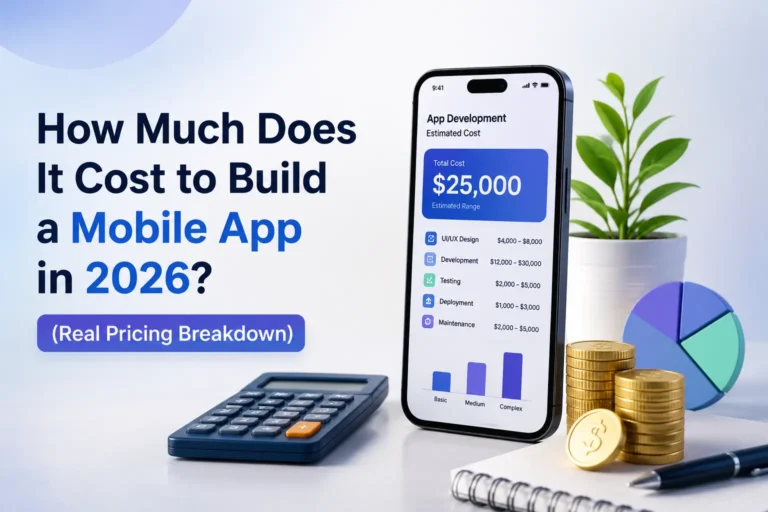
There is no honest single number, because MVPs differ a lot. These factors move the price the most:
- Number and complexity of core features
- Platforms. One platform costs less than iOS and Android together, and cross-platform tools such as Flutter can reduce that gap
- Design depth. A clean, simple interface costs less than a fully branded experience
- Integrations like payments, maps, messaging and AI
- Admin panel and reporting
- Team model and location
Timeline follows the same logic. A narrow MVP can often launch within weeks, while a broader one takes a few months.
At PWH Services, our MVP projects typically start from [ADD YOUR STARTING PRICE] and take [ADD TYPICAL TIMELINE], depending on scope. We send a fixed quote within 24 hours of understanding your idea.
Tip: Freeze your scope first, then ask two or three teams to quote the same feature list. That is the only way to compare like with like.
Seven mistakes non-technical founders make
- Building too many features in version one
- Choosing the cheapest quote without checking the scope behind it
- Skipping user conversations before development starts
- Not owning the code, cloud accounts or app store listings
- Paying everything upfront
- Treating launch as the finish line instead of the start of learning
- Staying out of the process. Join the demos and give feedback quickly
How PWH Services helps founders build their first MVP
PWH Services is a software team founded in 2022. We have delivered 87+ projects for clients in 14+ countries, with a 4.8 rating from 208 Fiverr reviews and 20 Trustpilot reviews. Many of our clients are non-technical founders who needed someone to turn an idea into a working product.
Here is how a project works:
- Discover and define: we clarify your idea and send a clear scope, timeline and fixed quote within 24 hours
- Design and prototype: you review wireframes before any code is written
- Develop and integrate: you get weekly updates and demos
- Test, launch and support: you approve each stage before we move on, and we stay with you after launch
See examples in our portfolio, or learn more about our mobile app development service.
Have an MVP idea? Let’s scope it together.
Tell us what you want to build and get a clear plan, timeline and fixed quote within 24 hours. No pressure, no obligation.
Final thoughts
You don’t need to write code to launch a product. You need a clear problem, a small scope, and a team you can trust to build it. Start narrow, learn from real users, and grow from there.
When you are ready, tell us about your idea and we will send you a fixed quote within 24 hours.
Frequently asked questions
Yes. Many successful products started this way. You can hire an agency or freelancer, or start with a no-code tool. What matters is a clear scope, regular demos and owning your code and accounts.
It depends on features, platforms and integrations. Write your one-page scope first, then ask two or three teams to quote the same list. A simple web MVP costs far less than a cross-platform mobile app with payments and AI features.
A focused MVP can take a few weeks. A wider one with several integrations can take a few months. Cutting features is the most reliable way to shorten the timeline.
If you only need to test demand with a simple workflow, no-code is a sensible first step. If your idea needs a native mobile app, custom logic or sensitive data, hiring developers from the start can save you a rebuild later.
You should. Before you sign, confirm in writing that you will own the source code, design files and accounts, and that you will have access to the repository.
Written by the PWH Services team, who design and build mobile apps, websites and AI products for startups and growing businesses.