Two games with the same number of players can earn very different amounts from ads. One makes a few dollars a day, the other pays its developers’ salaries. The difference is rarely luck. It’s ad format, placement, player location, and how the ads fit the game.
This guide from PWH Services answers a simple question: how much do mobile game ads pay in 2026? It covers how ad revenue is calculated, what each ad format typically earns, worked examples you can apply to your own game, and the practical ways to earn more per player without driving players away.
In this guide:
- The Short Answer
- How mobile game ad revenue is calculated
- How much do mobile game ads pay by format?
- What changes how much you earn
- Worked examples: what a game can earn from ads
- Ads vs in-app purchases vs subscriptions
- How to increase mobile game ad revenue
- When ads are the wrong model
- FAQs
The Short Answer
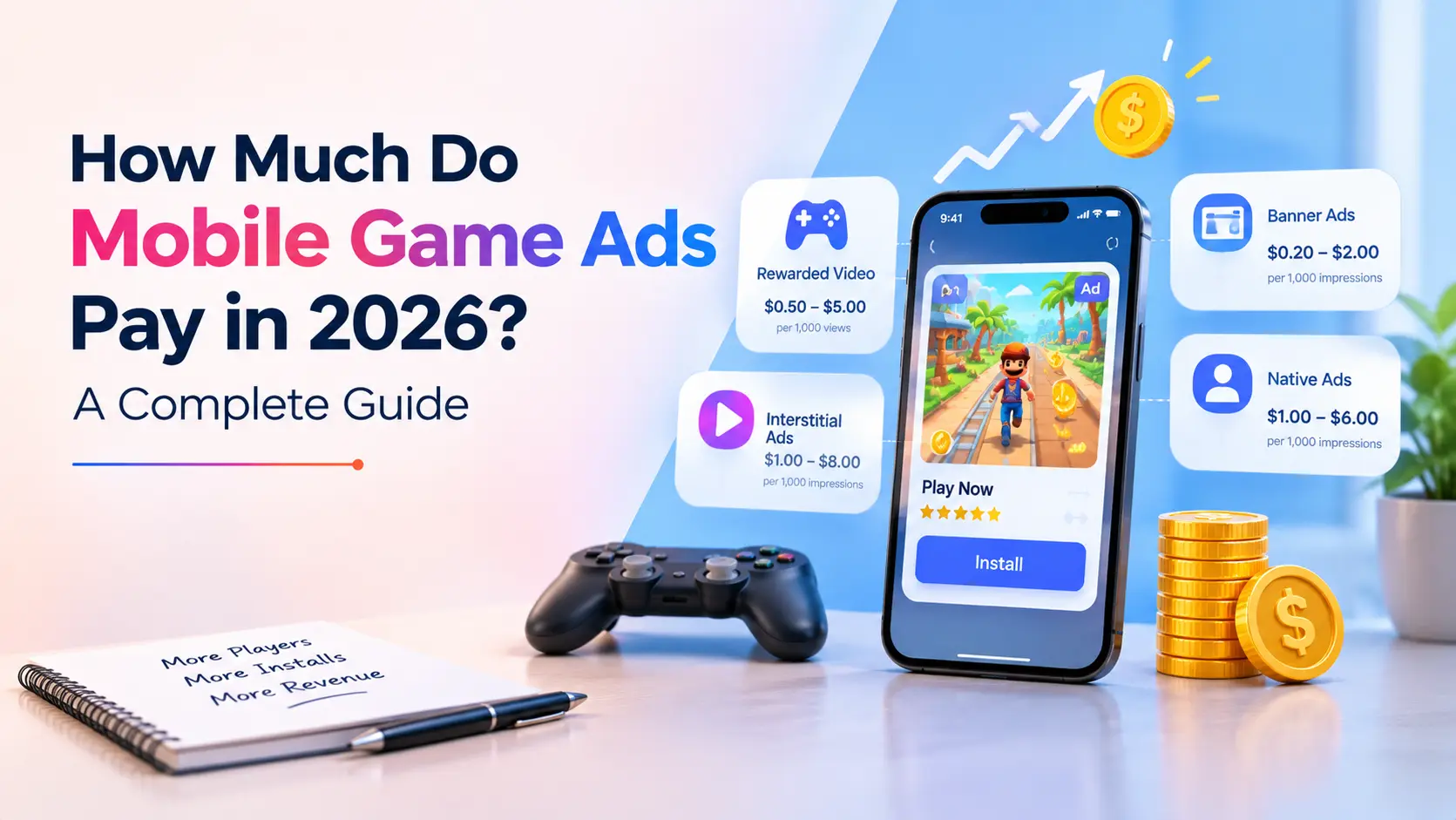
How much do mobile game ads pay? They pay per thousand impressions, measured as eCPM. In 2026, typical ranges are roughly $0.20 to $1.50 for banner ads, $5 to $15 for interstitial ads, and $10 to $25 or more for rewarded video ads, with the highest rates usually coming from players in the US and other high-income markets.
In practice, many ad-supported games earn somewhere between $0.02 and $0.15 per daily active player per day. A game with 10,000 daily players can therefore earn anywhere from about $200 to $1,500 a day from ads, depending mainly on its ad mix and where its players are. These are broad industry ranges, not guarantees, and your own ad network dashboard is the only reliable source for your game.
How Mobile Game Ad Revenue Is Calculated
Mobile game ads are usually paid by impression, by click, or by install. Most developers compare performance with one number: eCPM, or effective cost per mille, meaning earnings per 1,000 ad impressions.
eCPM formula:
eCPM = (Total ad earnings ÷ Total ad impressions) × 1,000
For example, if your game earned $300 from 40,000 impressions, your eCPM is $7.50.
The more useful number for planning is ARPDAU, or average revenue per daily active user:
ARPDAU = Daily ad revenue ÷ Daily active users
If 10,000 players generate $450 in ad revenue today, your ARPDAU is $0.045. ARPDAU tells you what each player is worth to you, which helps you decide how much you can spend to acquire new players.
Other terms you’ll see:
| Term | Meaning | Why it matters |
|---|---|---|
| eCPM | Earnings per 1,000 ad impressions | Compares ad formats and networks |
| ARPDAU | Revenue per daily active player | Shows what each player is worth per day |
| Fill rate | Share of ad requests that actually show an ad | Low fill means lost revenue |
| CPI | Cost per install, what advertisers pay for a new player | Relevant if you buy users |
| ROAS | Return on ad spend | Shows whether paid user acquisition is profitable |
| Mediation | Software that lets several ad networks compete for each impression | Usually raises eCPM |
How Much Do Mobile Game Ads Pay by Format?
These are typical 2026 ranges for players in high-income markets. Rates in other regions are often much lower.
| Ad format | How it works | Typical eCPM | Player experience |
|---|---|---|---|
| Banner | Small ad at the top or bottom of the screen | $0.20 to $1.50 | Low disruption, low earnings |
| Interstitial | Full-screen ad at a natural break, such as between levels | $5 to $15 | Effective but annoying if overused |
| Rewarded video | Player chooses to watch an ad for a reward, such as coins or an extra life | $10 to $25+ | Usually the most player-friendly format |
| Playable | A short interactive demo of another game | Often similar to or higher than rewarded | Engaging, but you don’t control the content |
| Native | Ads styled to match your game’s interface | Varies widely | Can blend in well when designed carefully |
| Offerwall | A list of tasks, such as installing another app, in exchange for rewards | Varies widely | Works best in games with strong in-game economies |
Why rewarded ads usually win: players choose to watch them, so they finish the ad more often, advertisers pay more, and players feel they got something of value. For most casual and mid-core games, rewarded video is the backbone of ad revenue, with interstitials used carefully and banners only where they don’t distract.
What Changes How Much You Earn
Two games can use the same ad format and earn very different eCPMs. The main factors:
- Player location. Players in the US, Canada, the UK, Australia, and Western Europe typically earn several times more per impression than players in lower-income markets.
- Platform. iOS and Android rates differ, and the gap changes over time with privacy rules on each platform.
- Genre. Casual, puzzle, and hyper-casual games depend heavily on ads. Strategy and role-playing games usually earn more from in-app purchases.
- Season. Advertiser budgets usually rise late in the year, during the holiday season, and drop in January.
- Ad mediation. When several networks bid for each impression, prices tend to rise.
- Player consent and privacy settings. Ads that can’t be personalized usually pay less.
- Retention. A game that keeps players for weeks earns far more in total than one players delete after a day.
Worked Examples: What a Game Can Earn From Ads
These examples use simple, illustrative numbers. Plug in your own data from your ad network dashboard.
Example 1: Casual puzzle game with rewarded ads
- 10,000 daily active players
- 3 rewarded ads watched per player per day = 30,000 impressions
- $15 eCPM
- Daily revenue: 30,000 ÷ 1,000 × $15 = $450 a day, or roughly $13,500 a month
Example 2: Same game, adding interstitials
- Add 2 interstitials per player per day = 20,000 more impressions at $8 eCPM
- Extra revenue: 20,000 ÷ 1,000 × $8 = $160 a day
- But if interstitials make 10 percent of players quit sooner, total revenue can fall over time. Test before rolling out to everyone.
Example 3: Same audience, mostly lower-income markets
- Same 30,000 rewarded impressions at a $3 eCPM
- Daily revenue: $90 a day
- Same game, same players, one fifth of the revenue. That’s why player location matters so much.
Ads vs In-App Purchases vs Subscriptions
| Model | How it earns | Best for | Watch out for |
|---|---|---|---|
| Ads only | Advertisers pay per impression, click, or install | Casual and hyper-casual games with large audiences | Needs scale to earn meaningful revenue |
| In-app purchases | Players buy items, currency, or upgrades | Games with deep progression and loyal players | A small share of players usually drives most revenue |
| Hybrid (ads plus purchases) | Rewarded ads for most players, purchases for engaged ones | Most free-to-play games today | Balancing the economy takes testing |
| Subscription or premium | Players pay monthly, or once upfront | Ad-free experiences and niche audiences | Harder to attract players at first |
Most successful free-to-play games use a hybrid model, often with a paid option to remove ads. Our guide to mobile app monetization strategies covers each model in more depth.
Planning a game or app and not sure how it will make money? Tell us about your idea, and we’ll help you plan a monetization model that fits your players, with an itemized fixed quote within 24 hours. Get a free consultation.
How to Increase Mobile Game Ad Revenue
- Lead with rewarded ads. Offer real value, such as an extra life or bonus coins, at moments when players want it.
- Place interstitials at natural breaks. Between levels, never in the middle of play.
- Cap frequency. Limit how many ads one player sees per session and per day.
- Use mediation. Let several ad networks compete for every impression. Common platforms include AdMob, AppLovin MAX, and Unity LevelPlay.
- Test one change at a time. Use A/B tests to compare placements and frequencies, and watch retention, not just revenue.
- Offer a paid “remove ads” option. Some players will happily pay to skip ads, which adds a second revenue stream.
- Keep ads fast. Slow-loading ads hurt both earnings and reviews.
- Respect privacy rules. Follow app store policies and laws such as GDPR and CCPA, and ask for consent where required.
- Improve retention first. Every extra day a player stays is another day of ad revenue.
When Ads Are the Wrong Model
Here is the honest part. Ads aren’t the right choice for every game or app.
Ads are usually a poor fit when:
- Your audience is small but loyal. A few hundred dedicated players earn far more through purchases or subscriptions than through ads.
- Your game depends on immersion. Story-driven or competitive games can lose players with every interruption.
- Most of your players are in low-eCPM regions and you have no plans to grow elsewhere.
- Your app serves businesses or professionals. In business apps, ads usually hurt trust, and subscriptions work better.
If you’re still validating a game or app idea, start small. Our guide on what an MVP is in app development explains how to test an idea before investing in a full build, and our game ideas for startups post can help you choose a concept.
Ready to Build an App or Game That Earns?
At PWH Services, we design and build mobile apps with monetization planned from the start, whether that’s rewarded ads, in-app purchases, subscriptions, or a mix. We’ll help you scope a first version, give you an itemized fixed quote within 24 hours, and tie payments to milestones you approve. If you’re comparing development partners, our guide on how to compare an app development quote shows what a good proposal should include.
- See our mobile app development services
- Request a fixed quote
- Book a 30-minute call
- Agency or consultant? Join our partner program.
Frequently Asked Questions
How much do mobile game ads pay per 1,000 views?
It depends on the format and player location. Typical 2026 ranges in high-income markets are about $0.20 to $1.50 for banners, $5 to $15 for interstitials, and $10 to $25 or more for rewarded video. Rates in many other regions are significantly lower.
How much does a mobile game make per ad?
A single ad impression usually earns a fraction of a cent to a few cents. That’s why ad revenue is measured per 1,000 impressions (eCPM) and per daily player (ARPDAU), and why ad-supported games need a large, engaged audience.
How much can a game with 10,000 daily players earn from ads?
Roughly $200 to $1,500 a day, depending mainly on the ad mix and where players are located. A game relying on rewarded ads with a mostly US audience sits near the top of that range.
Which mobile game ad format pays the most?
Rewarded video ads usually pay the most per impression and are the most accepted by players, because players choose to watch them in exchange for a reward.
Do iOS or Android games earn more from ads?
It varies over time and by region. Rates on both platforms are influenced by privacy rules and how much advertisers can target players, so compare both in your own ad network dashboard rather than relying on general averages.
How do I calculate my game’s ad revenue?
Multiply your daily ad impressions by your eCPM and divide by 1,000. For example, 30,000 impressions at a $15 eCPM earns $450 a day. Divide daily revenue by daily active players to get your ARPDAU.
Are ads or in-app purchases better for a mobile game?
Ads work best for casual games with large audiences, while in-app purchases suit games with deep progression and loyal players. Most successful free-to-play games combine both, often with an option to pay to remove ads.
Written by the PWH Services team, who design and build mobile apps, websites and AI products for startups and growing businesses.